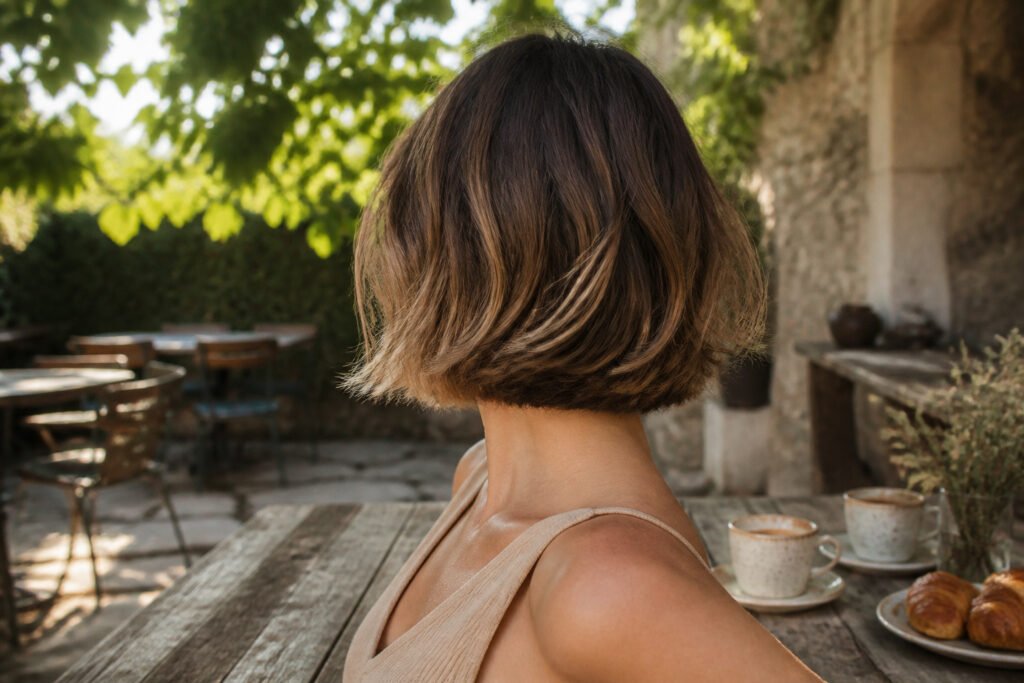
Short hair balayage is a hand-painted coloring technique that adds dimension to cropped styles by concentrating lighter tones at the ends and around the face while keeping deeper roots intact. The method matters more on short cuts because there is less length to hide a grow-out line or a harsh foil placement, and a single flat tone can collapse visually without layers to break it up. One of the 13 ideas below, cafe au lait blonde, pairs a darker base with soft beige-blonde pieces that catch light exactly where a bob or lob needs movement most.
1. Cafe au Lait Blonde Balayage

The cafe au lait blonde balayage sits somewhere between a morning coffee and the last pour of cream, and that in-between quality is exactly what keeps it from going flat on a short cut. On a bob or a lob, the darker base does the structural work while the soft beige-blonde pieces catch light at the ends and around the face. The warmth keeps it from looking washed out, but the cool beige notes stop it from tipping into brassiness.
What surprised me, looking through dozens of these, was how much the blend of warm and cool tones adds movement that a single-tone blonde never achieves on short hair. The eye reads the shift as depth and lift happening at once, which matters when you do not have length to create the illusion. A shadowed root, kept maybe an inch or two deep, anchors the whole thing so the grow-out does not announce itself after six weeks.
The mix is not forgiving if your stylist goes too heavy on either side. Too warm and it reads as dated honey-highlight; too cool and the beige turns ashy against a darker base. Ask for the blonde to stay in the lower half of the strand, hand-painted, so the transition stays soft enough to look like it happened in the sun rather than at the bowl.
2. Macchiato Brown Balayage

A macchiato brown balayage layers warm caramel streaks over a medium brown base, the same way espresso gets marked with a spot of steamed milk. On short hair, that contrast does something useful: the lighter pieces catch light near the face and crown, while the deeper brown stays quiet underneath, so the color reads as dimensional rather than stripey.
The mix of warm and cool browns matters more here than on longer cuts. Short hair has less length to hide a grow-out line or a harsh foil placement, so the balayage hand-painting keeps the transition soft. Warm caramel against cool ash brown creates shadow where the hair curves and brightness where it catches overhead light, which gives a bob or pixie the movement it might otherwise lack. I have seen this go wrong when the caramel pulls too orange or the base reads flat black; the sweet spot is a medium brown that still has some warmth in it, not a deep espresso, so the lighter streaks have something to talk to.
Ask your stylist to keep the brightest pieces around the face and toward the ends, with the interior left darker. On short hair, that placement keeps the grow-out graceful and the daily styling simple: the color works whether you air-dry or round-brush.
3. Copper Red Balayage

Copper red balayage on short hair lives or dies by the gradient. Deeper auburn roots melting into brighter copper ends create the dimension that keeps a pixie or bob from reading as one flat flame on your head. That shift from shadow to light is what lets the color move when you turn.
Warmth this intense catches light differently than ashier tones. In direct sun, the brighter ends ignite; in dimmer rooms, the darker roots keep the whole thing from looking like a costume. The balance matters more on short hair, too, because there is less length to hide a muddy transition.
Maintenance is where I have seen this go wrong. Copper fades fast, and the line between lived-in and grown-out is thin on a cut that sits above your shoulders. Plan for glossing appointments every six to eight weeks if you want the fire to stay deliberate rather than accidental. The grow-out itself can look intentional with balayage, but only if the original placement was conservative enough near the crown. Ask for the brightest pieces to start no higher than your cheekbone on a bob, lower still on a pixie. Roots that stay deep until about two inches from the part give you the most forgiving fade, which on short hair translates to fewer emergency salon trips.
4. Mocha Java Brown Balayage

Mocha Java Brown Balayage reads darker in the bottle than it finishes on the head, which is where most of the confusion starts. The base is a rich dark brown, not quite black, with espresso-colored lowlights hand-painted close to the scalp and milk-chocolate highlights lifting the ends. On short cuts, that warm-cool mix matters more than it does on long hair. A single-tone dark brown collapses visually; the eye reads it as a flat surface, and a short cut has no length to break that up with movement or layering. The espresso cools keep the depth from reading muddy, while the milk-chocolate warms catch light at the tips and give the eye somewhere to travel.
The contrast is what builds the illusion of thickness. On a pixie or a blunt bob, where every millimeter of density counts, those shifting tones create horizontal depth the cut itself can’t supply. I watched three stylists apply this color to short hair before I understood the placement: the lowlights sit underneath, the highlights on top, so the shadow lifts the upper layers forward. The result looks like more hair than you started with, not less, which is the usual fear with going short and dark at the same time.
5. Mother of Pearl Dark Brown Balayage

Dark brown balayage on short hair risks going flat, especially under office fluorescents where warm caramel reads as plain brown. The mother of pearl shift fixes this by threading cool violet and silver that only surface in direct light, then disappear back into the depth. On a collarbone bob or a textured pixie, that iridescence creates movement without the high-contrast streaking that can look stripy on shorter layers.
The trick is keeping the cool undertones subdued enough that they never tip into gray. Silver that sits too pure against dark brown can read aging or accidental; violet keeps it alive, almost petrol-like, shifting rather than declaring itself. Ask your colorist to stay below a level 6 violet and to avoid foiling near the crown, where short hair exposes the scalp and any harsh line of demarcation. Hand-painted pieces around the face and ends let the pearl effect collect where light actually hits, which on short cuts is the perimeter and the very top layer.
Maintenance is lighter than true fashion color. The violet fades toward ash, which still works, though a purple conditioner every third wash keeps the shift present for longer.
6. Opal Glow Haircolor Balayage

Pastel tones on short hair live or die by placement, and the pearlescent mix of soft pink, lavender, and mint over a blonde base only works when the colors are feathered low enough to catch light at the ends without muddying at the roots. The luminous shift happens where the tones overlap, not where they sit alone. On a chin-length cut or a textured bob, that overlap sits right at the cheekbone, so the color changes as you turn your head, cool mint catching window light while warm pink glows under indoor bulbs.
The blonde base has to be lifted clean, almost white, or the pastels turn murky in weeks. I have watched stylists save time by stopping at pale yellow, and the lavender ends up looking like dishwater within a month. The maintenance is real: color-depositing conditioners in at least two of the three tones, rotated so no single shade fades out first. Without that rotation you end up with mint ends and nothing else, which reads less opal and more accidental.
Short hair makes this easier to refresh than long, at least. A full redo takes less product and less time in the chair. The trade is that growout shows fast on a high-contrast base, so plan the balayage placement to stay within two inches of your natural color at the root, or budget for touch-ups every six to eight weeks.
7. Gold Dip Blonde Balayage

A concentrated gold dip blonde balayage keeps the brightest color at the ends while the root stays two to three levels deeper, almost like a dip-dye that someone took a blending brush to before it dried. The high contrast reads intentional rather than grown-out because the transition is hand-painted, not a straight line.
On short cuts, this particular contrast does heavy lifting that softer balayage sometimes skips. A pixie with the gold concentrated at the tips catches light differently with every head movement; the short length means the eye travels from dark root to bright end in inches, not feet, so the effect stays punchy without looking stripey. The same logic holds for a blunt bob, where the perimeter becomes a kind of frame you notice from across a room.
The deeper root also buys time between appointments, which matters more on short hair where there is less length to hide a quarter inch of regrowth. What sold me on this combination, looking through dozens of reference photos, was how the darkness at the crown added depth to cuts that can otherwise read flat from the front. The gold reads expensive rather than brassy when it sits on a shadowed base, and on a bob that swings, the two tones flicker against each other like actual metal catching sun.
8. Chrome Blonde Balayage

Chrome blonde balayage sits right at the edge of platinum without tipping into costume territory. The color reads as near-white with a steel undertone, that reflective coolness catching light like brushed metal rather than warm honey. On a short cut, that metallic quality does something a bob or pixie can’t achieve with softer blondes: it reads as deliberate architecture, not beach aftermath.
The balayage placement is what saves it. Hand-painted sections leave darker roots and subtle lowlights through the crown, so the eye travels through dimension instead of landing on a solid wall of ice. Without that shadowing, short hair flattens into wig territory fast. The technique also keeps grow-out from broadcasting itself every three weeks, which matters when the tone itself already demands enough attention.
9. Brownstone Balayage

Brownstone balayage borrows its palette from the actual sandstone and slate facades you see on older city blocks. Warm sandstone golds sit against cool slate browns in the same way natural stone carries both temperatures at once, and that tension is what keeps short hair from reading flat. On a chin-length bob or a textured pixie, the colorist paints the warmer pieces where light would naturally hit, around the face and toward the ends, while the cooler browns anchor the underneath and the roots. The result is subtle movement that shifts when you turn your head, not a stripey highlight grow-out waiting to happen.
The mix matters more than the exact shade. Too much warmth and short hair can look brassy fast; too much cool and the cut loses dimension against winter light. What worked for me was asking for the cool tones to sit about two levels deeper than the warm ones, so the contrast reads as shadow rather than stripe. Short hair shows every placement choice, which is the point: the color becomes part of the shape of the cut itself.
10. City Ballet Pink Balayage

A dusty rose blonde reads as neutral on short hair because the pink lives underneath rather than on top. The muted warmth flatters without tipping into bubblegum territory, which matters on a pixie or blunt bob where there is nowhere for a loud color to hide. I have seen this shade turn harsh when the pink lifts too clean, so ask your colorist to keep the base slightly smoky, almost like a faded ballet slipper. On short cuts the balayage placement stays concentrated near the ends and around the face, which keeps the grow-out soft and the overall effect intentional rather than accidental. The understated statement works because the cut does the talking and the color only nods. A cooler scalp with warmth at the tips also adds the illusion of thickness to finer hair, something a solid pink all-over rarely manages.
11. Cayenne Red Balayage

Cayenne red sits deeper on the color wheel than copper, carrying brown undertones that keep it from shouting across a room. On short hair, that depth can turn flat and helmet-like if the color sits uniform from root to tip. The balayage hand-painting method solves this by leaving the crown in a quieter, darker register and concentrating the brighter cayenne strokes toward the ends, where they catch light without weighing the whole cut down.
The technique matters more than the shade itself here. Short hair has less length to distribute visual weight, so a full-head single-process cayenne risks looking like a solid cap. Balayage breaks it into ribbons that move as the hair moves. Ask your stylist to keep the top two inches close to your natural base and let the red build intensity from mid-shaft to ends. That gradient reads as texture even on a blunt bob or a tucked-under pixie.
Maintenance sits in the middle ground between vivid copper and safe brown. The brown undertones fade softer than orange-based reds, but the ends still need a color-depositing mask every third wash to keep the cayenne from drifting into generic auburn. Plan on a balayage refresh every 14 to 16 weeks rather than the six-week panic typical of all-over reds.
12. Sterling Silver-Blonde Balayage

True silver with zero warmth lives or dies in the toning phase. Lift the hair too pale and the toner grabs violet; leave it too dark and you get steel instead of mirror. The sweet spot, from what I’ve watched colorists wrestle with, is that fragile moment where the underlying pigment has just cleared yellow but hasn’t gone hollow.
On short hair, this color flatters because balayage leaves the crown intentionally darker. Those deeper pieces at the root do two jobs: they keep the silver from reading like a solid helmet, and they catch light differently as you move so the cool finish shifts instead of sitting flat. The darker crown pieces are what keep mirror-bright silver from looking synthetic, especially on a pixie or a blunt bob where there isn’t length to create shadow through layering.
Maintenance runs colder than warm blondes. Purple shampoo twice weekly keeps the tone crisp, but the real work is the refresh every six to eight weeks before the underlying warmth creeps back through. Skip that and the silver dulls to dishwater faster than you’d expect.
13. Butter Cream Blonde Balayage

Pale yellow-blonde with creamy rather than platinum undertones reads as butter cream blonde, and the soft warmth flatters most skin tones without the harshness that cooler blondes can throw against pink or olive complexions. On short hair, balayage placement matters more than the exact shade because the shorter canvas leaves nowhere for sloppy transitions to hide. The colorist paints the lighter pieces where sun would naturally strike, around the crown and the ends that frame the face, so the grow-out stays plausible rather than striped. What sells the look is the deliberate avoidance of uniformity. A solid butter cream all over turns helmet-like on a pixie or bob; the hand-painted variation keeps it sun-kissed and lets you stretch salon visits.
Warm and Cool Tone Mixing

Short hair balayage lives or dies by whether the color looks like it moves. Without length to catch light and shift with every turn, a single-tone short cut can read flat against the scalp. The fix is a deliberate mix of warm and cool tones painted at different depths. Warm pieces near the face and crown catch overhead light and create the illusion of lift, while cooler, shadowed ribbons underneath add weight and shape. The contrast itself becomes the movement short hair otherwise lacks.
This principle runs through every idea ahead, though each one plays the balance differently. Some lean heavier on warmth for glow, others cool things down for a sharper edge, and a few keep the tension almost equal so the color shifts as you move through different rooms and light sources. The point is not to pick one temperature and stick with it. Ask your stylist where your natural base sits on that spectrum, then build the balayage to push against it. That opposition is what keeps a short cut from looking like a single block of color growing out of your head.
Balayage Grows Out Naturally

The hand-painted application of balayage means no harsh regrowth line forms as your short cut grows, which is why I stopped booking the six-week touch-ups my old foiled highlights demanded. With traditional all-over color on a pixie or bob, even a quarter inch of root shows as a hard stripe against the scalp; foiled highlights on short hair can leave a checkerboard effect that needs fast correction. Balayage skips the foil entirely and paints color where it would naturally lighten, so the fade looks intentional rather than neglected. For anyone who stretches salon visits to ten or twelve weeks, that difference matters more on short hair than long, since there is less length to hide the grow-out zone. The technique trades precision for patience: you sacrifice the crisp, uniform lift of foils and gain a lived-in color that still looks styled three months later.
Consulting Your Stylist

Short hair balayage lives or dies on placement, and placement is something you cannot eyeball in the mirror. The same hand-painted sweep that opens up a long mane can sit heavy on a pixie or read as stripes on a blunt bob. What convinced me, looking through dozens of these cuts, is how much the specific short cut reshapes the color plan.
A stylist reads density and growth pattern before choosing where to lay the lighter pieces. Coarse hair holds warmth differently than fine hair; a lob with natural wave carries shadow differently than a razored crop. The 13 color ideas above, from the buttery blondes to the cooler brunettes, all shift depending on whether the goal is to add width, stretch a round face, or let a strong jawline lead. On a textured pixie, the painter might concentrate lightness at the crown for lift. On a one-length bob, the same tones might thread lower, near the ends, to keep the line clean.
The end result you want matters too. Subtle dimension for an office environment uses a different saturation than the high-contrast look that reads well on camera. A good colorist maps this before mixing a single bowl, and the best ones will tell you which of these ideas they would dial back or push harder for your particular length.
Frequently Asked Questions
What colors look best for short hair balayage?
A mix of warm and cool tones creates the most vibrancy and dimension on short hair. Warm pieces near the face and crown catch light and create lift, while cooler, shadowed ribbons underneath add weight and shape. That deliberate opposition keeps a short cut from looking like a single block of color growing out of your head.
How do I maintain balayage on short hair?
Balayage grows out naturally with no harsh regrowth line, so you can stretch salon visits to ten or twelve weeks instead of the six-week touch-ups traditional foiled highlights demand. The hand-painted color goes where light would naturally strike, so the fade looks intentional rather than neglected. You trade the crisp, uniform lift of foils for a lived-in color that still looks styled three months later.