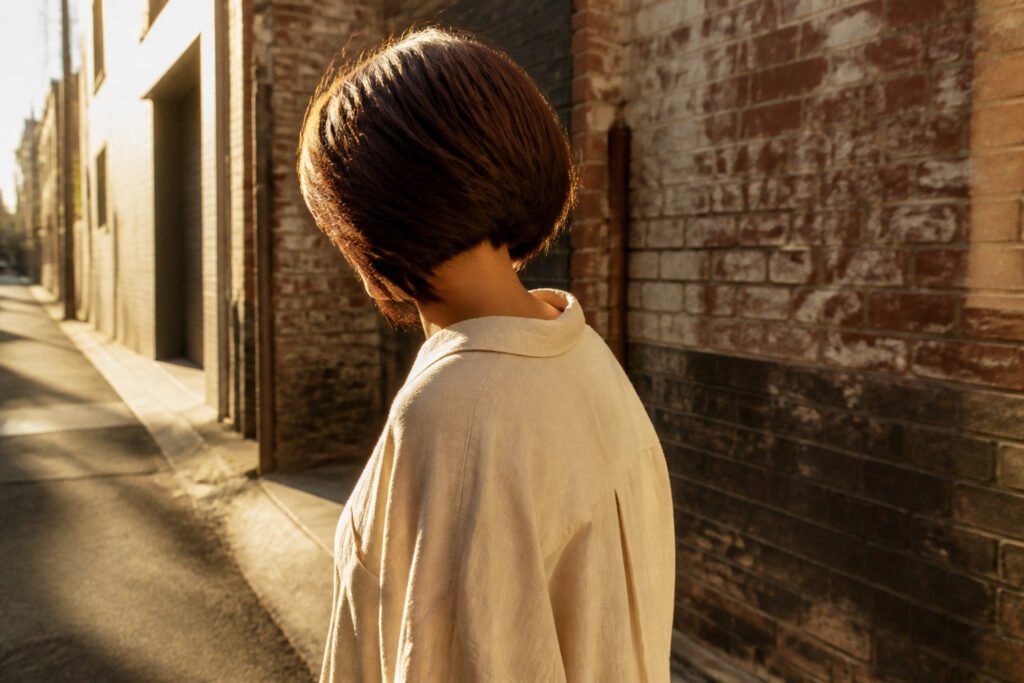
Rihanna hairstyles are a catalog of deliberate structural choices rather than a collection of passing trends. The catch is that most of them only work because of the specific proportion she and her stylists built around her face shape, not because the cut itself is universally flattering. Her 2007 asymmetrical bob, for instance, sat dramatically longer on one side than the other, a silhouette inspired by Charlize Theron in Aeon Flux but calibrated specifically to Rihanna’s jawline and the stage lighting of her "Umbrella" era.
Flipped Out Ponytail

The 60s-inspired flipped-out ponytail Rihanna wore in 2022 lands somewhere between vintage salon poster and modern red carpet. The style keeps the height and swing of a 1960s pageboy flip, but the execution is cleaner: hair pulled back sleek at the crown, then flicked outward at the ends with a hot tool rather than teased into a helmet.
What keeps it current is the pairing. Rihanna matched the retro silhouette with a full face of Fenty Beauty and the glow that came with late pregnancy, so the look read as deliberate contrast rather than costume. The ponytail itself is simple enough to recreate: start with a regular short ponytail, then run a flat iron through the ends and bend them outward. The trick is stopping before the flip goes too theatrical; an inch or two of outward curve keeps it wearable for daytime, while a heavier bend pushes into full retro territory.
Face shape matters more here than with most ponytails. The flipped ends widen the silhouette at the jaw, which can balance a longer face or add structure to softer features. Rihanna’s version was shaped specifically to her proportions, and the outfit coordination, down to the makeup, made it feel complete rather than borrowed.
Side-Swept Glam

Side-swept styling on Rihanna tends to land where the drama is deliberate, not accidental. At the 2018 Diamond Ball, she wore a side-swept blowout that left one ear and her diamond earrings fully exposed, while the opposite side carried all the volume and movement. The asymmetry works because the exposed side creates a clean line for jewelry or makeup to register, and the loaded side gives the camera something to track as she turns.
The 2011 red smooth style with side-swept bangs kept the same principle at a longer length: bangs swept across the forehead to frame the top of the face, ends blown out with just enough movement to keep the shape from reading flat. Regular trims matter here. The 2014 glossy black updo pulled the length back to the nape but kept the side sweep at the front, parted deep and smoothed down so the face stayed the focus.
What separates these from a standard side part is the weight distribution. One side is doing all the work, the other is intentionally bare. On an oval or heart-shaped face, that exposed cheekbone becomes the point of interest. On rounder faces, the loaded side needs enough height at the crown so the sweep does not pull the silhouette wider. Rihanna’s team has played both versions, and the red carpet shots show which choice they made by what they wanted to frame that night.
Asymmetrical Bob

The asymmetrical bob Rihanna debuted in 2007 remains the cut most people picture first. Her stylist Ursula Stephen built it with a sharp angle: one side swept dramatically longer than the other, breaking from the traditional bob’s even line. The inspiration came from Charlize Theron’s look in Aeon Flux, though Rihanna’s version landed harder in mainstream culture because she wore it through the "Umbrella" era when her visibility was at its peak.
Length variation was the whole point. The short side sat at jaw level while the long side dropped several inches past it, creating a silhouette that read as edgy rather than safe. That contrast made it a signature 2000s look, the kind of haircut fans actually brought to salons. Stephen has noted that they wanted to do something new, and the result went beyond red carpet moment into genuine trend territory. What worked was the specificity: it wasn’t just asymmetrical, it was dramatically so, with enough structure that the shape held up under stage lights and street style photography alike.
Sleek and Straight

Precision-straightened hair is the one Rihanna look that never tries to compete with the volume of her curls or the drama of her updos. The glass-like finish reads as control rather than effort, and that is the trick of it. In 2010, while promoting her fifth album, she kept the crimson shade she was known for but traded her signature curls for something sleeker and straighter, a move that proved the color could carry the style rather than fight it. The flat iron is the tool behind this; investing in a good one matters if you want the same polished result rather than a finish that separates by noon.
Stopping traffic quite literally on the streets of New York, Rihanna and ASAP Rocky stepped out for the ultimate movie date night in the city… her hair was styled pin-straight showing off her vanilla blonde highlights.
— Elle
That 2024 date night look, with its Y2K-evoking side part and vanilla blonde highlights, shows how the style shifts with era while keeping the same core demand: heat protection and a slow pass if you are re-creating it on natural hair or a wig. The sources note that extensions work for this, but the same flat iron discipline applies either way.
Cornrows

Rihanna’s cornrows have moved between street style and couture with the kind of ease that makes the placement matter as much as the braid size. Early on, she wore them as a straightforward protective style, rows pulled back with no particular pattern, the kind you might see on any summer afternoon. That casual foundation is what let her push further later.
By the time she hit red carpets with braided looks, the geometry had sharpened. She mixed thick and thin cornrows in the same install, some running straight back, others curving along the hairline or feeding into a high ponytail. The contrast between big and small braids created texture without needing loose hair, and the placement drew attention to her face shape rather than hiding it.
What stands out across her career phases is how she treated cornrows as a base rather than a finished statement. She added gold cuffs, wrapped sections, or let baby hair detail frame the rows. The style worked for a paparazzi grocery run or a Met Gala afterparty because the execution changed while the technique stayed consistent. If you are considering cornrows, the mix of braid sizes and the path the rows take across your scalp matter more than length or added accessories. Start with clean parts and a pattern that follows your natural hairline, then build from there.
Jumbo Faux Locs

The jumbo faux locs Rihanna wore in 2016, photographed in SoHo and later on the Ocean’s 8 set, sat at a scale that completely redefined the silhouette you’d expect from locs. Where traditional locs form close to the scalp and stay relatively uniform to the head’s shape, these extensions cascaded past her shoulders with a volume that pushed the profile outward, almost architectural against her frame.
As a protective style, faux locs wrap synthetic or human hair around braided sections, shielding natural hair from daily manipulation and environmental stress. The exaggerated size changes the practical equation: more weight at the crown, more tension distributed across a larger surface, and a finished look that reads closer to statement accessory than everyday hairstyle. Rihanna’s version in black, worn loose around her face, leaned into that drama rather than minimizing it.
Installation runs two ways. You can braid the natural hair and wrap extensions around each section, or opt for knotless braids as a base, which some find lighter on the scalp. Either approach demands product investment to keep the wrapped hair from frizzing or slipping; the protective benefit collapses if the locs dry out and you end up manipulating the style more than you would your own hair.
Edgy Top Knot

Rihanna’s top knots sit so high and tight they stop looking like a lazy-day fix and start looking like architecture. The placement is the first thing that changes the game: pulled to the crown rather than the occipital bone where most of us default, the knot becomes a vertical exclamation that lengthens the neck and frames the face from above. Her stylists keep the surface sleek and sculpted at the base, then let the knot itself carry the texture, a combination that reads intentional rather than like you gave up and twisted it up.
The texture choices matter as much as the height. A perfectly smooth ballerina bun would disappear into formal territory; too much mess and it collapses into bedhead. Rihanna’s versions land in the narrow space between, usually with the perimeter gelled down to a reflective finish while the gathered hair retains enough body to cast shadows and catch light. That contrast is what keeps the style alive when you see it from different angles in a room.
For anyone recreating this, the sectioning is where the edge lives. Clean parts, even if they’re curved or asymmetric, signal that the whole thing was planned. The style works best when the knot itself has some irregularity in its wrapping, enough that it looks hand-built rather than mold-formed.
Fun Pixie

Rihanna’s pixie era landed in 2008, right as "Disturbia" and "Take a Bow" were climbing the charts, and the timing mattered. The cut kept getting shorter, but she held onto that signature side bang, which kept the shape from feeling too severe against her face. By 2012 she had pushed it even further, a feminine black pixie with the front cropped close and longer lengths at the sides, almost a retro silhouette that softened her features rather than sharpening them.
The real freedom of this shape is the styling range it gives you without much morning effort. Rihanna wore it sleek, textured, tucked behind one ear, or with volume pushed forward; the short crown and tapered sides made each version read as intentional rather than grown-out. Maintenance runs tighter than longer cuts, about every four to six weeks to keep those side edges clean, but the trade is worthwhile if you want a cut that carries both a t-shirt and a structured jacket without looking like two different people.
Color sat differently on this length too. The natural black read as polished and deliberate, but the same cut in pink proved the shape could handle something theatrical without collapsing into costume. The pixie works when the proportions are specific: enough length at the sides to frame the cheekbone, enough shortness at the back to keep the neck line exposed. Rihanna’s versions got that balance right, which is why the 2012 cut still photographs cleanly more than a decade later.
Bow Braids

Rihanna’s bow braids work because the ribbon isn’t an afterthought tied over finished plaits. She weaves the material straight through the braid structure itself, so the bow becomes part of the architecture rather than jewelry sitting on top. The sources describe her making "little gorgeous bows out of them," which suggests she sections the ribbon into the hair during the braiding process, letting each crossover of the three-strand pattern catch and hold the fabric in place.
This changes how the style holds up. A bow pinned to the outside loosens, shifts, and eventually slides. One built into the braid tension stays put through an evening. The decorative element also reads differently: it looks intentional, almost structural, rather than like a clip someone added at the last minute.
For someone trying this at home, the ribbon needs to be the same width as the hair section or it will bulk unevenly. Satin or grosgrain both grip well against the natural texture of braiding hair. Rihanna’s version tends toward smaller, repeated bows rather than one large statement piece, which keeps the look wearable rather than costumey. The scale matters more than the color.
Long and Wavy

Rihanna’s long wavy phase stretched across years when she kept her hair past her shoulders, letting the texture shift with the setting rather than locking into one signature. In 2007 she wore the style swept back and tucked behind one ear, a move that opened up the face and drew attention to cheekbone structure. That same tuck worked particularly well on rounder face shapes by minimizing width at the sides.
By 2012 the waves had turned more formal, dressed through the sides and back with added shape and movement that balanced longer face proportions. The difference between the two looks came down to wave definition: loose, almost beach texture for daytime or softer events, then tighter ripples for anything requiring a gown. The trick was never the length itself but how the wave pattern was calibrated to the occasion.
Side-swept wavy bangs appeared in some of these long looks, blending into the rest of the hair rather than sitting as a separate blunt piece. That integration kept the style from feeling like two competing ideas. For anyone recreating this, the tools matter less than the product choice; a heat protectant and medium-barrel iron handle either version, but the 2012 formal waves needed stronger hold spray to survive an evening without falling into loose frizz.
Voluminous Half-Up

A half-up style with real volume at the crown only works when the top holds its structure against whatever is happening below. Rihanna’s version from 2011 pulled this off with uniform layers cut through the back and sides that balanced the lift up top, while the bottom half stayed loose and wavy enough to read as playful rather than formal. The height at the crown added inches to her overall silhouette without looking like a bump-it add-on. Extensions helped build that fullness and shape, which matters if your own hair is fine or just not thick enough to support the proportions. The trick is keeping the top sleek enough that the volume looks controlled, not accidental. A light gel at the roots keeps flyaways down before you start backcombing or pinning. Without that balance between the structured crown and the free waves, you end up with two hairstyles fighting each other instead of one that actually works.
Space Buns

Rihanna’s space buns sat high and tight, almost at the crown, where the placement lifted her face rather than dragging it down. The style worked because she treated symmetry as optional: sometimes the buns matched in size and height, sometimes one sat slightly forward or looser than the other, which kept the look from feeling costume-y. She also threaded braids through the buns and along the front hairline, adding texture that made the style feel finished rather than thrown together.
What struck me, looking back at those appearances, is how the buns functioned as a deliberate counterweight in her style vocabulary. They showed up alongside streetwear, next to glam makeup, paired with pieces that could have read as severe. The playfulness of the shape softened everything else without undercutting it. For anyone recreating this, the spacing matters: too wide and the effect is cartoonish, too narrow and you lose the lift. Aim for the width of your own eye distance as a rough guide, then adjust based on how round or elongated your face reads in the mirror.
Short Curls

The cropped curls Rihanna wore to launch her Fenty Hair line landed differently than anything she’d done with length or straightening before. Shorter curls pull the eye to bone structure, and on her that meant the emphasis sat at cheekbone and jaw rather than trailing down through lengths that compete for attention. Auburn color lifted the same cut into something bolder for her fragrance launch, the shade matching her outfit tone-for-tone in a way that longer hair rarely coordinates so precisely.
Natural texture changes the framing math entirely. Where long straight styles create vertical lines that elongate, these tight rounds build width at exactly the point where features need balancing. The bounce matters too; those ombre curls with center parting created symmetry that stricter styles avoid. I’ve watched women request this cut expecting the maintenance of a pixie and finding instead the daily negotiation of curl pattern, product weight, and the shrinkage that turns a planned three inches into one by noon. Rihanna’s versions worked because the shape was built around her curl’s natural spring, not forced against it.
Pink Pixie

A pink pixie on Rihanna landed differently than the same cut in brown or black would have. The short shape alone read as gamine, almost polite. Flooding it in cotton-candy rose made the look noisy, almost belligerent, which was exactly the point. Soft color on hard geometry creates tension you can’t get from a natural tone. The pink didn’t apologize for the cropped length; it doubled down.
Natural bases let the cut speak for itself. This shade made the viewer do a double-take, parsing whether the color or the length came first. For anyone considering a statement pixie, the lesson holds: pastel dye on cropped hair reads as deliberate rebellion, not accident of birth. The maintenance is unforgiving, of course, pink fading fast against dark roots. Rihanna carried it long enough to burn the image in, then moved on before upkeep became the story.
Straight Shoulder-Length

Straight shoulder-length hair on Rihanna carried a quiet confidence that louder cuts sometimes missed. The blunt ends sat clean and heavy, no tapering or wispiness to soften the line, which made the style read as intentional rather than grown-out. I noticed this length appeared most often in the gaps: after a shaved side or before a color swing, when the drama needed somewhere to rest. The sources note a 2007 chin-length blunt bob for the MTV Movie Awards, but the true shoulder-length moments stayed closer to collarbone territory, layered or blunt depending on the year. What worked was the restraint. Rihanna’s face shape carried asymmetry and height easily, so choosing something this straightforward almost felt like a palate cleanser. For someone recreating it, the key decision is that end finish. Blunt keeps it graphic; layered gives it movement for daily wear. Neither reads as a wig trying to be real hair, which matters more than you’d think at this length.
Straight with Bangs

Rihanna’s straight hair with bangs shows how a single fringe decision reshapes a face entirely. In her 2005 era, she wore heavy side bangs with sleek brown locks that fell past her shoulders, the density of that fringe cutting her forehead down to a narrower band. The weight sat low, almost grazing her eyelashes on one side, which pulled attention to her cheekbones and away from her hairline’s height.
Later she pushed the bangs shorter and blunter, landing them at brow level with a chin-length bob. The density stayed, but the even line across her forehead changed the proportion again: her face read rounder, softer, the jawline less prominent against that straight horizontal. Wispy bangs give mystery; blunt bangs give structure, and Rihanna has run both directions without leaving the straight texture behind.
The side-parted version she wore with long sleek blonde hair frames the forehead and cheekbones at an angle, the part helping those bangs elongate rather than shorten. For anyone measuring this against their own face, the rule is simple: side-swept fringe lengthens, full blunt fringe widens and softens. Rihanna’s straight hair made the test clean, no curl or wave to complicate the line.
Bantu Knots

Rihanna’s Bantu knots at the 2015 iHeartRadio Music Awards landed differently because she paired them with a matte green lip that made the whole look feel intentional rather than merely referential. The knots themselves were small, rounded, and evenly sectioned, sitting close to the scalp in a grid that read almost graphic from a distance. I keep coming back to how the shape of each knot mattered: too loose and they sag into bumps, too tight and they strain the hairline. Hers held that middle ground where the coil stays cylindrical and the scalp pattern stays visible.
The style carries specific cultural weight as a protective technique with roots in Southern Africa, and Rihanna’s version neither hid that history nor treated it as costume. She wore it on a mainstream awards stage with the same ease she brings to a tracksuit or a couture gown. For anyone recreating the look, the sectioning is the work: part the hair in a pattern you actually want to see, because those lines become part of the finished shape. Twist each section until it coils back on itself, then wrap the ends underneath to lock the round form in place. The lip, in her case, was the bridge between hair and outfit, a single color choice that made the knots feel modern rather than nostalgic.
Beads and Braids

The beads added real weight to the ends of Rihanna’s braids, which changed how the hair moved entirely. Instead of soft, uniform swings, each turn of her head gave a separate click and shift, almost like percussion. I noticed this most in close-up shots where the beads caught light at different angles, some matte, some catching a flash of metallic or color against the braided base.
The combination worked because the braids themselves stayed clean and tight, usually close to the scalp in neat rows or a pulled-back shape, while the beads did the decorative work at the ends or at random intervals as accents. You could hear the difference before you saw it in video clips, a light rattle that made the style feel alive rather than static.
For anyone trying this, the placement matters more than the bead size. Clustering too many at one spot throws off the balance and can stress the root. Spreading them along the last few inches, or adding a single accent bead every few braids, keeps the movement light and the sound subtle rather than noisy.
Curly Bob

A curly bob sits right at the jawline or just below, short enough to hold a defined shape but long enough for the curl to spring. That length changes everything. A straight bob relies on clean edges and a sharp perimeter; add curl and those edges soften into rounds that frame the face instead of boxing it. Longer curls can flatten at the crown and widen toward the bottom, but the bob cut removes that bottom weight so the volume sits higher, closer to the cheekbone.
The real fight is controlling that volume without killing the texture. I have watched this style go wrong when the cut is too blunt underneath; the curl stacks and the silhouette turns into a triangle. Slight layering, or at least texturizing the interior, lets the curl group into softer pieces rather than one solid mass. Diffusing upside down gives lift at the roots, though the wrong product underneath leaves the surface frizzy by noon. The balance is specific: enough hold to define the curl, light enough that the bob keeps moving when the head turns.
Sleek Bun

A sleek bun pulled every strand flat against the scalp served as Rihanna’s reset button between her louder phases. The style showed up in 2018 with the top section parted, swept back from the face, and pinned tight while the length either disappeared into a knot or fell straight to the back. The severity of it, the refusal of a single flyaway, read as deliberate restraint rather than safe choice.
Thick, straight hair carries this best, though the real requirement is patience with gel and an elastic that can hold the tension without slipping. Extensions help build the topknot volume if your own ponytail runs thin. The look works across face shapes because it removes hair entirely from the framing equation, forcing attention to bone structure and whatever statement the makeup or outfit is making that day.
What I notice comparing her timeline is how these bun moments functioned: after a run of finger waves or color experiments, the sleek pull-back arrived like a deep breath. It let the bolder looks stay bold by giving the eye a rest. For someone building a rotation from pieces they already own, this is the hairstyle equivalent of a white button-down between patterned pieces. It costs nothing extra, takes maybe twenty minutes once the smoothing gel hits its stride, and keeps working when the occasion turns formal without warning.
Retro Finger Waves

The sculpted S-pattern waves of a true finger wave sit flat against the scalp, each ridge and valley locked in place with nothing but comb pressure and setting lotion. Rihanna wore this 1920s and 1930s revival with the kind of precision that makes the style read as expensive rather than costume. The wave breaks if even one section gets modern texture, so the hair has to be smoothed almost straight before the comb work starts, and the setting product needs to hold without adding grit or volume at the roots. I have watched enough tutorials to know the mistake most people make: they try finger waves on hair that still has its natural body, and the pattern lifts off the head within an hour. The mold has to be perfect while wet because there is no fixing it dry.
Wavy Bangs

The wavy bangs Rihanna wore softened the hard line you get with a straight-across blunt cut. Where a sharp fringe can sit like a ruler across the forehead, the wave broke that edge into movement that caught light differently at each section. That irregularity mattered around her eyes, since a blunt cut can box them in while the wave opened the area and let the brow bone read as a feature rather than a boundary. The curl also widened slightly at the cheekbone, which framed the face horizontally where the jaw tapers. I have tried to replicate this on my own hair with a 1-inch iron and too much tension, which pulled the wave out into a bend that looked accidental rather than styled. The trick is to set the wave deeper back from the ends so the fringe keeps its structure while the texture lives in the middle of the strand.
Half-Up, Half-Down Bantu Knots

The half-up, half-down Bantu knots Rihanna wore split the difference between a full protective style and wearing hair loose. The top section was divided into small parts and rolled into knots, while the back flowed freely. Two textures in one look gave it both structure and movement.
What made this combination work was the contrast. The knots carried a cultural reference and kept the front controlled, while the loose length below kept it modern and wearable for a night out. It read youthful without trying too hard.
To recreate it, part the hair around the crown. The front portion gets the knot treatment, plaited or twisted first if you want a tighter pattern underneath. The back stays down and styled however the texture demands. The split is the whole point, so the line between the two sections needs to be clean.
Wet Hair Look

The wet hair look Rihanna wore takes more discipline than actually stepping out with damp strands. Stylists build it in stages: a heavy base of gel or oil-based pomade raked through from roots to ends, then a glossing serum pressed over top before anything sets. The result reads as freshly showered but stays dry to the touch all night, which is the whole point. Without that dryness underneath, the shine collapses into stringiness within an hour.
What makes it editorial rather than accidental is the product load sits visible, not blended. In everyday styling, you’d break up the clump with a comb or a blow-dry. Here the section marks stay, the crown stays slicked flat, and the ends stay glued together in thick ribbons. It photographs as high fashion precisely because it breaks the rule that hair should look touchable.
The maintenance is where most attempts fail. Any humidity in the room reactivates the gel and the whole thing turns tacky. Rihanna’s version worked because it was built for controlled environments, red carpets and studio sets, not a dinner where the heating runs high. If you’re recreating this, timing matters more than product choice: finish it ten minutes before you leave, not an hour, and carry nothing that needs to go over your head, like a coat with a tight collar.
Hair Evolution

Rihanna’s hair has tracked her career in distinct chapters, each with looks that sources still point to first. The asymmetrical bob from her "Umbrella" era in the late 2000s became one of those defining cuts, the kind stylists still get asked to recreate. By the end of 2010, the "Loud" era opened with fiery red color and longer, bouncier curls, a shift that marked her move toward more dramatic, statement-making hair. The shaved-side looks and bold color experiments kept coming through the 2010s, each phase documented enough that fans can usually place the year by the cut alone. What strikes me reading back through these references is how rarely she repeated herself; even the bob came back altered, not copied. The sources run from "Pon De Replay" through the Fenty years, and the range is what makes the timeline useful: you can trace a clear evolution rather than a random series of changes. For anyone looking for rihanna hairstyles as actual inspiration, that progression matters. It means the looks are anchored to real moments, not just styled for a single photo, so the cut or color usually came with enough context to judge whether it translates off a stage.
Iconic Looks

Two hairstyles from Rihanna’s catalog still show up in chair-side conversation more than a decade later, and both trace back to specific moments that made them stick.
The asymmetrical bob arrived in 2007, right around "Umbrella." Her stylist, Ursula Stephen, cut it after Charlize Theron’s look in Aeon Flux, and the angle was sharp enough that fans and stylists immediately started recreating it. What made it a reference point rather than a one-night look was the precision: one side dramatically shorter, the other weightier, so the shape read even in motion or under a cap. I have watched that cut cycle back into request lists every few years, usually from clients who want something editorial but still wearable.
The Loud era brought the fiery red curls in late 2010, marking a shift toward longer, bouncier shapes for her. The color was the headline, but the curl pattern mattered too: defined, voluminous, and deliberately high-maintenance in a way that signaled commitment. That combination of shade and texture became shorthand for a certain kind of boldness, and it is still the reference people bring in when they want "something that looks like I actually tried."
Fenty Hair and Hair Care

Rihanna’s June 13, 2024 launch of Fenty Hair lands differently than another celebrity product drop because her own hair has been through enough to make the promise credible. She has cycled through shaggy blonde bobs, fire-engine red waves, jet-black pixies, and relaxed natural textures, often within the same month. That kind of chemical and mechanical stress builds a specific expertise: you learn what actually repairs hair when you have personally fried yours for a music video.
The line is pitched as flexible, with every product designed to strengthen and repair all hair types. That "all types" claim matters because her own history spans the spectrum, from bone-straight weaves to textured natural styles. She previewed the brand with a shaggy blonde bob in the teaser video, the same chameleon move she has pulled since 2005. The difference now is she is selling the recovery, not just the transformation.
Styling Recreations

Recreating Rihanna’s retro finger waves at home takes patience and the right setup. A rattail comb, hooded hairdryer, mousse, and styling strips form the core kit. The comb draws the S-shaped ridges, the strips pin them while they set, and the hooded dryer locks the shape without the blast distortion of a handheld nozzle.
For her Bantu knots, the sectioning matters as much as the twist itself. Her versions keep the parts clean and the knots sitting close to the scalp, sized so they read as texture from a distance rather than individual sculptures. The sources differ on whether to start on damp hair with mousse or dry hair with a light pomade; the mousse route gives a softer, more movable finish, while dry twisting holds sharper geometry. I would test one knot at the nape before committing the whole head, since the tension changes how the pattern reads once you release them later.
The finger wave technique especially rewards working in thin, horizontal panels rather than rushing the full head. Each ridge needs to dry completely before you release the strip, or the wave collapses into a vague ripple.
Cultural Styles and Context

Rihanna’s rotation of Bantu knots and Fulani braids carries weight that most hairstyle roundups skip past entirely. The Bantu knots she has worn, including a half-up, half-down pairing and a classic rooted version with precise sectioning, trace back to Southern African traditions where the style served as both protective technique and cultural marker. Fulani braids, which she wore to the 2019 Fashion Awards as award recipient, originate with the Fulani people of West Africa, defined by their distinctive patterning and often beaded or looped elements.
What strikes me, reading through the coverage, is how often sources note her creative ownership rather than treating these as borrowed looks. She ranges the braid sizes, adjusts the patterns, adds her own occasions to the style. The gap in most write-ups is the origin itself: the knots and braids are catalogued as "youthful" or "splendid" without the geographical or cultural lineage attached. For readers actually considering these styles, that context matters practically. Wearing Bantu knots or Fulani braids without understanding their roots risks flattening a living tradition into a costume choice. Rihanna’s embrace, as sources describe it, seems to come with that awareness built in.
Frequently Asked Questions
What are some of Rihanna’s most iconic hairstyles?
Rihanna’s most iconic hairstyles include the 2007 asymmetrical bob from her "Umbrella" era, Bantu knots at the 2015 iHeartRadio Music Awards, the 60s-inspired flipped-out ponytail from 2022, jumbo faux locs in 2016, and her 2008 pixie cut that kept evolving shorter while holding onto a signature side bang. Other standout styles are her sleek and straight looks with crimson or vanilla blonde color, cornrows that moved between street style and couture, and the edgy top knots she wore pulled high and tight at the crown.
How can I recreate Rihanna’s hairstyles?
For her flipped-out ponytail, start with a regular short ponytail, run a flat iron through the ends, and bend them outward an inch or two for daytime wear or heavier for full retro effect. To get her sleek and straight looks, invest in a good flat iron, use heat protection, and make slow passes through the hair. For bow braids, weave ribbon straight through the braid structure during the braiding process rather than tying it over finished plaits, using satin or grosgrain ribbon the same width as your hair section. Her cornrows work best when you mix braid sizes and plan the path of rows across your scalp following your natural hairline.
What hair colors has Rihanna worn?
Rihanna has worn black in her pixie and asymmetrical bob eras, a signature crimson red during her 2010 "Loud" era and beyond, vanilla blonde highlights with pin-straight styles in 2024, and a bold cotton-candy pink on her pixie cut. She also wore auburn for a fragrance launch with short curls, and various brown tones early in her career including heavy side bangs with sleek brown locks in 2005.