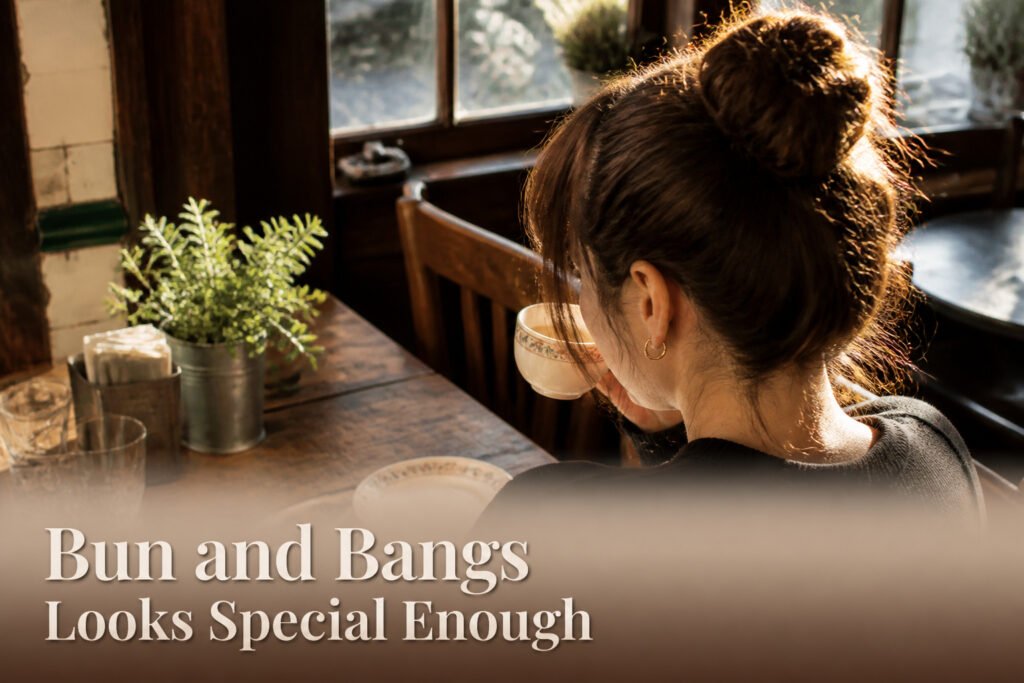
A bun with bangs can read bridal, playful, or deliberately messy depending on where you sit the bun and how you weight the fringe. The deciding factor is not the style you pick but the tension you build between the two elements: a scrunchie at the nape needs loose top hair so the bangs look planned, while a clean top knot demands day-three oils to grip the perimeter smooth. Penélope Cruz’s red-carpet version, shiny fringe against a neat bun, is the proof that the contrast itself does the work.
1. Cute Bun for Brides

A wedding bun with bangs only reads as bridal if it survives the entire day without sagging, and that security comes down to pins matched to your natural hair color rather than the usual metallic flash. Blunt bangs, Birkin fringe, or bottleneck styles all pair cleanly with a low or mid-height bun because the bangs do the visual work while the bun stays anchored at the nape. The pinning itself is the hidden labor: crisscross two pins at each anchor point so they lock against each other, and place a third perpendicular to catch any slide. Bunny bangs, worn long and slightly separated like Penélope Cruz’s red-carpet version, need the same foundation but reward you with a softer line across the forehead. Skip the hairspray until the structure is set; spray first makes pins slip on fine hair. If your bangs are choppy or textured, the contrast against a smooth bun actually looks more intentional than a perfectly matched finish, so don’t over-smooth the crown.
2. Cute Bun with a Ribbon

A ribbon threaded through a bun turns the simplest updo into something that feels intentional. The placement matters more than the bow itself. Pull the bun to the crown, and the ribbon should sit just above it, letting the ends trail down the back or tuck underneath. Lower buns, at the nape, need the ribbon wrapped around the base and tied slightly off-center so the knot doesn’t fight the bangs for attention.
Bangs change the whole balance. Wispy or curtain bangs need the ribbon to sit higher, drawing the eye upward so the fringe doesn’t look like an afterthought. Blunt, straight-across bangs can handle a wider ribbon sitting lower, almost level with the brow, because the strong line already anchors the face.
Ribbon width should match hair density, not personal taste alone. Fine hair disappears under anything wider than about an inch; the ribbon swallows the bun instead of framing it. Thick hair can carry two-inch grosgrain or velvet without the accessory looking like a string lost in the volume. Satin slips on smooth hair and grips texture, so the finish matters as much as the width.
3. Cute Bun with a Scrunchie

A scrunchie bun with bangs sits in the sweet spot between looking like you tried and looking like you tried too hard. The trick is keeping the top slightly loose rather than slicked back; that tension between the casual fabric and the polished fringe is what makes the whole thing feel intentional.
Fabric matters more than color here. Silk or satin scrunchies slide less and leave fewer dents if you are pulling the bun out later for waves, while velvet or terry add bulk that can overwhelm fine hair. I keep the scrunchie low, at the nape or just above, so the bangs frame the face without competing for attention. Too high and the scrunchie becomes the whole story; too low and the bangs look like an afterthought.
For day-to-day wear, this works because it takes roughly ninety seconds and survives coffee runs, desk work, and the occasional video call without looking like you gave up. A light mist of hairspray on the crown keeps flyaways in check, but skip the full sleek finish. The point is the contrast: the scrunchie reads relaxed, the bangs read deliberate, and together they look like a plan rather than a compromise.
4. Cute Bun with a Fringe

A full fringe paired with a bun lives or dies by the tension between the two shapes. The fringe needs to sit low enough to read as a deliberate frame, but the bun has to clear the crown so the fringe does not get visually swallowed. I have seen this go wrong when the bun droops: the fringe suddenly looks like an afterthought, not an anchor.
The fringe here is styled smooth, almost polished, which lets it hold its own weight against the structured bun. Penélope Cruz has worn this exact balance on the red carpet, and the shine on the fringe is what keeps it from looking schoolgirl. A slight wave or smoother texture makes the styling easier, though curly hair can work if the fringe is cut longer than you think you need, since shrinkage once dry will pull it up.
Rounded faces need a longer, sweeping fringe instead of this blunt cut, which can accentuate roundness. Oval or heart-shaped faces carry it better, especially with soft side pieces breaking the line at the cheeks. The difference from side-swept or curtain bangs is that a full fringe creates a horizontal stop across the forehead; the bun has to sit high and tight to keep the whole silhouette from flattening. Side bangs let you place the bun lower and looser because the diagonal line keeps the eye moving.
5. Double Buns

Two buns worn with bangs split the hair’s weight in a way that keeps the style from feeling top-heavy or pulling at the roots. The placement matters: set the buns slightly behind the crown, not directly on top, so the bangs section keeps its own visual ground and the whole silhouette reads as intentional rather than accidental. Space the buns wider than you think, roughly in line with the outer edges of your eyebrows if you wear blunt bangs, or slightly closer for wispy or curtain bangs that already carry width across the forehead.
What convinced me, looking through dozens of these styles, is that the gap between the buns does the work. Too narrow and the look collapses into one lump; too wide and the bangs float like an island between them. The even distribution also means this style holds longer without the headache that comes from piling everything into one tight center knot. For a 2026 occasion that calls for something playful but not costume-y, double buns with bangs hit that mark when the spacing is deliberate and the bangs are trimmed to sit just at or below the brow, weighted enough to stay put while the buns move.
6. Half Up Bun

A half up bun keeps the weight of your hair off your face while your bangs do the actual framing, which makes it the least risky entry point if you are new to pairing buns with bangs. The placement matters: set the bun at the crown or just above, not higher, so the bangs read as a deliberate front piece rather than leftover fringe you forgot to sweep back. Penélope Cruz has worn this exact proportion, shiny fringe against a neat bun, and the effect reads red-carpet enough without requiring the maintenance of a full updo.
The half-down portion does the work of softening the look. Where a full bun can turn severe against bangs, the hanging hair keeps the silhouette casual. If your bangs are the wispy, lash-skimming kind Jenna Ortega favors, the contrast against a structured topknot adds interest without heaviness. Heavier bangs need more care: the bun must be tight enough that the two textures do not compete, but not so severe that the overall effect is librarian. Start here if you are testing whether bangs and buns suit you at all. The style takes under two minutes, and if the proportions feel wrong, pulling the rest up into a full bun is an easy fix.
7. Modern French Twist

A modern French twist with bangs keeps the classic vertical roll but leaves the front section free so the fringe falls naturally over the forehead. The twist itself sits lower than a traditional ballroom version, anchored at the nape rather than crown height, which creates a cleaner line against the bangs instead of competing for space.
The pinning sequence matters more than the twist shape. I start by sectioning the bangs out with a clip, then build the twist from the sides toward the center back. Once the roll is formed and gripped with U-pins in a crossed pattern, the bangs get a light mist of dry texture spray before blending the side pieces into the twist with small bobby pins hidden underneath. The front stays soft because forcing every strand back exposes the hairline in a way that reads dated, not special-occasion.
Fine hair needs a bit of backcombing at the twist base before rolling, or the whole structure collapses by hour two. Thick hair fights back against smoothness, so a light pomade through the sides before twisting keeps flyaways from escaping the roll. Either way, the bangs need their own finishing step: a quick pass with a small round brush at the roots preserves the slight curve that makes this look contemporary rather than costume.
8. Lacy Bun

The lacy bun lives or dies by surface detail, and that detail comes from working with second-day hair rather than fighting it. A light mist of dry shampoo at the roots gives the grip needed for pinning, while the mid-lengths stay pliable enough to twist into loops that sit flat against the head. I pin each loop with a small U-pin, crossing them in pairs so the pattern holds without collapsing into a standard roll.
Bangs are the clean frame that lets the lacework read. Without them, the eye wanders from the hairline to the bun and back, never settling. A straight or slightly curved fringe draws attention downward to the texture, the same way a mat borders a photograph. The contrast matters: the bun should look touched, almost fragile, while the bangs stay sharp enough to look intentional rather than grown-out.
The texture itself comes from leaving ends out. Each twisted loop has a tail that pokes through, and those tails get lightly backcombed with a fine-tooth comb before being tucked under the next loop. The result reads like openwork from a few feet away, especially under evening light where shadow does half the work.
A light-hold spray finishes it. Anything stiff kills the movement that makes the pattern convincing, and anything stronger turns the loops into a helmet. Two pumps from arm’s length, let it settle for thirty seconds, then check from the side mirror.
9. Clean Top Knot

Day 3 or 4 hair holds a clean top knot better than freshly washed strands ever could. The natural oils give the brushed-back perimeter enough grip to stay smooth without the halo of flyaways that clean hair tends to produce. I learned this the hard way after trying to force the style on blowout-fresh hair, only to watch baby hairs escape within the hour.
The bun itself can go messy, but the hair leading into it has to read as deliberate. A wide tooth comb knocks out any lumps before you pull everything up, and a small amount of gel pressed along the hairline keeps that mini-lifted effect neat.
Bangs are where the real work happens. By day three they have slept-on texture and a slight bend that no round brush fully revives. Dry shampoo at the root buys you volume, but the real fix is a quick pass with a straightener or a curling wand, just through the mid-lengths to ends, to reset the shape against the polished crown. The contrast between the sleek top and the slightly rumpled bun is what keeps this from looking like you are trying too hard.
10. Messy Braided Bun

A messy braided bun works best when the braids are placed at the sides or crown, not woven through the whole shape. Two small Dutch braids starting at the temples and meeting at the back give the bun its architecture; everything else stays loose and pinned where it lands. The control comes from prep: day-old hair holds the texture without falling apart, and a light texturizing spray on the lengths before braiding keeps the fuzz deliberate rather than sloppy.
The bangs do the real balancing here. Because the bun itself is soft and irregular, straight-across bangs with a clean edge add a counterweight that keeps the look intentional. Curtain bangs can work too, but they need a slight bend from a round brush so they do not dissolve into the same chaos as the bun. I have seen this style read as "effortless" on one person and "I gave up" on another, and the difference is almost always whether the bangs were styled with heat or left to air-dry.
Bang Types That Work With Buns

Not every fringe behaves the same once the rest of your hair is swept up. Blunt bangs cut straight across demand the most commitment; they read severe and graphic against a bun, which can look intentional on a longer face but risks feeling costume-y elsewhere. I keep a flat iron within arm’s reach when I wear mine pulled back, because any kink or separation breaks the line entirely.
Wispy bangs are the softer countermove. They feather out at the edges so the bun does not have to compete for attention, and they forgive a little grow-out between trims. Curtain bangs split the difference: parted slightly off-center, they frame the cheekbones while the bun sits high or low, and they work whether you tuck the ends back or let them brush the jaw.
Then there are bunny bangs, the newest of the four. Hairstylist Richard Mannah describes them as short, airy fringe paired with longer, disconnected side pieces that flop down like ears, giving a fluffier finish than a standard blunt cut. They are intentionally lightweight and piecey, built for movement rather than structure. On double space buns they turn playful; on a single low bun they read romantic rather than severe. The side pieces do the heavy lifting, so the fringe itself stays soft and manageable even as it grows.
Texture and Hold for Bun Styles

Fine hair and a bun do not get along without help. The same twist that holds all day on thick hair slips out in an hour on strands that lack natural grip. Texture spray changes that equation by adding friction without stiffness, letting fine hair stay put through an evening event. I learned this the hard way after too many top knots that looked crisp at 6 PM and sagged by 8.
The difference starts before the bun goes up. Wavy or slightly textured hair already has the body to grip itself; smoother textures need that body built in. Curly hair brings its own structure, though the finish will read different, not worse, just distinct. A stylist I trust once noted that curly fringe needs to be cut longer than you think, since shrinkage changes the line once dry.
For the bun itself, dirty hair helps, but product helps more. Dry shampoo buys time between washes, yet texture spray does the active work of giving strands something to catch against. On fine hair, I mist it through the crown and mid-lengths, let it set a minute, then twist. The hold lasts without looking shellacked.
Bangs Upkeep Every 3 to 4 Weeks

Bangs in a bun and bangs look special need more frequent attention than most people expect. Every three to four weeks is the real interval, not the six-week salon standard, because even a week past that window changes how fringe falls across the forehead. The bangs start splitting, catching on eyebrows, or falling into that awkward grown-out phase that lasts at least four to six weeks once it begins. For a wedding or a holiday party where the bun needs to read as intentional rather than last-resort, timing the trim two weeks ahead gives the cut a chance to settle. Jennie Roberts, a textured hairstylist and educator for Curlsmith, puts it plainly: "The fringe is the first thing you see. It’s got to look well."
"The fringe is the first thing you see. It’s got to look well."
— Allure
That means booking the appointment before the calendar fills, not after you notice the bangs have gone flat.
Frequently Asked Questions
What are bunny bangs?
Bunny bangs are a short, airy fringe paired with longer, disconnected side pieces that flop down like ears, giving a softer and fluffier finish than a standard blunt cut. Hairstylist Richard Mannah describes them as lightweight and piecey, built for movement rather than structure. They work especially well with double space buns for a playful look or a single low bun for something more romantic.
How often should I trim my bangs?
Trim your bangs every three to four weeks, not the six-week salon standard, because even a week past that window changes how fringe falls across the forehead. The bangs start splitting, catching on eyebrows, or falling into an awkward grown-out phase that lasts four to six weeks once it begins. For a special event where the bun needs to look intentional, time the trim two weeks ahead so the cut can settle.
What types of buns can I wear with bangs?
You can wear several bun styles with bangs, including a low or mid-height bridal bun, a ribbon-accented bun, a scrunchie bun, a full fringe with a high structured bun, double space buns, a half-up bun, a modern French twist, a lacy looped bun, a clean top knot, and a messy braided bun. Each pairs differently with blunt, wispy, curtain, or bunny bangs depending on the balance you want between the bun height and the fringe weight.