Blue hair is a semi-permanent dye category that spans from barely-there pastel to near-black cobalt, with the critical difference being how much bleach your hair can survive. Pastel blue demands lifting to level 10 platinum blonde first, a process so harsh that the resulting color can wash out in a handful of shampoos without cold-water discipline. That same Arctic Fox Periwinkle tint, though, is what makes the damage worth it for the ethereal finish.
Pastel Blue

Pastel blue sits at the lightest end of the blue hair spectrum, the shade that reads as almost weightless, like something caught in a dream rather than applied in a salon. Getting there means lifting your hair to level 10 platinum blonde first, which is about as light as hair goes before it turns to straw. The color itself, something like Arctic Fox’s Periwinkle, deposits over that blank canvas and gives you the ethereal, otherworldly finish that makes this shade worth the trouble.
The trouble is real. Pastel blue fades faster than any darker blue, sometimes washing out to nothing in a handful of shampoos if you are not careful. Cold water becomes non-negotiable, and color-safe products stop being a suggestion and start being the only thing standing between you and a $200 color job circling the drain. I have watched friends ration their washes like water in a drought, stretching four days to six to eight, learning to love dry shampoo in a way that becomes almost spiritual.
Skin undertones matter here more than with deeper blues. Pastel blue pulls extremely cool, so it flatters pink and neutral undertones best. Warm undertones can fight against it, making the color look like it is sitting on top of the skin rather than belonging to the person wearing it. If your veins look green in natural light, this particular fantasy shade may not be your fantasy.
Light Blue

Light blue sits one step deeper than pastel on the commitment scale, and that small shift matters more than the name suggests. The color holds longer in the hair while keeping the same airy, weightless quality that makes soft blues wearable in daylight. For anyone hovering over the decision, this is the practical middle ground: bold enough to read as actual blue, soft enough to wash out quickly if the experiment fails.
Bleaching is still non-negotiable for the true version of this shade. The hair needs to lift to level 10 platinum blonde before a light blue dye will deposit evenly; anything darker and you are looking at a tint visible only in sunlight, not the clean color you see in reference photos. Semi-permanent formulas work here, which is part of why the shade functions as an entry point. The dye fades with washing, so a hesitant first-timer can test the look without living with it through grow-out. If the tone works, moving to something more saturated is a simple next step. If it does not, a few washes and a conditioning mask return you to blonde without the drama of a color correction.
Ice Blue

Ice blue sits at the coldest end of the blue hair spectrum, carrying a metallic edge that reads silver before it reads color. The shade demands an almost-white base, which means lifting natural hair to a pale yellow and then countering every remaining warm pigment with violet toner before the blue ever touches it. Skip that second toning step and the result goes greenish or denim, not arctic.
For anyone already gray or white, the chemistry changes entirely. The lifting stage disappears, but the underlying yellowing that natural silver develops still needs neutralizing. What reads as "white" hair often carries enough warmth to shift ice blue toward turquoise, so a violet or silver pre-toner matters even more on gray heads than on bleached ones.
Winter fashion cycles have latched onto this shade partly because it mirrors what the season already does to light. Pale winter sun, bare branches against sky, the blue cast of snow in shadow: ice blue hair completes that palette rather than competing with it. The shade tends to surface in editorial work and street style from late November through February, then retreat as warmer pastels take over for spring.
Turquoise

Turquoise is where the blue family starts borrowing from green, and that warmth changes who can wear it. True blue dyes lean on violet or ash bases to stay cool; turquoise shifts the formula toward yellow-green reflect, which is why it flatters warm undertones that true blue can leave looking sallow. The tropical, mermaid associations aren’t accidental. Colorists often build this shade by laying green over a pre-lightened yellow base rather than fighting it, letting the warmth live in the hair instead of correcting it out.
The same green content changes how it fades. True blue drops toward silver or slate as pigment washes out. Turquoise heads somewhere else: toward mint, then toward blonde with a faint seafoam cast. That fading path is easier to live with, less corpse-gray at the two-week mark, though the trade is that it never quite reaches the depth of a pure cobalt. If your water runs hard with minerals, the green shift accelerates; a chelating shampoo buys you another week of the original tone.
Mermaid Blue

Mermaid blue lives or dies by whether the placement looks deliberate. The colorist interweaves blue and green hues so the shift between them mimics actual ocean water rather than a root line growing out. Natural brown roots can work as the perfect backdrop, but only if the electric blue is painted low enough to read as depth rather than neglect.
Hand-painted balayage is what separates this from a grown-out dye job. The technique lets the colorist leave strategic breaks of natural or lighter tone between the saturated pieces, so the eye reads dimension instead of stripe. Long layered beach waves help, since the movement catches the color at different angles and sells the underwater illusion.
Washing less frequently with cold water and using color-safe products keeps the blue from draining toward green too fast. Pastel versions like Periwinkle fade much faster than dark blues like Sorceress, so mermaid blue sits in a practical middle if you want the green shift to stay controlled rather than muddy.
Electric Blue

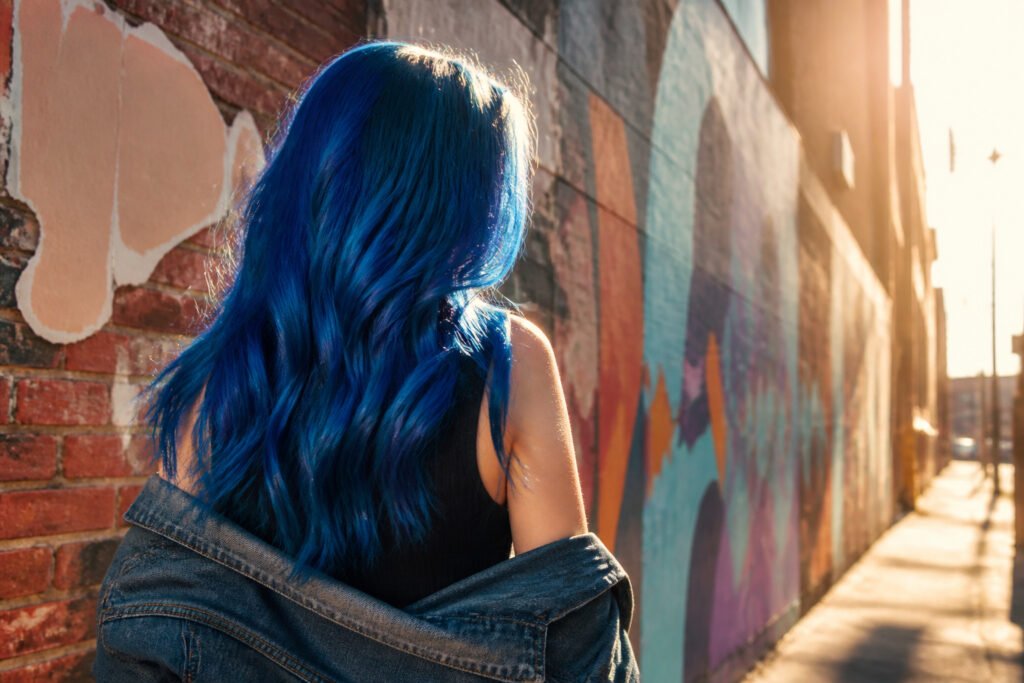
Electric blue sits at the edge of visible light, and that is exactly where it lives on your head. Against pale skin, the neon intensity reads as deliberate confrontation, not accident. The punk and rave lineage runs deepest here: this is the shade that signaled subculture before social media made color accessible to everyone.
Semi-permanent formulations dominate, which means the commitment is real but not lifelong. The pigment molecule in electric blue is large and stubborn, clinging to the cuticle until it washes down the drain in six to eight weeks. What makes it a harder wear than softer blues is the regrowth line that announces itself like a calendar. Dark roots against electric lengths do not blend; they stage a debate between who you were and who you are choosing to be.
That visibility is the point. Electric blue functions as rebellion precisely because it refuses the politeness of natural color. It does not ask to be taken seriously in a corporate room. It does not age gracefully toward something else. The maintenance is ongoing, expensive, and public, which is why the people who stay in it tend to mean something by it.
Denim Blue

Denim blue sits in the practical middle of blue hair, close enough to natural dark blondes and light browns that it reads as intentional rather than rebellious in most offices. The color mimics the way indigo fades in well-worn jeans: muted, dusty, with that slight gray cast that keeps it from shouting across a conference room.
What makes it workable is the lower lift required. Where pastel or ice blue demands hair lifted to near-platinum, denim blue takes on a level 6 or 7 base, the kind of pre-lightening that leaves underlying pigment intact. Less time in the bleach bowl means less structural damage, which matters if you’re maintaining the color for months rather than a weekend.
I noticed the shift around 2019, when stylists on social media started showing "corporate blue" results alongside their neon work. The hashtag pulled in clients who wanted the blue hair experience without the blue hair conversation every Monday morning. It became the compromise shade: visible enough that you know it’s there, quiet enough that your manager doesn’t have to.
The maintenance is forgiving, too. Fading just pushes it toward steel or silver, still professional, rather than the mint or green drift that ruins brighter blues. Root regrowth blends longer than you’d expect against the muted tone, stretching salon visits to every eight to ten weeks if budget matters.
Dark Blue

Dark blue sits right at the edge where color becomes shadow, and that threshold is what makes it wearable for months instead of weeks. A shade like Sorceress holds onto its pigment through washes that would strip a pastel back to blonde, and the fade goes silvery rather than muddy. The trade is subtlety: under fluorescent office light, the blue reads almost black, then catches daylight or candlelight and shows its true depth.
The forgiving base color is the real draw. Dark blue deposits well over hair that still carries old red or brassy undertones; the cool pigment simply absorbs the warmth rather than fighting it. Pastels demand near-platinum canvas and still turn green at the first hint of yellow. Dark blue lets you skip a bleaching session, or stretch the one you already had across six months instead of six weeks.
Washing cold and less often still matters, but the margin for error widens. Skip the color-safe shampoo for a week and the shift is gradual, not catastrophic. For anyone weighing the cost of salon upkeep against how loudly they want their color to announce itself, dark blue is the compromise that leans practical without surrendering entirely to ordinary.
Navy Blue

Navy blue hair sits right where caution and commitment meet. In a dim restaurant or evening light, it reads as a deep, expensive brunette. Step outside or flip a bathroom switch and the blue wakes up, subtle but definite, like ink catching the sun. That chameleon quality is what makes it the safest first move into blue hair without the neon announcement of brighter shades.
The tone flatters across skin tones in a way electric blues struggle with. Warm undertones pick up the cool depth without clashing; cooler complexions get that porcelain contrast people chase with black. What navy offers that black never will is dimension, light moving through the color rather than stopping at it.
For the blue-curious still hedging, this is the shade that lets you test the reaction, your own comfort, and the maintenance reality before any bolder jump. If the upkeep or the mirror surprise feels off, a single all-over dye in natural brown covers it cleanly. No bleach rewind, no color-correction bill. The sophistication reads as intentional, not experimental, which matters in rooms where you need both.
Indigo

Indigo sits at the exact point where blue stops defending its territory and purple starts creeping in, and that instability is what makes it the most theatrical shade in the blue family. Under fluorescent bathroom lights it can read almost violet; step outside into overcast afternoon and it collapses into something closer to midnight navy. The color wheel mechanics are straightforward enough: indigo contains enough red undertone to warm the mixture, but not enough to fully commit to purple, so the balance shifts according to whatever wavelength happens to be hitting it. Warm base hair pulls that red undertone forward and indigo turns visibly plum within a week, while cool base hair keeps the blue dominant and the fade runs truer to a steel-gray. Natural indigo dye, the plant-derived stuff that dates back to at least 4000 BC in Peru and India, was so historically precious that it literally built trade empires; the synthetic version that colors hair today carries none of that labor but still inherits the same chameleon behavior. If you are starting from brassy or golden tones, expect the purple to win. If you are starting from ash or natural white, the blue stays in charge longer, though the fade in both cases heads toward green eventually because yellow base plus blue residue equals the color of old swimming pools. The unpredictability is not a flaw. It is the point. You are not buying a single color; you are buying a shade that performs differently at 9 AM, at 5 PM, and under every restaurant dimmer switch between.
Blue Black

A blue cast on black hair lives or dies by the light hitting it. Direct sun or a camera flash pulls the undertone forward; indoor office lighting usually swallows it whole. That conditional visibility is what makes blue black the safest entry point for anyone curious about blue hair but bound by dress codes or skepticism.
Garnier’s NUTRISSE ULTRA CRÈME in Intense Blue Black retails at $10.99 MSRP, and that price point matters more than the shade itself used to. Before drugstore lines carried this tone, getting a controlled blue undertone meant salon mixing or ordering specialty dye online. The box format put the experiment within a grocery run, which opened the door to people who would not have risked a $75 commitment on a color they might hate.
The tradeoff is saturation. On hair darker than medium brown, the blue reads as a cool sheen, not a color shift. Sources describe it as "discreet" and "office-appropriate," and that is accurate if your office has fluorescent overheads. Step outside on a bright day, though, and the undertone announces itself. What reads as conservative indoors becomes something else in natural light, which is either the appeal or the liability depending on your workplace windows.
One caution from people who have gone this route: the "temporary" label on box dyes can mislead. Blue pigment clings to porous hair longer than expected, and correcting it can take professional sessions that cost far more than the initial $10.99. A strand test is not optional here; it is the only way to see how your particular hair grabs and releases the tone.
Reflective Jet Blue Black

Reflective jet blue black sits at the boundary where blue hair becomes almost invisible, then snaps into view under the right light. The newer formulas use microscopic reflective pigments layered into the dye rather than flat color molecules. Tilt your head under a streetlamp and the black shifts to deep navy; face away and it reads as ordinary dark hair.
I spent time comparing how this works against standard blue-black dyes. Traditional formulas deposit uniform pigment that looks the same from every angle. The reflective versions embed plate-like particles that catch and bounce light directionally, similar to how pearlescent car paint operates. The effect is genuinely dimensional, not gimmicky.
Whether the higher price point holds up depends on how much you value that shift. In dim indoor lighting, the blue stays hidden; you are paying for moments of revelation rather than constant display. The technology does what it promises, but the promise itself is narrow. For someone who wants blue hair that still passes in conservative settings, the trade makes sense. For full visible color, a standard formulation delivers more hours of actual blue for less money.
Cosmic Cobalt

Cosmic cobalt carries a violet depth that surfaces under dim light, the kind of shift that makes the color read as night sky rather than simple electric blue. The galaxy hair trend leaned hard into this specific shade around 2016, pairing it with scattered lighter pieces to mimic star clusters against dark space. Achieving it usually demands a multi-step process: lift to pale blonde first, then lay down a blue base with violet added to push saturation toward that midnight tone. Without the violet undertone, you land closer to basic royal blue; too much, and the color tips into purple territory entirely. The balance is what separates cosmic cobalt from its neighbors on the blue spectrum, and what makes it read as artistic statement rather than costume choice. Maintenance runs demanding; the depth fades toward navy within two to three weeks, and the violet component washes out faster than the blue, leaving a flatter color behind. Refreshing the violet with a pigmented conditioner between salon visits keeps that dimensional quality intact longer than dye alone.
Holographic Hair

Holographic hair stacks iridescent panels of pink, silver, lavender, and blue through the mid-lengths and ends so the color shifts when you turn your head. The technique demands either micro-foiling in alternating slices or freehand painting with the brush held almost flat to keep the tones from bleeding into muddy gray. Most colorists section the hair into horizontal ribbons no wider than a finger, laying each foil with a different diluted formula so the finished surface catches light like oil on water.
The cost runs steep because you are paying for three to five distinct color formulations plus the labor of placing them precisely. Touch-ups every four to six weeks are non-negotiable; without them, the blue panel fades fastest and the whole effect collapses into a dull, greenish wash. At-home maintenance with color-depositing conditioners slows the shift slightly, but the dimensional contrast depends on professional re-foiling. Most clients I have watched budget for this treat it as a six-month experiment rather than a permanent look, and plan the grow-out or a single-tone cover before the upkeep exhausts them.
What Blue Hair Meant Before It Meant This

The phrase "blue hair" meant something entirely different when I first heard it as a kid in the 1980s. Back then, it described elderly women who rinsed their gray with a faint blue tint, a trick that supposedly brightened silver strands but mostly made them fade into the background of church pews and grocery lines. The color signaled invisibility, age, and a kind of polite conformity.
That association flipped completely sometime after the 2010s. The same blue became a beacon rather than a camouflage. Environmentalists, feminists, and LGBTQ communities, particularly younger Millennials and Gen Z members, adopted deliberately vivid blue dyes as a visible marker of identity and politics. What once hid gray now announces presence. Where the blue rinse aimed to make aging women disappear, the current blue hair demands to be seen, turning the earlier meaning almost inside out.
The shift carries some irony. The elderly women using blue rinse and the young activists using cobalt dye both chose blue for transformation, just toward opposite ends. One sought to blend in; the other refuses to.
What Changes How Long Blue Lasts

Cold water washing and color-safe products are the baseline for any blue that lasts more than a few washes, but pastel shades like Periwinkle fade much faster than dark blues like Sorceress. The lighter the tone, the less pigment there is to lose with each rinse, so a soft pastel can wash toward gray in under two weeks while a deep navy lingers for closer to six.
Bleaching sits at the center of this tradeoff. Darker hair, around level 6 to 9, can take colors like Aquamarine or Sorceress without lifting and still show a subtle blue tint in sunlight. For anything vivid, electric, or pastel, the hair needs to hit level 10 platinum first, or the blue will either refuse to show or muddy into something unintended. A strand test before the full application saves the disappointment of discovering this on your whole head.
Washing less often matters more with blue than with most colors because the pigment molecules are large and rinse out readily. Two to three washes a week with sulfate-free, color-safe formula keeps the fade gradual rather than sudden.
Skin Tone and the Blue That Works

Cooler blues sit better on cool undertones, while warmer teals balance warm undertones, but any skin tone can wear blue if you pick the right shade. The undertone test is simple: look at the veins inside your wrist. Greenish usually means warm, purple or blue means cool, and a mix points neutral. Silver jewelry flatters cool undertones; gold flatters warm. A stylist at Hair Perfection in Short Pump, Virginia, told me she keeps a white towel at her station because natural light on bare skin tells the story faster than any chart.
Mismatching deliberately is its own move. A warm undertone with a cold, almost violet blue creates friction that reads as intentional, editorial, a little off. The navy balayage Jenna styled with those darker roots spilling into denim tones works partly because the warmth of the scalp area fights the cool ends. That tension is the point. If you want harmony, match. If you want the color to announce itself first and your complexion second, mismatch and commit fully.
How Blue Hair Reads in a Room

Blue hair sends a signal, and the signal has changed faster than most people realize. A decade ago, a vivid cobalt streak practically announced nonconformity; now, that same shade might just mean someone follows the same color-depositing mask tutorials the rest of us do. The shift from rebellion to mainstream trend cost the color its edge, but it also opened the door for people who never saw themselves as "alternative" to try something expressive without signing up for a subculture.
What the research actually says is more modest than the assumptions. Studies on hair color and first impressions find that unconventional colors like blue register as creative and open-minded, not unprofessional or unapproachable, in most casual and creative workplaces. The penalty shows up in conservative fields, where hiring managers still read it as a distraction, though even that gap has narrowed since 2020. Socially, the effect splits by context: blue hair tends to spark conversation at a party and fade into background noise at a music venue, which is exactly the point for many people who choose it. They wanted a filter, not a megaphone.
The real tradeoff is personal. Wearing blue hair still requires a certain tolerance for being remembered, for the cashier who comments every time, for the family member who asks when you are going to "go back to normal." That cost has dropped, but it has not disappeared. Whether it reads as approachable or performative depends less on the shade itself and more on whether the person wearing it looks comfortable in their own reflection.
The Dyes and What They Cost

Semi-permanent blue dyes sit on the surface of the hair shaft and wash out in roughly four to twelve shampoos, while permanent formulations open the cuticle and deposit color that grows out rather than fading clean. That distinction matters for budget and commitment both. A permanent box color like Garnier Nutrisse Ultra Color in IN1 Dark Intense Indigo or IN2 Intense Pure Indigo runs $10.99 MSRP and promises up to eight weeks of fade-resistant wear with full gray coverage, plus the avocado and shea oil blend that keeps drugstore color from feeling like straw.
The semi-permanent side has a wrinkle most shoppers miss. Disperse Blue 1, a common semi-permanent dye in European and Asian markets, does not appear in U.S. formulations because of carcinogenic concerns raised by FDA regulation. That exclusion narrows what is available on American shelves, pushing semi-permanent buyers toward alternative blue pigments that behave differently on pre-lightened hair. Salon-grade semi-permanents still exist, but the gap between a $10.99 box and a professional bowl-mixed application runs wide, and the colorist is pricing for the bleach work underneath as much as for the blue itself.
Frequently Asked Questions
Does blue hair fade quickly?
Pastel shades like Periwinkle wash toward gray in under two weeks, while deep navies and dark blues such as Sorceress linger for closer to six. The lighter the tone, the less pigment there is to lose with each rinse. Cold water, sulfate-free color-safe products, and washing only two to three times a week stretch that timeline.
What skin tone works with blue hair?
Any skin tone can wear blue if you pick the right shade. Cooler blues flatter pink and neutral undertones best, while warmer teals and turquoises balance warm undertones. Check the veins inside your wrist: greenish usually signals warm, purple or blue signals cool, and a mix points neutral.
Can I go blue without bleaching?
Yes, with limits. On darker hair around level 6 to 9, shades like Aquamarine or Sorceress give a subtle blue tint visible mainly in sunlight. For vivid, electric, or pastel results, you still need to lift to level 10 platinum blonde first. A strand test before full application prevents disappointment.