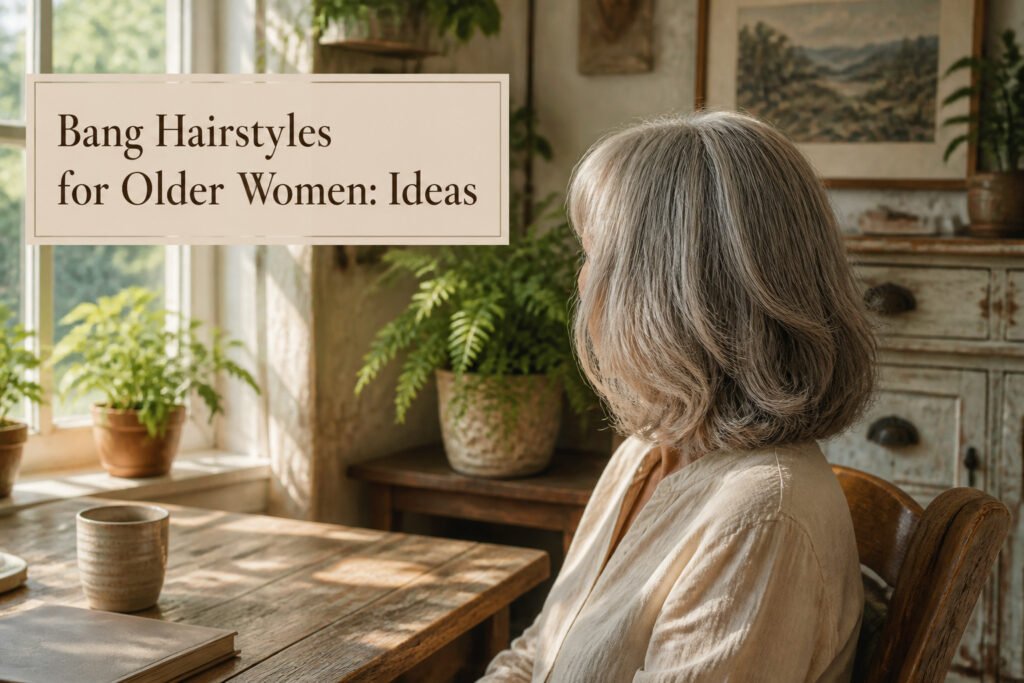
The right bang style for an older woman depends less on age itself than on whether her face has grown rounder, longer, or squarer than it was two decades ago. Helen Mirren and Jane Fonda both wear fringe that shares a line with the rest of the cut rather than looking added on, and that integration is what separates a style that holds from one that demands daily repair. The catch is texture: gray hair grows wiry against softer lengths, so the density and weight of the fringe matter more than the shape alone.
1. Classic Bob with Bangs

A classic bob with bangs is one of those pairings that genuinely never leaves the rotation, and after paging through enough salon portfolios I understand why. The blunt or slightly curved fringe sits right at the eyebrow line, echoing the clean edge of the bob itself so the whole shape reads as intentional rather than leftover. That structure matters more as silver hair grows in, because the new growth can look wiry against softer lengths. A blunt fringe gives the eye a place to land, creating a horizontal line that balances the vertical lift of gray roots. Wispier bangs work too, skimming the forehead to soften expression lines without the heavy commitment of a solid fringe. The sources describe this as a style older women return to when thinning becomes a concern, which makes sense: the density at the front adds visual weight where hairline recession tends to show first. Light color helps there as well, since darker shades against pale scalp only emphasize what has pulled back. What convinced me, reading through the recommendations, is how little daily negotiation this style demands. The fringe and bob are cut to work together, so the shape holds even on days when styling time is short.
2. Side-Swept Bangs

Side-swept bangs came up in four out of six style guides I checked, more than any other single type. The angle matters: sweeping across the forehead softens the eye and cheekbone area without the harsh line that straight-across bangs can create against changing skin texture. That same diagonal works on round faces, long faces, and most everything between, which explains why stylists default to it when someone isn’t sure what they want.
The grow-out period is where this style pays off. Because the bangs are already longer at the ends, they blend into layers or the rest of the cut rather than hanging awkwardly at eyebrow length for weeks. You skip the phase where you’re pinning them back with clips just to leave the house.
For styling, a round-brush blow-dry from roots to tips keeps the sweep smooth and prevents the frizz that can make side-swept bangs look accidental rather than intentional. Direct the airflow downward as you work the brush through. The Drybar The Double Shot Blow-Dryer Brush handles both jobs at once if you want one tool instead of two.
3. Wispy Bangs

Wispy bangs live somewhere between a commitment and an accident, which is exactly why they work when hair starts to thin. The feathered edges break up the line so no single chunk of hair has to do all the visual work, and that scattered density reads as fuller than a solid blunt fringe ever could on fine strands. Dry shampoo matters more here than with heavier bangs because there is simply less hair to absorb scalp oil before it separates into stringy pieces. A product like Living Proof Perfect Hair Day Dry Shampoo keeps the separation looking intentional rather than greasy, and the light texture of wispy bangs means a quick puff at the roots revives them without the chalky residue that can show on thicker cuts. The forehead coverage is there, but the weight is not, and that distinction becomes the difference between bangs that age you and bangs that soften the whole face.
4. Curtain Bangs

Curtain bangs split down the center and part away from the face like fabric on a window, which is exactly where the name comes from. The part stays visible while the fringe itself melts into the rest of the hair, softening forehead lines without covering the whole area. Stylists call this low-maintenance because the grow-out is forgiving; if you change your mind, the bangs simply become face-framing layers rather than an awkward in-between stage.
The trim cycle runs every three to six weeks, closer to six if you like them grazing the cheekbone and closer to three if you want them at the bridge of the nose. That range matters because it determines how much daily styling you face. Longer curtain bangs air-dry with just a spritz of texturizing spray or dry shampoo for hold; shorter ones need a small round brush pulled toward the center then glided outward to keep the sweep from collapsing. A hair roller rolled inward at the root, kept flat, gives the gentle bend that frames rather than helmets. The key is lightweight product. Heavy creams or oils collect at the part and separate the strands into clumps, which ruins the whole effect.
5. Blunt Bangs

Blunt bangs cut straight across the forehead in a heavy, solid line demand more from your calendar than most styles. The precise edge grows out fast enough that every 3 to 4 weeks is the real maintenance window, not the looser 6-week stretch that works for softer fringe. Skip that rhythm and the shape collapses into an awkward curtain.
The bold statement this makes on an older woman is exactly the point. The weight draws the eye upward and masks forehead lines, but the severity needs the right architecture underneath. Oval and longer faces carry it without looking boxed in. Rounder shapes tend to fight the horizontal line rather than benefit from it, and the effect turns harsh instead of striking.
Straight or slightly wavy hair keeps the edge honest; too much natural wave fights the geometry and demands daily heat work that undoes the low-maintenance promise. When the texture cooperates, the payoff is structure that needs almost no morning styling, just that disciplined trim schedule.
6. Curly Bangs

Curly bangs on older women used to draw the same tired advice: straighten them, tame them, blend them into something "polished." That assumption misses what happens when you let natural texture sit forward. Curls shrink as they dry, so the length your stylist snips while wet will land shorter than it looks in the chair. Ask for the bangs to be cut at least half an inch longer than your target, then watch them spring up to where you actually want them.
Product choice matters more here than with straight fringe. Stiff gels turn curls into helmet territory, which ages the face rather than opening it up. A styling cream, something like Pattern Beauty Styling Cream, gives definition while the hair still moves. The goal is moisture that holds shape without freezing it, because frizz control and flexibility are not opposing forces on mature hair that has already turned drier or more wiry with gray.
What this style challenges is the idea that aging means smoothing everything out. Curly bangs frame the eyes directly, draw attention upward, and add the volume that finer hair often loses. They also hide forehead lines without the blunt mask of straight-across fringe. The result reads as intentional, not as someone giving up on maintenance.
"The best version always feels integrated and easy."
— Vogue
That integration is the whole point: the curl pattern determines the cut, not the other way around, and the products serve the texture rather than fighting it.
7. Baby Bangs

Baby bangs sit well above the eyebrows, usually mid-forehead, and the effect is deliberately stark. On a mature face, they pull every bit of attention to the eyes and the forehead itself rather than softening anything. The sources I read ranked this style lower than heavier-recommended cuts like wispy or Bardot-style bangs; only two mentioned it at all against the fuller coverage others gave classic shapes.
The maintenance is real. These need trimming every few weeks to keep that precise line, and they demand daily styling since there’s no length to hide behind. A heavy hand with product kills the movement that makes them look modern, so a light touch with something like a bond smoother works better than thick creams.
This cut exposes rather than camouflages. Forehead lines stay visible, and the short line can feel severe if your features aren’t already angular in a way you want to emphasize. The stylists who back it pair it with confidence as the actual accessory.
8. Choppy Bangs

Point-cutting the ends of bangs leaves a broken, feathered edge instead of a solid line, which is what keeps this style from looking like a helmet on thicker hair or lying flat against fine hair. The technique removes bulk in a way that reads as intentional texture, not a grow-out phase. A razor can do similar work, though it tends to slide through coarser strands more cleanly while point-cutting gives the stylist more control on medium density.
The unevenness catches light differently across the forehead, so the bangs move even when the head is still. That slight shift is what keeps the look younger without the stiffness of a perfectly even cut. On thinning hair, the spacing between those point-cut ends creates the impression of more strands than are actually there. A little wax or styling paste worked through dry bangs helps separate the pieces further, though too much product collapses the effect into clumps.
9. Micro Bangs

Micro bangs sit well above the brow line, cropped short enough to read as deliberate rather than grown-out. The cut demands commitment: there is no pinning them back or blending them into a side part when the mood shifts. What you get in return is a fully exposed forehead and eyes, which opens the face in a way longer bangs simply do not.
This severity works best with strong brows or defined glasses to anchor all that visible space. Without either, the look can tip into unfinished rather than bold. The attitude the cut carries is unmistakable, and sources describe it as eye-catching and modern, though they also note it can be tricky to pull off unless you are fully prepared for the statement it makes. A confident posture helps, but the real requirement is accepting that this is a high-contrast choice: it will not soften features so much as frame them starkly. If your daily routine already includes brow grooming or you wear glasses with a defined frame, the balance is already built in.
10. Birkin Bangs

Jane Birkin’s fringe sits low, grazing the brow with a soft center part that lets the forehead breathe. The grown-in quality is the whole point: these bangs look like you last thought about them six weeks ago, which is exactly how they hide the maintenance. A trim every few weeks keeps the shape, but the slightly uneven, effortless line does the forgiving work for you.
Longer layers behind the fringe keep the silhouette open rather than heavy. The combination reads as intentional hair, not a costume, which matters if you are past the age of wanting to look like you are trying. The face-framing pieces can sweep forward or pin back, so the style shifts without a full redo.
A light styler keeps the center from separating into stringiness. Oribe’s Featherbalm Weightless Styler is the product name that comes up for this, though anything with similar weightlessness works. The goal is polish without product sitting visibly on the hair.
For women who want bangs that do not announce themselves as a youth attempt, this is the specific cut to ask for: cut from the bridge of the nose, softer in the center, fuller toward the sides.
11. Bottleneck Bangs

Bottleneck bangs start shorter at the center and widen toward the temples, forming the curved silhouette that gives them their name. That narrowing-to-flaring shape frames cheekbones directly while softening the jawline, which explains why stylists working with mature clients have moved toward this cut over blunter alternatives. The longer pieces at the sides integrate with face-framing layers, so the fringe reads as part of the overall shape rather than a heavy horizontal line across the forehead.
The cut sits softer in the center and fuller toward the sides, a proportion that can be worn forward or swept aside depending on the day. For hair that has gone drier or more textured with age, that versatility matters: you can pin the pieces back entirely when you want them gone, or let them fall naturally without the rigid maintenance a straight-across fringe demands. The gentle sculpting effect, as one stylist described it, brings structure without exposing the face when hair is pulled up.
12. Textured Fringe

A textured fringe lives or dies by product, not by the cut alone. That distinction matters because it separates this style from choppy bangs, where the unevenness is carved in with scissors and stays put on its own. Here, the separation is deliberate and temporary: you build it in with texturizing shears at the salon, then activate the piece-y look each morning with a styling product that breaks up the strands.
Natural wave or texture works in your favor. The bangs do not need to sit perfectly; the slight unevenness is the point. They blend into layered cuts and read as casual rather than messy. Fine or straighter hair can still hold the separation if you add grit. A dry texture powder, something like Sexy Hair Powder Play, soaks up oil while giving the strands lift and enough tack to stay separated. The small bottle travels easily for midday touch-ups, which matters because this look collapses when grease weighs it down.
The maintenance is product-dependent in a way choppy bangs are not. Skip the powder or cream, and textured fringe falls back into ordinary bangs. Use too much, and it turns stiff. The sweet spot is a light dusting at the roots, worked through with your fingers until the pieces separate naturally.
13. Feathered Fringe

The 1970s gave feathered fringe its signature move: ends that flick outward instead of curling under, creating a soft frame that floats rather than weighs. That outward roll matters more with age, because hair that droops at the jawline drags the whole face down with it. Rolled the other direction, the same length lifts.
A round brush and a blow-dryer are the only tools needed. Work from roots to tips, keeping the airflow aimed downward to avoid frizz, but roll the brush so the ends finish away from the face. The Drybar The Double Shot Blow-Dryer Brush combines both tools, which saves the awkward hand-coordination routine. Layered cuts carry this fringe far better than blunt ones: the feathered texture needs somewhere to dissolve into, and a blunt edge leaves it hanging like an afterthought. With layers, the fringe flows into the rest of the haircut with no harsh lines, and the airy texture builds volume rather than fighting it.
14. Airy Bangs

The lightest possible bang starts with a sparse section of hair, barely enough to cover a fingertip’s width at the part. From there, the stylist removes weight in tiny increments until the strands fall sheer, more suggestion than curtain. Done right, this gives forehead coverage without demanding density you no longer have, which matters when thinning has moved from occasional to constant.
What separates airy bangs from a mistake is the line itself. A stylist who treats this like standard texturizing will chip into the ends until the section looks broken, not intentional. The cut has to keep a soft, continuous edge even while letting light pass through, and that takes deliberate tension and a very sharp point of the scissors. I have watched two consultations go wrong on exactly this: the client asked for "wispy," the stylist heard "thin," and the result was gaps that showed scalp instead of the feathery veil the sources describe.
For women with significant thinning, this is one of the few bang options that does not borrow hair from elsewhere on the head. The coverage is real but the weight is minimal, so the remaining follicles are not pulled or stressed. The tradeoff is maintenance; airy bangs lose their shape quickly and need trimming every three to four weeks to keep from drifting into stringy territory.
15. Tapered Fringe

A tapered fringe starts with real weight at the front hairline and gradually lightens into the rest of the cut, so there is no blunt edge waiting to grow out into an awkward shelf. The stylist point-cuts vertically into the ends rather than snipping straight across, removing bulk in thin slices that blend the bang into longer layers behind it. I watched this done once on someone with thick, straight hair that had always fought its bangs; the difference was the absence of a line to maintain. Most bang wearers face the same cycle, trimming every three weeks or letting the shape collapse while they wait for an appointment. The tapered fringe solves this by design. The grow-out is the style. What starts dense near the brow simply reads as longer face-framing pieces two months later, and the point-cut texture keeps the ends from looking heavy as they lengthen. It asks more of the initial cut and less of the calendar.
What Face Shape Changes

Face shape shifts more than most of us notice, and the bang style that worked at thirty-five may sit wrong by fifty-five. Reading through the guidance on this, I kept seeing the same pairings repeat. Side-swept bangs draw the eye diagonally and break up roundness, which is why they keep getting recommended for round faces. Blunt bangs, meanwhile, land on the opposite end: they shorten a long face rather than widen it further. Square and heart shapes both need softening, so wispy or curtain styles win out there. Oval faces carry the most freedom, though even then, a clean blunt cut just above the brows reads more intentional than random.
| Face shape | What works | What to skip |
|---|---|---|
| Round | Long, side-swept bangs; softly layered versions | Full, blunt bangs |
| Oval | Blunt bangs just above the brows | None specifically |
| Square | Soft, wispy or curtain bangs | Super straight or blunt bangs |
| Heart | Wispy or curtain bangs (softening) | n/a |
| Long | Blunt bangs | n/a |
The pattern that held up across sources: round and long faces want opposite treatments, while square and heart both call for softness. Oval faces carry the widest range, though a deliberate choice still beats a random one.
Trim Schedule and Daily Upkeep

A blunt fringe starts looking ragged around the three- to four-week mark, while curtain bangs can stretch closer to six before they lose their shape. That 3–6 week cycle is the general rule, and where you land depends on how sharply your style is cut.
Bangs pick up oil from the forehead faster than the rest of your hair, so dry shampoo between washes keeps them from clumping. Living Proof Perfect Hair Day (PhD) Dry Shampoo is the one usually named for this.
For the blow-dry, a round brush is non-negotiable. Work from roots to tips with the airflow directed downward to avoid frizz. The Drybar Double Shot Blow-Dryer Brush combines both tools, which saves time if you are doing this daily.
Product weight matters more on older hair than it used to. Lightweight stylings are the safer bet; heavy creams drag finer strands flat and emphasize dryness rather than fixing it.
How Helen Mirren and Jane Fonda Wear Them

Helen Mirren and Jane Fonda make bangs look like something you could actually walk out of a salon with, not just pose with on a red carpet. Mirren’s fringe tends toward a soft, piece-y texture that works with her gray hair rather than fighting it; the slight irregularity keeps the color from reading as severe. Fonda, staying blonde, uses a fuller, more structured bang that creates contrast against lighter tones and draws attention to her eyes. Both women keep length around the face, which matters more than the bangs themselves: those longer pieces can be swept back or left forward, so the fringe doesn’t feel like a commitment you can’t undo by Tuesday. The replicable detail is the integration: neither fringe looks "added on." The bangs share a line with the rest of the cut, grow out gracefully, and don’t require daily heat styling to hold their shape. A stylist who cuts dry, watching how the hair falls naturally, gets closer to this result than one who sections everything wet and straight.
Frequently Asked Questions
Are bangs good for older women?
Bangs can quietly transform your look without the drama of a major cut. They draw focus to the eyes, blur fine lines across the forehead, and bring movement that balances proportions. The right fringe modernizes a haircut and adds youthful energy, provided the style works with your face shape and hair texture.
What type of bangs work best for my face shape?
Side-swept bangs break up roundness with their diagonal line, while blunt bangs shorten a long face. Square and heart shapes both call for softness, so wispy or curtain styles work best there. Oval faces carry the widest range, though a clean blunt cut just above the brows reads more intentional than random.
How often should I trim my bangs?
Blunt fringes need attention every three to four weeks before they start looking ragged, while curtain bangs can stretch closer to six. That 3–6 week cycle is the general rule, and where you land depends on how sharply your style is cut.