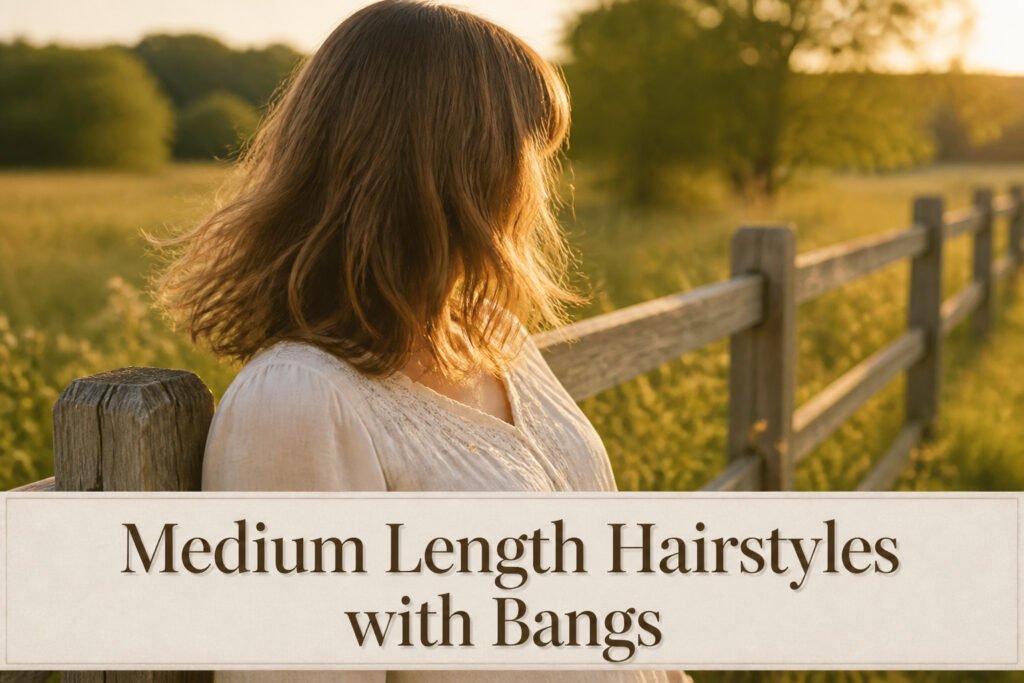
Medium length hairstyles with bangs sit in a 12- to 18-inch window where hair is long enough to move but short enough to manage without eating your morning. The catch is whether your texture can carry the fringe you want: curl pattern decides blunt bangs more than face shape does, and a stylist who cuts them like straight hair leaves you with a spring-back surprise an inch shorter than planned. Most of these styles collapse into shapelessness by week eight, so the real choice is not which cut looks best on day one, but which maintenance rhythm you will actually keep.
1. Layered Medium Cut with Soft Side Bangs

A layered medium cut with soft side bangs lands right in that 12- to 18-inch range where hair is long enough to move but short enough to manage. The layers do the heavy lifting here, adding body and keeping the style from falling flat, while the side bangs sweep across the forehead with enough curve to avoid looking stiff or overdone.
The real payoff comes from the round-brush blow-dry. Working the brush at the roots builds volume where you want it, and the movement from the layers shows up only when the hair shifts, not as an obvious chopped look. That clean blend matters, especially if your hair is on the finer side, since poorly blended layers read as thin instead of intentional.
For round faces, this cut works because the side bangs and vertical layers draw the eye downward, creating the illusion of length rather than width. The slight wave you can get from a quick pass with the brush adds texture without looking overstyled. I have seen this described as a 40-minute style, but the truth is closer to ten minutes with a round brush and a decent dryer, which is why it keeps coming up for people who want polish without the morning commitment.
2. Bouncy Curly Medium Cut with Soft Blunt Bangs

Curly bangs on medium length hair live or die by the person holding the scissors. Your curl pattern matters more than your face shape here, and a stylist who does not work with texture regularly will cut them like straight hair and leave you with a spring-back surprise that sits an inch shorter than planned. The blunt edge needs to be cut while the hair is wet and stretched, with length left to account for shrinkage. Tighter curls require even more length built in than looser waves. The volume on the sides comes from layers that move with your natural texture rather than fighting it. For thicker curl types, a stronger-hold product becomes necessary; a basic curl cream may not be enough to keep the shape defined through the day without scrunching and leaving it alone to set.
3. Textured Medium Cut with Soft Wispy Bangs

Wispy bangs let the forehead peek through in a way that feels light rather than committed, and that openness is exactly why they grow out without the awkward stage heavier bangs hit. The weight stays low enough that the line stays soft as it lengthens, so you are not racing back to the salon every three weeks.
Texturizing shears create the separation that keeps this cut from going bulky. Your stylist works them through the ends to break up the density, which matters because medium length can flatten at the crown if the bottom holds too much weight. The result moves without looking thinned out.
Fine hair carries this look best when you keep the product load minimal. A light-hold spray gives enough grip to separate the pieces without coating them in something that shows every strand’s diameter. I have watched heavier products turn this exact cut stringy by noon, and the fix is always the same: switch to something that sets without building up.
4. Shag Cut with Bangs

The shag cut that dominated 1974 album covers has found its way back into salon chairs, and the 2026 version keeps the heavy layering through the crown while letting the fringe play two different roles. Worn curtain-style, the bangs split to frame the face; pulled full, they sit straight across with that deliberate unevenness the original was famous for. Either way, the layers are doing the real work, building volume at the top and tapering down so the ends feel piecey rather than blunt.
What surprised me, watching this cut come back around, is how fast it goes flat without attention. Every six to eight weeks the shape starts collapsing into something shapeless, the layers growing out just enough to lose their separation but not enough to look intentional. The fringe grows quickest of all, hitting that awkward length where it neither parts nor stays put. Budget for that rhythm before you commit; a shag on month four looks like a grown-out mistake, not a style choice.
5. Shoulder-Length Bob with Bangs

A shoulder-length bob lives or dies on the precision of its perimeter. The cut sits at 12 to 18 inches, the working definition of medium length, and the blunt edge must fall clean at the shoulder without wobbling above or below. That crisp line is what gives the style its structure, especially on thicker hair where blunt cuts create weight and visual discipline.
The bangs are where you customize. Square faces in particular need the longer, softer version here; the angular jawline gets too much reinforcement from short, straight-across fringe, while a longer bang with feathered or curtain texture breaks the geometry and draws the eye upward. Oval and heart-shaped faces have more freedom, though the same principle applies: the bang should talk to the perimeter, not fight it. I have seen this cut go wrong when the stylist treats the bangs as an afterthought, cutting them dry and flat while the bob is shaped wet. The two grow apart within a week. Ask for the bangs to be mapped while the perimeter is still being established, so the fall of each is calculated against the other.
6. Collarbone Length Lob with A-Shape Bangs

A collarbone-length lob grazing right at the clavicle pairs naturally with A-shape bangs that sit shortest at the front and taper longer as they move away from the face. That graduated angle does the heavy lifting for rounder face shapes. The shorter pieces at the temple draw the eye upward toward the cheekbones, while the longer lob below keeps vertical length in the overall silhouette so the face reads more oval than circular.
The bangs themselves need enough weight to hold that tapered line without falling apart, but not so much bulk that they fight the lob’s movement. Ask for the shortest point to hit somewhere between the eyelid and the top of the cheekbone, then let the pieces lengthen to merge with the rest of the cut around the ear or just past it. The grow-out stays manageable because the bangs are already designed to become part of the surrounding layers rather than a separate fringe that needs constant trimming to keep its identity.
7. Mid-Length Bob with Full Bangs

A mid-length bob with full bangs sits right at the collarbone or just above, with the fringe cut straight and heavy across the forehead. The blunt line draws the eye upward, which makes a high forehead look intentional rather than exposed. That same bluntness, though, means the style falls apart fast once the bangs start creeping past the eyebrows. Six to eight weeks is the real maintenance window here. Stretch it to ten and you hit the split-bang phase, where the fringe separates in the middle and no amount of round-brushing will pull it back together.
The sources disagree on how to finish the ends. One approach keeps the perimeter soft with natural texture breaking up the severity; the other curls the ends inward with a round brush for a more structured, almost retro silhouette. Wavy hair helps the bangs settle without much work, though humidity will demand a quick pass with a flat iron. Fantasy color against this cut reads as deliberate contrast, the structured shape keeping something whimsical from looking accidental.
8. Messy Lob with Textured Bangs

Point-cut or razor-cut bangs with uneven ends that read as texture rather than mistake give the messy lob its deliberate edge. The hair sits at collarbone or just above, long enough to pull back for work but short enough to swing when you turn your head.
Salt spray on damp hair builds the piece-y separation that separates styled from grown-out. Scrunch, then diffuse, or let it air dry if your waves have enough natural spring. Dry shampoo at the roots adds lift and keeps the fringe from collapsing into a solid sheet by day two. The bangs should sit light enough to open up the face without the weighty curtain effect that heavier fringes create.
Subtle highlights, almost sun-kissed, catch light on the texture and keep wavy hair from looking merely unbrushed. On fine hair, the waves create volume while the bangs stay wispy enough not to compete with the movement underneath.
9. Modern Shag with Feathered Fringe

The modern shag keeps the movement people love about the classic version but shifts where the layers live. Most of the layering sits through the ends rather than stacked up at the crown, which keeps the shape from turning into a triangle the second humidity hits. The fringe follows the same logic: feathered and lighter than traditional bangs, so it splits and moves without looking like a mistake when you push it aside.
Balayage or hand-painted highlights are what make this cut worth the maintenance. The color variation catches light across the layered ends and shows off the texture you paid for; without it, the shape can read as one flat mass. I watched this distinction play out in dozens of reference photos while researching this piece, and the dimensional color consistently separated the styles that looked intentional from the ones that looked grown out.
The cut works best on hair with some natural wave or body. Straight hair will need texturizing spray or a quick pass with a curling wand to get the ends to behave, and very thick hair may need the interior thinned so the feathered fringe does not sit like a shelf.
10. Long Curtain Bangs and Framing Layers

Curtain bangs parted in the center or slightly off-center blend into face-framing layers so gradually that the whole cut reads as one continuous line. That softness is what makes this the most forgiving grow-out style you can ask for; the bangs simply become part of the surrounding layers instead of hanging in obvious isolation. I have watched friends panic six weeks after a fringe cut, but with this shape, the only difference at month three is slightly more cheekbone exposure.
The off-center parting sits better on most faces than a dead-center split, which can look too symmetrical and flat. A round brush and blow-dryer, or a decent hot brush, keeps the curtain shape intact with minimal effort. Tuck the bangs behind your ears when you want them gone for the day, or mist them with water and restyle on day two or three without starting over. Every six to eight weeks is the trim window stylists recommend for keeping the shape precise, though this is the one fringe style that looks intentional even when you stretch that timeline. For anyone hesitant about commitment, this is the right first step.
11. Straight Bangs With a Low Bun

Pulling medium-length hair into a low bun at the nape leaves the neck bare and the collarbone open, which feels surprisingly formal without any real effort. The straight bangs do the actual work here. They sit severe and graphic against the forehead while the bun stays soft, maybe a little loose, maybe with a few pieces slipping free. That contrast between the hard line of the bangs and the easy texture at the back is what keeps the look from reading too librarian or too messy. It lands in a polished middle that works for a dinner where you want to look like you tried, but not like you spent an hour trying.
The key is letting the bun stay imperfect. A slick, tight chignon fights the bangs and turns the whole thing severe in a costume way. A low, slightly rumpled bun, secured with a few pins and maybe teased for volume at the crown, lets the bangs feel intentional rather than strict. If your hair is freshly washed and slippery, a touch of dry texture spray at the roots before you gather it keeps the bun from collapsing into a ponytail by the end of the night.
12. Full Fringe and Shoulder-Length Hair

A dense, straight-across fringe paired with hair that lands precisely at the collarbone creates a bold horizontal line that frames the face like a picture frame. The graphic impact is immediate and architectural, but the cut has to be exact; even a quarter inch too long or too short throws the whole proportion off. I learned this the hard way after a stylist left my bangs heavy at the ends, which made them kick out instead of lying flat. Blow-dry with a paddle brush, not a round brush, to keep the fringe smooth and pressed against the forehead. The round brush adds curve and volume where you want the opposite. Work the bangs first, while the hair is still damp, directing airflow downward and slightly from side to center to train them straight. Skip product near the roots; it builds up fast on bangs and separates them into clumps by noon. This combination reads as polished and intentional when the line is clean, but the precision means trims every three weeks or the shape collapses into something accidental-looking.
13. Side-Swept Fringe With a Ponytail

Pulling medium length hair back can expose every angle of the face, which is why a side-swept fringe changes the math. The asymmetry breaks the circular symmetry that makes round faces read wider, and the diagonal line draws the eye upward instead of across. I learned this the hard way after years of center-parted ponytails that photographed like moons.
The height of the ponytail matters more than most people bother with. A high placement, sitting at the crown or just above, adds the elongation that round faces need most. It stretches the silhouette vertically and lets the swept fringe act like a diagonal frame. Drop the ponytail to the nape for errands or humidity, and the effect flips: the look relaxes into something casual, but the face reads softer and wider. The fringe still does its work, just less dramatically.
What saves this style from looking like a gym shortcut is the weight and movement of the bangs themselves. Light, jagged ends add texture that keeps the line from reading too severe against pulled-back hair. Too blunt a fringe with a ponytail can look like a wiglet from a distance. A lightweight volumizing mousse at the crown prevents the flatness that kills the shape, especially on finer hair where the bangs are doing structural work. The ponytail holds; the fringe moves. That contrast is what makes the style intentional rather than accidental.
14. Wavy Shoulder-Length Hair With Fringe

Wavy shoulder-length hair with fringe lives or dies by how you dry it. Air-drying with a light curl cream or diffusing on low heat keeps the wave pattern intact; blasting with a regular dryer breaks up the formation and invites frizz that no amount of serum fixes later. The wave itself does half the styling work, but only if you let it set undisturbed while damp.
The density of the bangs matters more than most people expect. Wavy hair carries more body at the ends, so heavy, blunt fringe paired with loose waves creates a pyramid: flat at the crown, wide at the shoulders. Lighter bangs, texturized or feathered at the ends, balance the silhouette instead of fighting the natural expansion below. Vanessa Hudgens has worn this balance well, leaning into natural texture with texturizing spray rather than forcing the waves straight or the bangs too solid.
Product choice tracks the method. Creams and light mousses suit air-drying; sprays layer better if you are diffusing. The wrong pairing, a heavy oil under a diffuser, weighs the wave down exactly where you wanted lift.
15. Half-up With Wispy Fringe

Pulling the top half back while leaving the rest loose gives medium length hair lift exactly where the crown tends to flatten, and wispy fringe keeps the whole effect from reading too done. I saw this combination on the Miu Miu Spring/Summer 2025 runway, where the half-up height sat just far enough back to open the face while the see-through bangs broke up the forehead without going heavy.
The fringe here is deliberately weightless. Light, feathery bangs let your forehead peek through, which matters if you are new to bangs or working with fine hair that would buckle under anything blunt. You can also redirect them: blow-dry with a nozzle and a light-hold spray, and the same pieces fall into curtain-bang territory for days when you want the face more open.
For the texture underneath, a quick scrunch with sea salt spray on damp hair plus a diffuser builds the movement that stops the half-up portion from looking too prim. The waves give fine hair volume; the wispy bangs add softness without competing. A flat single color would kill the dimension, so the slight variation you often see, almost sun-kissed, keeps the eye moving between the lifted crown and the loose ends.
Styling Techniques for Bangs

The round-brush blow-dry is what gives curtain bangs that face-framing shape everyone wants. I pull the bangs forward, wrap them around a medium round brush, and aim the dryer down the hair shaft while rolling the brush under. Point the straightener up at the ends if you want a flipped finish like the vintage-inspired looks coming back.
For flat sleekness, switch to a paddle brush. This keeps bangs pressed straight against the forehead without the rounded volume. It is the better choice if your hair already has natural lift or if you are working with a blunt fringe.
Hairspray locks either shape in place, but light-hold spray for fine or thin hair, strong-hold for thick strands. Heavy spray on fine hair turns bangs into a helmet; light spray on thick hair quits by noon. A quick mist of water on second- or third-day hair revives the style without starting over.
Matching Bangs to Face Shape

Side-swept bangs that sweep past the cheekbone add the diagonal line a round face needs to look longer, rather than wider. For square or angular jawlines, the softer edge of a longer bang helps balance the geometry; curtain styles or a wispy texture do this without hard corners. Oval and heart shapes have more flexibility, though most stylists steer them toward curtain or wispy bangs for the same reason: these styles adapt rather than fight the bone structure. A high forehead is the one feature bangs openly correct, since the fringe brings the hairline down visually and adds proportion there.
| Face shape | Bang style that works | What it changes |
|---|---|---|
| Round | Long, side-swept | Elongates the face |
| Square or angular | Softer, longer bangs | Balances jawline |
| Oval or heart | Curtain or wispy | Most adaptable; tailored to comfort |
| High forehead | Full or curtain fringe | Brings hairline down visually |
If you are unsure about committing, longer curtain bangs are the forgiving entry point. They tuck behind the ears on lazy days and still frame the face when you want them to.
Trim Schedule and Grow-Out Strategy

The six-to-eight week trim cadence is what keeps bangs from drifting into territory where they fight your face shape instead of framing it. I learned this the hard way after pushing a curtain-bang trim to week eleven and watching the center pieces split awkwardly across my eyebrows. Longer bangs, those that start closer to the chin, stretch that window to ten or even twelve weeks because the extra length gives you styling options as they grow.
That middle length, where bangs skim the eyelashes but refuse to tuck behind the ear, is where most people give up and hack at them over the bathroom sink. Proper shears, not kitchen scissors, make the difference between a clean line and a frayed edge that your stylist has to spend months fixing. A sharp pair of hair-cutting scissors, used dry and in small snips, can take off just the quarter-inch that restores shape.
Pinning back or sweeping to the side buys another two weeks easily. A small flat clip at the temple, or training the bangs with a round brush while they are still warm from the dryer, shifts them into a deliberate style rather than an awkward grow-out phase. The goal is never to eliminate salon visits, but to control which appointment feels urgent and which can wait.
Frequently Asked Questions
What are the best hairstyles for medium-length hair with bangs?
Layered cuts with soft side bangs, shoulder-length bobs, collarbone-length lobs, and modern shags are all strong choices. Each pairs a specific fringe style with medium length to solve a particular problem: layers add body to fine hair, blunt bobs create structure on thick hair, and graduated A-shape bangs lengthen round faces. Curly and wavy textures each have their own cut rules, with curl pattern and shrinkage dictating how the bangs are shaped.
How do I style bangs for medium-length hair?
Blow-dry with a round brush for curtain bangs, wrapping the fringe forward and aiming the dryer down the shaft while rolling under. Use a paddle brush instead for flat, sleek blunt bangs. Set with hairspray matched to your hair type: light-hold for fine hair, strong-hold for thick. A quick mist of water revives second- or third-day bangs without a full restyle.
How often should I trim my bangs?
Every six to eight weeks keeps most bang shapes from collapsing into something accidental-looking. Full blunt bangs and shag fringes grow fastest and need that cadence most strictly; longer curtain bangs can stretch toward ten or twelve weeks because the extra length gives styling options as they grow. The split-bang phase, where fringe separates in the middle and refuses to reunite, hits right around week ten for most blunt styles.