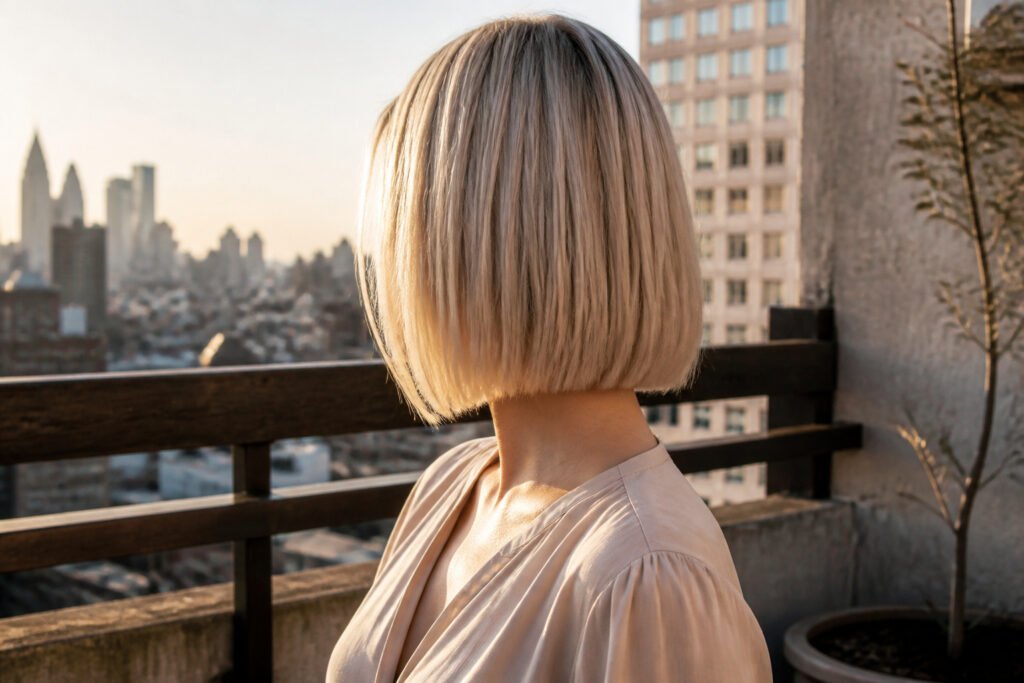
The beautiful medium bob haircuts below range from architectural one-length cuts to hidden undercuts, and the right choice depends almost entirely on how much daily effort you will actually perform. A blunt metallic blonde bob demands a downward-pointed blow-dry to seal the cuticle flat; skip this and the cool tone turns brassy, the graphic quality lost. The shaved back bob, meanwhile, hides its surprise underneath, collarbone-length panels in front clipped close at the nape.
1. One-Length Bob for Straight Hair

A one-length bob cut anywhere between the jaw and shoulder level will settle into its line with almost no daily effort, provided the bottom edge is cut clean and true. Gravity does the work on straight hair that lies flat naturally; the even perimeter keeps the shape from splaying or flipping out at the ends. This is the version that flatters most face shapes, since the horizontal line draws the eye across the cheekbones and the length can be nudged slightly shorter or longer to balance a wider forehead or a softer jaw. A crisp center part adds polish and symmetry, though a soft curtain fringe works equally well if you want the face-framing pieces to open up the eyes. The graphic, straight-across ends read bold rather than severe on hair that has natural shine, so a glossing serum or a cool rinse helps the cut read expensive rather than basic. The line must stay even; hidden texture can be added underneath for movement, but the bottom edge should read as one solid plane from the back.
2. Tapered Auburn Bob

The tapered auburn bob narrows gradually from the cheekbones to the ends, creating a shape that hugs the jawline without the harsh geometry of a blunt cut. That slimming line works particularly well on medium-length hair, where the weight has room to travel downward rather than pooling at the shoulders.
Warm auburn color, a red-brown that sits between copper and chocolate, does more than cover gray or follow a trend. On this cut, the tone shifts slightly from roots to ends because the tapered layers expose different angles of each strand to the light. The result reads as dimension rather than stripey highlights, even on hair that has never seen bleach.
I have watched this color turn muddy on women with olive undertones, so the auburn reads best on neutral or pink complexions, or on anyone willing to commit to color-depositing conditioner between salon visits. The fade goes orange before it goes dull, and there is no recovering that warmth with a purple shampoo. Budget for refresh appointments every six to eight weeks if you want the richness to hold.
3. Shaved Back Bob

A shaved back bob hides its surprise underneath. The longer front panels fall past the collarbone while the nape is clipped close, sometimes buzzed clean, sometimes left with a short undercut that disappears beneath the top layer. The contrast reads as a standard medium bob from the front and something else entirely when you turn around.
Thick hair benefits most. Removing bulk at the nape keeps the shape from widening at the jaw, and the remaining weight sits cleaner against the neck. Straight and wavy textures handle the reveal best; curls tend to spring up and expose the line unpredictably throughout the day.
Maintenance splits into two schedules. The visible layers need the usual trim every eight to ten weeks, but the shaved section grows out fast enough to lose its sharp edge in four. Some stylists taper the undercut so it softens more gracefully, though that also means less dramatic contrast at the start.
The real consideration is whether you actually want the hidden weight reduction or just the look of it. An undercut thins permanently until it grows back; for women with fine hair, that can leave the crown looking wispy where the longer layers separate. Ask for the shaved section to stay narrow, no wider than two fingers at the nape, and you keep the option to wear it up without revealing too much scalp.
4. Blonde Balayage Bob with Soft Layers

The balayage technique works especially well on a medium bob because the shorter length keeps the hand-painted highlights visible without growing out into a stripey mess. Soft layers cut throughout add movement that catches light differently than a blunt edge would, which means the dimensional color reads as natural variation rather than a salon job you notice across the room.
I like this combination for medium to thick hair specifically. The layers remove enough bulk to let the waves or bends sit where they should, while the balayage grows out with that darker root area intact so you’re not back in the chair every six weeks touching up a hard line. The face-framing pieces matter more than you’d expect here; they soften the transition between cheekbone and jawline in a way that reads flattering rather than merely trendy.
Buttery blonde ends melting from a deeper base give the lived-in look that makes this feel wearable past the first week. Tousled styling shows it off best, though the cut adapts to straighter textures too without requiring daily heat work.
5. Glossy Reddish Brown Bob with V-Cut Layers

The glossy reddish brown sits somewhere between auburn and chocolate, a shade that warms up most complexions without tipping into costume territory. What makes this particular medium bob interesting is the V-cut layering at the back. The shortest pieces sit at the crown, then angle down toward a soft point at the nape, creating internal structure that pushes the surface outward. The result reads as full and polished rather than piece-y or shaggy.
That internal shape needs the right finish to show. A smoothing serum worked through damp hair, then blown dry with a round brush, pulls the cuticle flat so light catches evenly across the V. Skip the flat iron and the shape collapses into a triangle. The gloss comes from healthy hair and deliberate styling, not from the color alone.
This cut works best on hair with some natural density. Fine hair can look wispy where the layers taper, and very thick hair fights the sleek silhouette. Ask your stylist to keep the perimeter blunt and one length while the V lives underneath. The contrast is what gives it that expensive, salon-finished look.
6. Choppy Inverted Bronde Bob

The choppy inverted bronde bob builds its shape from a classic inverted cut, shorter at the nape and gradually longer toward the collarbone. That stacked back creates natural lift where fine hair tends to fall flat, while the forward angle keeps the face open. What makes this version workable is the choppy texture: uneven, piece-y layers break up the line so the silhouette reads deliberate, not grown-out.
Bronde sits right between blonde and brunette, a mix that reads expensive because it requires real color placement to avoid looking muddy. The choppy layers help here too; each piece catches light differently, so the brown and blonde tones shift as you move rather than sitting in obvious stripes. Maintenance lands somewhere between a single-process color and full highlights, since the grow-out is softer when the shades are already blended.
The stacked back will need trimming every six to eight weeks to keep its shape. Skip that, and the angle collapses into a generic bob faster than you’d expect. Ask your stylist to keep the choppiness through the ends rather than the crown; texture on top flattens with a day’s wear, but piece-y ends hold their separation.
7. Poker Straight Choppy Bob

The choppy end on a poker-straight medium bob lives or dies by the contrast: hair so flat it could have been ironed, cut into deliberate unevenness that looks like you grabbed the scissors yourself but somehow landed right. What saves it from actual accident territory is the precision underneath. The interior stays blunt enough to keep that glassy fall, while the perimeter breaks into varying lengths, usually two to three inches of difference from the shortest point to the longest.
Styling this demands a flat iron held at exactly the right angle, or the choppy bits flip out and read as grown-out rather than intentional. I learned that watching a stylist work in sections, pulling each one straight down and sealing the ends with a single pass, no curling under. Any roundness kills the sharpness that makes the texture feel modern instead of messy.
This cut reads undone in a way that still photographs well, which is rarer than it sounds. The uneven ends catch light differently, so the shape shifts slightly in motion without requiring actual waves. For anyone whose hair cooperates with straightening but refuses to hold a curl, that is the practical appeal: you get visual interest without fighting your texture daily.
The maintenance is specific. Those choppy ends need refreshing every eight to ten weeks, or the grow-out softens the edges into something that just looks damaged. Not a low-effort style, but the effort is front-loaded into the cut itself rather than the morning routine.
8. Shaggy Bronde Bob with Bright Highlights

The shaggy bronde bob lives somewhere between polished and slept-in, and that is exactly the point. Bronde, that muddy-perfect middle ground between blonde and brunette, gives the medium length a base that reads expensive even when it is not freshly toned. Against that, brighter highlight pieces catch light at the cheekbones and the ends, so the face gets the lift without the maintenance of full blonde.
The shaggy layering is strategic weight removal, not random choppiness. Air moves through the mid-lengths, which keeps the shape from collapsing into a triangle on anyone with natural density. The texture means you can rough-dry it and walk out, or spend ten minutes with a wand for something more deliberate. Either way, the cut forgives you.
What separates this from a standard highlighted bob is the rock-and-roll finish: piece-y, slightly disheveled, never too clean. The bright highlights are placed to flash when the layers move, not to sit in predictable ribbons. If your hair is thick, the internal layers remove bulk without sacrificing the perimeter length. If it is finer, the bronde base adds visual density while the highlights create the illusion of movement you might not actually have.
9. Shaggy Bronde Bob with Razored Layers

Razored layers give a bronde medium bob its feathered, shaggy texture by cutting the ends at a sharp angle rather than snipping straight across. The blade slices through the hair shaft diagonally, removing weight in strips so the layers fall soft and jagged instead of blunt. Warm golden or caramel bronde tones suit olive or neutral skin undertones best, since the color sits close enough to natural depth that the cut itself does the talking.
The difference between this and the bright-highlight version comes down to technique, not the bronde base. Ask for razored layers and ends specifically if you want that lived-in, piece-y movement; the same color with conventional scissor-cut layers reads smoother and more controlled. Strategic weight removal through the mid-lengths keeps the shape airy and voluminous, and the messy, cool finish means you can wear it rumpled or tucked without fighting the silhouette.
10. One Length Bronde Bob with Feathered Layers

A one-length perimeter with feathered layers inside sounds like a contradiction until you see it move. The cut keeps that blunt, uniform line at the bottom, but the interior is sliced to remove bulk and let the bronde color shift with the light. I kept watching for the catch, because "feathered" usually means visible layering, and "one length" usually means heavy. The trick is that the feathering sits high enough, maybe two to three inches above the perimeter, that the silhouette stays clean while the hair bends and breathes.
Bronde works here because the dual tones need movement to show off. On a truly flat cut, that color blend can read muddy; with the internal texture, you catch the blonde where light passes through and the deeper brown where density pools. Ask your stylist to keep the perimeter scissor-cut and untouched while texturizing with a sliding stroke on dry hair, not a razor. Razored ends in a bob this length tend to flip out by week three, and the whole point of the one-length line is control.
This style flatters most on hair that has some natural wave or enough thickness that feathering removes weight without leaving gaps. Fine hair can go wispy fast, so the internal layers need to stay shallow and spaced wider apart.
11. Blunt Metallic Blonde Bob

A blunt perimeter cut to one length reads almost architectural in metallic blonde, the line so clean it catches light like a polished edge. The mirror-like finish comes from pointing the hairdryer downward to seal the cuticle flat; skip this and the cool tone turns brassy, the graphic quality softens into something ordinary. Straight, fine-to-medium hair carries it best, the density sitting evenly without internal layering to break the silhouette. Metallic blonde is not a low-lift color, but the style itself asks little once the tone is set: a quick brush-through in the morning, the cool shade maintained with purple shampoo to keep ash from drifting warm. The precision is the whole statement. One errant layer and it becomes a different cut entirely, the boldness lost to movement that this particular bob refuses to allow.
12. Textured Caramel Cut with Swoopy Bangs

Warm caramel against a textured medium bob does what flat color on a one-length cut never quite manages: it catches light at the ends and in the sliced layers so the whole shape seems to move even when you’re standing still. The swoopy bangs matter here because they remove the sharp geometry that makes some bobs feel like a helmet. Brushed with a round dryer away from the face, they melt into the main length instead of sitting on top of it as a separate piece.
I tried something close to this two winters ago after growing out a blunt cut that had started to feel heavy at my jawline. The texture came from point-cutting into the ends, not razoring; the difference is that the layers stay soft but don’t feather out into wispiness after three washes. The caramel itself sat a half-step lighter than my natural brown, which meant no visible root line at week four and no salon appointment I couldn’t afford. Side bangs that flow into the cheekbone area draw the eye across rather than down, which is the whole point of the shape if you’re trying to avoid that lengthened-oval effect some bobs create by accident.
13. V-Cut and Razored Blonde Bob

The razored texturizing throughout a medium bob is what separates a shape that hangs flat from one that moves on its own. Add a V-shaped perimeter at the nape, and the cut gains architecture: the back tapers to a soft point while the front stays fuller, giving straight hair the suggestion of movement without requiring daily heat styling.
Blonde is the palette that shows this off best. The razored edges catch light differently than scissor-cut ends, creating a flickered, dimensional quality that reads as depth even in a single process color. For maintenance, the usual rules apply: point the dryer downward to seal cuticles and keep frizz controlled, and keep purple shampoo on hand if you lean cool-toned.
Teasing at the crown before a light mist of hairspray gives the body that straight hair often lacks with this cut. The combination reads as effortful in the best way: piece-y, lived-in, and deliberately undone rather than simply unstyled.
14. Razored Bronde Bob with Ashy Balayage

Razored ends change how a bronde base reads against the skin. Where a blunt cut would sit heavy and graphic, the razor opens the perimeter so light passes through in pieces. That diffusion matters more than people think: the same ashy balayage on a blunt edge reads stripey and deliberate, but razored it softens into something that looks like it grew in sun-faded.
The bronde itself has to sit in a narrow band, dark enough that the ash doesn’t read as gray, light enough that the cool tone doesn’t turn muddy. I’ve watched stylists push it too dark and the balayage disappears; too light and the ash goes platinum and brittle-looking. The sweet spot is usually where the base still catches warm in direct light but cools down in shadow.
Ask for the balayage to start mid-shaft, not at the root, with the lightest pieces concentrated where your natural part would catch sun. The razored ends should be point-cut, not sliced, so the texture feathers rather than frays. On medium bobs this matters because the length has just enough weight to collapse if the ends are too thinned.
15. Angled Dimensional Bronde Bob with Layers

An angled dimensional bronde bob with layers sits right where the cut and the color do equal work. The forward angle brings the front pieces down longer, usually grazing the collarbone, while the back stacks shorter for that lifted silhouette. Bronde, that deliberate middle ground between blonde and brunette, keeps the tone from reading as either too warm or too flat. When the color is dimensional, meaning highlights and lowlights sit one to two shades apart, the layers catch light at different depths and the whole style moves even when you are standing still.
The layering itself is the part that sells this on finer hair. Face-framing pieces blend back into subtle interior layers, which adds volume without the bulk that a heavy blunt line can leave behind. Razored or feathered ends keep the texture soft, so the bronde reads as sun-kissed rather than striped. Maintenance sits on the lighter side for a colored cut. The darker root area, whether natural or added as lowlights, stretches the time between salon visits, and the angle grows out gracefully because the front length has room to shift. For styling, a round brush on the crown lifts the stacked back, and a quick pass with a flat iron on the longer front pieces keeps the angle sharp. Skip the iron entirely and the layers fall into a relaxed wave that still holds the shape.
16. Textured Wavy Mid-Length Cut

A textured wavy mid-length cut puts the wave pattern itself in charge, not the color underneath. The length sits right at the shoulder, grazing it rather than falling past, which keeps the waves from pulling flat under their own weight. Soft waves built into this length add body that a straighter finish simply does not get, especially for medium to thick hair that can otherwise look heavy or boxy when cut blunt.
Piecey ends keep the whole thing from looking too finished, too salon-perfect. That slightly undone quality is what makes it wearable past the first morning. A texturizing spray helps the wave hold its shape without stiffness, though the cut itself does most of the work. Deep brunette or warm blonde both read the same way here; the texture carries the style, not the shade.
Thick hair benefits most, since the layering and wave break up density that would otherwise sit like a solid block. But the relaxed pattern works across types as long as the length stays true mid-bob, not drifting toward collarbone or creeping up to chin. The sweet spot is that shoulder-grazing zone where waves have room to move without stretching out.
17. Voluminous Layers and Dark Roots

A bob that hits right at the shoulders gives you room to work with both color and shape, and the combination of dark roots with voluminous layering turns grow-out from a problem into the whole point. The darker root shadow, sometimes called a root smudge or shadow root, extends the time between highlight appointments because the line of demarcation simply does not exist; the color is designed to fade into itself. Pair that with layers cut for volume rather than removal, and the style keeps its structure for months.
Hailey Bieber has worn this particular math out in public: visible roots on a mid-length bob read as deliberate, not neglected. The trick is asking your stylist for balayage with a root shadow rather than traditional foils, so the darkness starts intentionally at the scalp and dissolves into the lighter ends. For styling, a lightweight cream like Hershesons Almost Everything Cream adds separation to the layers without flattening them, and a round-brush blowout at the crown builds the volume that makes the cut feel expensive rather than grown-out. The maintenance is hydration and occasional glossing treatments rather than monthly color appointments; the cut itself grows out gracefully, which is the entire argument for the medium length.
18. Medium Sweet Blunt Bronde Bob

A medium sweet blunt bronde bob softens the severity that keeps some women away from classic blunt cuts. The length sits between the jaw and shoulder, which stylists call the mid-bob or "mob," and the bronde color, that balanced midpoint between brown and blonde, keeps the line from reading too harsh against most skin tones.
The blunt perimeter stays, but the execution is gentler: slightly rounded at the ends rather than razor-sharp, with the color doing part of the work to break up the solid mass. This is the cut Elliot Bute at Hershesons Fitzrovia sees clients requesting for 2026, a "fashionable but works in real life" midpoint that reads as quiet luxury rather than salon statement.
Styling stays minimal. A straight blunt cut like this carries polish on its own; soft bends from a quick pass with a flat iron, not full waves, keep the approachable feeling intact. Dry spray wax, something like Evo She-Bang-A-Bang, adds texture without the grit of heavy product. The maintenance is the tradeoff. Bronde needs refresh every eight to ten weeks to keep the tone from drifting muddy, and the blunt edge requires trimming to hold its shape. Skip both, and the cut collapses into grown-out indifference faster than a layered style would.
19. Burgundy and Copper Balayage Bob for Brunettes

A burgundy and copper balayage bob gives brunettes the warmth they usually chase through blonde without the maintenance trap of lifting that far. The deep burgundy base keeps your natural depth intact; copper pieces painted mid-shaft to ends catch light the way caramel does on lighter hair, just shifted two tones richer.
The placement matters on a medium bob. Ask for the balayage to sit where your hair would naturally sun-lighten, which on a collarbone-grazing cut means framing the face and concentrating toward the ends. That keeps the grow-out soft; you are not rebuilding the whole color every eight weeks. I have watched this particular combination read almost chocolate indoors and turn fiery under restaurant lighting, which is either a bonus or a commitment depending on your tolerance for comments.
Skin tone steers whether this flatters or fights. Olive and neutral undertones carry copper beautifully; if you run pink or very cool, the red family can pull ruddy against your cheeks. A gloss between appointments, something with a violet lean, keeps burgundy from drifting toward orange as it fades. The medium bob length is what makes the color wearable day-to-day, long enough to pull back if the copper feels loud, short enough that the ends stay healthy through repeated balayage sessions.
20. Brown Bob with Subtle Caramel Highlights

A medium brown bob with caramel highlights placed sparingly reads as expensive because it refuses to shout. The base stays dark chocolate, and the lighter pieces are woven so subtly that the dimension only catches under direct light or when the hair moves. This is the opposite of balayage drama; the goal is someone asking if you spent August outside rather than if you just came from the salon.
Placement matters more than brightness here. Face-framing caramel pieces break up the linear edge of a blunt cut without requiring layers, which keeps the shape clean for straight hair or lets the texture speak for itself on wavy days. The sources note this color approach works across textures, and that flexibility is worth planning around: if you occasionally heat-style waves straight, the highlights should sit where both versions catch light, not where only one does.
Maintenance is where this choice pays off. Sparse, fine-weave highlights grow out softly, so the six-to-eight-week touch-up schedule stretches closer to twelve. The tradeoff is that heavy-handed application ruins the effect entirely; ask for ribbons, not panels, and err on the side of less. You can always add more at the next appointment, but stripping overdone caramel back to subtle is a color correction you do not want to fund.
21. Asymmetrical Straight Ash Blonde Bob

Straight hair does the heavy lifting in an asymmetrical cut, letting the line read as intentional rather than grown-out. The ash blonde tone keeps that architecture cool and current, stripping away warmth so the angle itself stays the focus. I saw this most clearly when a stylist friend pinned back one side of my hair three inches shorter than the other; the blunt edge caught light like a shelf, and the longer sweep did the framing without any layering required.
The maintenance is where this cut makes its real demand. Pin-straight precision means trims every five to six weeks and a straightening iron you actually use, always with heat protectant. Skip either and the asymmetry softens into something that just looks uneven. An off-center part is non-negotiable here, it is what activates the imbalance and keeps the face-framing side doing its job. Round faces get the most obvious win, the diagonal line pulls the eye downward and narrows, while square jaws read softer against that single long sweep.
22. Piece-y Bob with Face-Framing Highlights

The piece-y texture in a beautiful medium bob haircut comes from deliberate cutting and the right finishing product, not from hoping your natural wave cooperates. Ask for internal layering or a point-cutting technique that breaks up the ends so they separate rather than clump. A texturizing spray gives the grip that keeps those pieces defined through the day without turning stiff.
Face-framing highlights do the real work of brightening the complexion. Concentrate lighter pieces from the cheekbone downward toward the chin, which draws the eye upward and adds dimension where the face needs it most. Warm blonde balayage on the front pieces tends to flatter most medium skin tones, though the exact level should match your base rather than fight it.
A shoulder-grazing length floats slightly above the collarbone on shorter frames and sits right at it for taller women, which helps balance proportions. The slightly undone finish reads as relaxed rather than messy because the color placement looks intentional. Style with a light hand; too much product kills the separation that makes the cut feel current.
23. Cute Golden Blonde A-Line Bob

The clean geometry of an A-line cut does the heavy lifting here, angling from a shorter back to longer pieces that graze the collarbone at the front. Golden blonde warms the whole shape into something that reads approachable rather than severe, a tone that flatters most skin types without demanding the maintenance of an ashy or platinum shade.
What convinced me, looking through dozens of these cuts, is how the color and structure balance each other. The sharp, intentional line keeps the blonde from feeling too casual or young, while the golden tone keeps the geometry from reading cold. The angle is what matters most; too subtle and it disappears into a standard bob, too dramatic and you are managing an asymmetrical grow-out for months.
For medium to thick hair, this combination works almost on its own: the weight of the longer front pieces smooths naturally, and the blonde catches light enough that you skip heavy layering. Fine hair needs more care; the shorter back can go limp without hidden texture at the crown, so ask your stylist to build in light interior layering that does not break the outer line. Skip balayage on this one. The solid golden tone keeps the cut’s silhouette legible; highlights fragment the shape that makes it worth doing.
24. Cropped Shoulder Length Cut

A cropped shoulder length cut sits right where the jaw meets the shoulder, almost tipping into short hair territory but stopping just short. The first time I saw this on someone in real light, not salon lighting, the length looked like a miscalculation that somehow worked better than the safer mid-shoulder versions around it.
The cut keeps enough length to pull back or tuck behind an ear, which saves it from the commitment of a true short style. What separates it from longer bobs is the perimeter: it reads blunt from the front but usually carries hidden texture underneath to stop the line from going helmet-stiff. That shattered edge, the kind stylists call textured long layers through the perimeter, gives it movement without visible layering on top.
For straight hair, this length shows every uneven snip, so the cut needs to be precise where it lands against the neck. Wavy textures get more forgiveness; the slight wave breaks up the line and the shorter length actually helps the wave pattern hold from root to tip instead of pulling straight under its own weight. The tradeoff is morning volume at the crown, which a quick pass with a round brush settles in about ninety seconds.
Color shows differently here too. Anything balayage or highlighted sits closer to the face, so the dimension reads stronger than on a longer bob where the ends drift toward the collarbone and away from direct sight.
25. Bronde Bob with Short Shaggy Layers

The short shaggy layers in a bronde bob do the heavy lifting that longer layers only pretend to. Chopped deliberately throughout the mid-length shape, they break up density and let the color shift between blonde and brunette read as movement rather than a flat wash. I watched this cut go wrong once when a stylist kept the layers too long; the bronde sat there like a single muddy tone instead of flickering between the two shades as the head turned.
Stacking the back slightly helps, though the real payoff comes from how those choppy pieces catch light at different angles. For thick hair, this is where you lose the bulk that makes a medium bob feel helmet-like. The layers remove weight without sacrificing the collarbone length that keeps it wearable.
Styling demands almost nothing. A bit of mineral clay wax, worked through dry ends, separates the pieces so the texture reads intentional rather than slept-on. Straight hair benefits most from that product assist; wavy types can often air-dry and go. If you’re adding highlights, keep them one to two shades lighter than the base and let darker roots or lowlights do the work of defining where those shaggy layers begin and end.
26. Disheveled Bob Style

A disheveled bob lives or dies by what happens after the scissors stop. The cut itself can be straightforward, even blunt, because the styling does the heavy lifting. Ample teasing at the crown builds the lift, then mousse scrunched through damp strands sets the piece-y separation. What reads as effortlessly tousled is actually a deliberate sequence, and skipping either step leaves you with flat hair that just looks slept on.
Frizz and flyaways that would ruin a sleek style become assets here. They amplify the texture rather than fighting it, which means this is one bob that actually improves as the day wears on and the elements do their work. A texturizing spray refreshes it between washes without rebuilding the whole structure from scratch. The payoff is a style that appears lived-in by design, not by neglect, and that distinction matters. A medium bob with this finish reads casual enough for errands but holds enough intention to carry through to evening without a full redo.
27. Medium Length Straight Layered Bob

Straight hair on a medium bob can fall flat, but internal layers change the equation without breaking the smooth surface. The layers sit underneath, invisible from the exterior, and create movement that shows up when you turn your head or the light catches the ends. The cut keeps its polished silhouette while the inside carries body and bounce.
I used to think straight meant one-length or nothing. A stylist explained that face-framing layers around the front, paired with deeper internal layering toward the back, add volume where straight hair typically collapses. The back view matters here: that internal structure creates a fuller shape from behind without visible steps or choppy texture breaking the line.
Fine to medium hair that holds a blowout responds best. The glossy finish shows off the dimension, and the movement comes from the architecture of the cut rather than styling products or hot tools. Rich brunette shades work particularly well, since the uniform surface reflects light evenly and the hidden layers create subtle shadow where they shift.
For maintenance, the layers grow out gracefully because they are not the defining edge of the style. The perimeter stays blunt and intentional even as the interior softens over a few months.
28. Collarbone A-Line Bob for Thick Hair

A collarbone-length A-line cut does the heavy lifting when thick hair wants to look polished instead of triangular. The forward angle starts shorter at the back and drops toward the face, which removes bulk where it tends to pyramid out while keeping enough weight in front to frame the jaw. Sitting right at the collarbone softens a sharp jawline better than shorter cuts, and the length gives you room to work with the density rather than fighting it.
The mistake most people make is going too short with thick hair and ending up with that boxy, heavy silhouette. This cut avoids that by using the length itself as a management tool: the hair’s own weight pulls it down, and the A-line geometry creates natural movement without requiring heavy layering that can frizz or expand. For styling, a scrunched-in texture dresses it down for weekends, while a smooth blowout with the ends turned under reads professional without extra effort. The versatility is built into the shape, not added on top of it.
29. Messy Bronde Bob with Jagged Ends

Jagged ends cut by hand, not sheared blunt, give this bronde bob its deliberately unfinished edge. The point-cutting technique removes weight in small, vertical snips so the perimeter breaks into soft, irregular pieces rather than a clean line. Bronde sits at that exact midpoint between blonde and brunette, and the tonal variation helps the texture read as intentional rather than grown-out. Messy layers through the crown add lift, while the stacked back builds subtle volume where the head curves. What convinced me, reading through a dozen of these cuts, is that the color has to shift across the length for the jagged ends to look styled rather than neglected: balayage one to two shades lighter than the base, with darker roots or lowlights anchoring the whole thing. Highly porous hair will need more protein to hold that dimensional color without going brassy; less porous hair wants hydration to keep the piece-y movement from turning stiff. The result reads as sass and class rolled into one, but only if the stylist commits to the irregularity. Half-measures, and the cut lands in awkward middle ground between polished and purposefully undone.
30. Gray Bob with Layers

Cool silver tones on a layered medium bob stopped being something to apologize for somewhere around 2019, and by now the look reads as intentional rather than resigned. The key is the layering itself: without it, gray can sit flat and expose every shift in texture that comes with the color. Feathered layers break up the line, add movement, and catch light at different angles so the silver reads dimensional instead of dull.
A side part helps here, lifting the crown and giving the face some framing to work with. Gentle waves soften the cut further, which matters because gray hair tends to be coarser and more wiry than its pigmented counterpart. The contrast between that natural texture and the deliberate shape is what makes the style look chosen rather than surrendered to.
Highlights can still play a role if the transition is uneven or the tone reads too yellow, but the goal has flipped. Where stylists once used highlights to hide gray, they now use them to brighten it, creating a glow that reads as silver rather than as aging. The layered mid-length base supports either approach, giving enough length to feel like hair while keeping the maintenance manageable.
31. Straight Ash Blonde Balayage Bob with Layers

Cool ash blonde reads as expensive because it is expensive to get right. The tone sits between platinum and beige, and balayage keeps the grow-out soft enough that you can stretch salon visits to twelve weeks without a harsh root line. Straight styling is what makes the color work this hard: any wave would scatter the light and hide the shift from darker base to lighter ends. A flat iron or a round-brush blowout on fine-to-medium hair gives you that glass-like surface, though you will need heat protectant and frequent trims to keep the ends from splitting and breaking the clean line.
Layers change the geometry. On a blunt bob, straight hair can hang like a curtain and show every gap where the density thins. Soft interior layers add body without disturbing the perimeter, so the silhouette still reads as crisp from the front. The money-piece highlight near the face, brighter than the rest, does the contouring for you. Skip it if your natural base is darker than a level six; the contrast turns brassy faster than cooler blends and the maintenance jumps from manageable to constant.
32. Frizzy Shaggy Bob with Babylights

Fine babylights, placed just a few strands apart, melt into shaggy layering so the color reads as depth rather than stripe. The cut itself is built to move: weight removal through the interior keeps the shape airy, and the perimeter stays intentionally broken so frizz registers as texture, not failure. What convinced me, reading through dozens of these, is how the style flips the script on humidity. Instead of fighting flyaways with serum and tension, you tease at the root and work in mousse to amplify the dishevel. The result sits at neck length, easy to pin half-back or leave loose. Babylights here are strategic, not decorative. They catch light on the surface layers where the cut already lifts away from the face, so the brightness looks incidental, like childhood sun streaks grown up. For women sizing down from longer hair, this is the forgiving middle. The shag accepts morning chaos, and the babylights mean even flat light flatters.
33. Elegant Blonde Bob for Fair Skin Tone

Cool blonde against fair skin can read ashy or washed out if the tone sits even half a step wrong. Warm blonde carries the same risk in reverse, tipping quickly into orange territory when the lift is aggressive. The medium bob length matters here because it gives the colorist enough real estate to build a gradual shift rather than a blunt stripe at the root.
A deep side part with warm blonde balayage that lightens toward the ends solves both problems at once. The warmth keeps the complexion alive, and the hand-painted placement means no harsh line grows out at the part. The clean, angled line of the cut itself reads as deliberate rather than grown-out, which is half the battle with blonde on fair skin.
Straight, blunt construction keeps the style polished for medium to thick hair. Hidden texture underneath preserves movement without breaking the surface line. Ask for the same shade if your skin runs fair with neutral or warm undertones; cool undertones need the warmth dialed back by a quarter to avoid sallow.
34. Disconnected Bob with Messy Waves

Disconnected layering means the sections of your cut sit at visibly different lengths without the usual soft graduation between them. The contrast is the whole point: a blunt perimeter at the bottom, then a chunkier layer floating somewhere above it, nothing feathered to merge the two together. On a medium bob, that structure keeps the shape from collapsing into a single heavy line, and the gaps between layers are what let you build real volume without teasing the life out of your hair.
The messy wave part is where you exploit that architecture. A large-barrel curling wand on medium heat will give you the bend; wrap small sections, hold for a few seconds, then brush the curls out while they are still warm. What you want is a wave that catches on those disconnected pieces so the whole cut looks slightly off-duty, not like you failed at a polished style. The brush-out is non-negotiable; defined ringlets fight the whole intention.
Frizz and flyaways actually help here. In a disconnected bob, stray texture amplifies the separation between layers instead of reading as a mistake. A little mousse at the roots before you start, maybe some teasing if your hair is fine, and the disheveled effect stays intentional rather than sloppy. The chunky strands move independently, which is the detail that makes this feel modern rather than just grown-out.
35. Sleek Blunt Brunette Bob

Darkness and precision together do the heavy lifting here. A blunt cut at medium length carries more visual weight when the color sits at a level 3 or 4, deep enough that light sinks into it rather than bouncing back. The gloss comes from alignment: every strand falling at the exact same perimeter, no tapering to soften the line. Without that sharp edge, brunette reads as safe. With it, the color turns intentional, almost architectural.
The maintenance is specific. A blunt bob grows out visibly, so the cut needs refreshing every six to eight weeks if you want to keep that graphic quality. Flat-ironing is not optional for the full effect; natural wave breaks the uniform surface that makes the darkness feel expensive rather than flat. I have seen this go wrong when someone requests the cut but keeps their warm-toned, highlighted ends. The contrast competes with the line instead of supporting it. Single-process color, cool or neutral base, no dimension: that is the combination that makes this particular bob feel like a decision rather than a default.
36. Straight Choppy Blonde Bob

The straight choppy blonde bob works because the two textures fight each other just enough. A flat-ironed base keeps the shape clean around the jawline, while the choppy ends break up the silhouette so it doesn’t read like a helmet. Blonde is what makes the cut visible: light catches the uneven ends at different angles, and the variation in tone between the top layers and the underneath creates depth that a single-process color would flatten out.
Ask your stylist to keep the chop concentrated in the last inch and a half rather than running it up through the mid-lengths. Higher chopping turns straight hair wispy, and this style needs the weight to stay modern rather than beachy. The blonde matters too: a warm honey base with slightly lighter ends reads expensive, whereas an all-over platinum can make the choppiness look accidental, like grown-out damage rather than intention.
Styling is minimal, which is part of why the cut persists. A pass with the flat iron, then a tiny bit of pomade or dry oil rubbed between fingertips and pulled through the ends. The product separates the chopped pieces without adding shine that would make the hair look helmeted again. Skip hairspray unless humidity demands it; the point is movement, and frozen ends defeat the purpose.
37. Dimensional Blonde Balayage Lob

A lob sitting between the shoulders and decolletage gives you the longest possible version of a medium bob while still reading as a true cut rather than grown-out hair. Dimensional blonde balayage keeps that length from falling flat; the color melts from darker roots into buttery blonde ends, so the eye reads depth even when the styling is minimal.
The face-framing pieces matter here more than with shorter bobs because there’s more hair to pull downward. Soft layering at the perimeter prevents the lob from looking like a single heavy curtain, and the gentle waves that balayage was practically invented for add movement without requiring daily heat work.
What sold me on this particular combination, reading through dozens of salon accounts, is how the color variation does the styling for you. The graduated tones catch light differently across each layer, which means second-day hair still looks intentional rather than slept-on.
A mid-length bob is great because it’s all about ease and wearability. Hair looks healthy and requires less maintenance than a shorter bob. It grows out gracefully, so you don’t need to be in the salon every four weeks.
That growing-out grace matters more with balayage than with single-process color, since the point is the lived-in root. Ask for the lightening to concentrate from mid-shaft to ends rather than starting higher; otherwise you are back in the salon chasing a line of demarcation you chose this technique to avoid.
38. Classy Rounded Bob

The curved-under perimeter is what separates a rounded bob from every other medium length cut. Each end tucks under cleanly, creating a silhouette that reads as polished from every angle rather than piecey or feathered. That uniform curve builds volume at the nape and jawline, which is why the style works especially well on fine to medium hair that needs the illusion of density.
A round brush and blow dryer are non-negotiable here. The ends have to bend under deliberately; air-drying leaves them flipping outward or falling flat, and either breaks the shape. The sources note this style pairs with warm caramel-brown tones particularly well, since the rounded form catches light evenly and shows off dimensional color without requiring heavy layering. Darker one-length versions read more severe, more office-appropriate, while lighter layered interpretations around the face soften the overall effect.
What convinced me, looking through dozens of these cuts, is how the rounded bob functions as a baseline. Tousle it with a middle part and it loosens into something casual. Keep it sleek and side-swept and it turns formal. The perimeter stays the same either way. That versatility matters for women building a wardrobe around pieces that work multiple contexts, not single-event statements.
39. Ash Blonde Razored Bob with Bangs

A razored bob in ash blonde lives or dies by the bangs. Side-swept, they pull the eye diagonally across the cheekbone and soften the jaw; worn straight across, the same cut turns graphic and boxy, which can read severe on a longer face. The razor itself matters less than where the stylist stops it: ends that taper above the shoulder keep the silhouette light, while a blunt finish fights the wispy texture the razor creates.
The color is what dates this cut or saves it. Gray and platinum tones, rather than warm beige, keep the look contemporary; the ash reads as intentional, not grown-out. Thin hair gains particular mileage here. The combination of subtle lowlights and the tapered shape builds density that a one-length bob would flatten.
What convinced me, reading through the stylists’ examples, was the face-shape claim. A cut described as universally flattering usually signals marketing, but the geometry holds up: the diagonal line of side-swept bangs shortens a long forehead, and the razored ends add width at the chin for narrow faces. The bangs are the proportion tool; the rest is maintenance.
40. Gorgeous Bob with Enhanced Crown

The crown is where a medium bob lives or dies. Without deliberate lift at the top, the cut can flatten against the head and read as a helmet rather than a shape. Teasing the crown sections and brushing the top layer over creates that hidden scaffolding, with the upper layers draping seamlessly so the volume looks grown-in, not sprayed-in.
A side part multiplies the effect by shifting the weight line and opening up the face. Soft waves through the mid-lengths keep the eye moving so the height never looks like a pouf stuck on top. The sources show this working best when the length sits between chin and shoulder, light enough to hold the shape without dragging it down.
Layered ends at the crown add bounce even before styling, which matters on day two or three when the teasing has settled. Ask for feathered rather than blunt layering through the top, and keep the perimeter cleaner so the contrast does the work.
Frequently Asked Questions
What is a medium bob?
A medium bob is a haircut that falls anywhere between the jaw and shoulder level, sometimes called a mid-bob or mob. The classic version is trimmed evenly around the head and works across textures because the length has enough weight to sit cleanly without the upkeep of longer hair or the commitment of a short cut.
How do I style a medium bob?
The styling depends on the cut you choose. Sleek one-length bobs need only a brush-through and a glossing serum; textured or layered versions take texturizing spray and rough-drying. Angled bobs with stacked backs need a round brush at the crown for lift, while poker-straight choppy cuts require a flat iron pulled straight down with no rounding under. Most of the styles in this list are designed to minimize daily effort once the cut itself is right.
What face shapes suit a medium bob?
Most face shapes can wear a medium bob with small adjustments. The horizontal line of a one-length bob draws the eye across the cheekbones and flatters most faces; nudge the length slightly shorter to balance a wider forehead or longer to soften a softer jaw. Forward-angled bobs keep the face open, and face-framing pieces soften the transition between cheekbone and jawline on nearly every shape.
How often should I get my medium bob trimmed?
Plan for every six to ten weeks depending on the specific cut. Blunt or stacked shapes collapse faster and need attention every six to eight weeks; choppy or layered versions stretch to eight or ten. Shaved or undercut sections are the exception, growing out fast enough to lose their edge in four weeks. Hidden texture added underneath can extend the visible shape longer than the perimeter alone would allow.
What are the latest trends for medium bobs?
The trends showing up in salon work right now include bronde and balayage color that grows out intentionally, textured and razored layering for movement without bulk, and hidden architecture like shaved backs or V-cut interiors that change the silhouette without visible layers. Bangs are back in specific forms: curtain fringes, swoopy side pieces, and soft face-framing rather than heavy blunt fringes. The overall direction is lived-in color and deliberate texture over polished uniformity.