
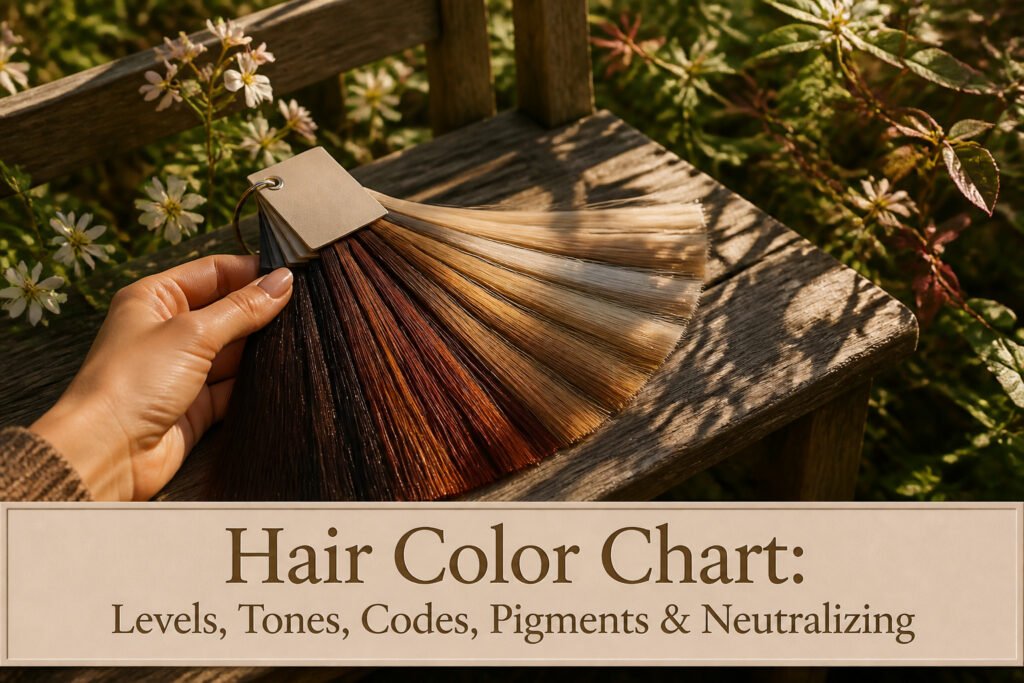
A hair color chart is a numbered scale, running 1 to 10, that tells you how dark or light a shade will sit on hair. The catch is that a 6 in one brand is not a 6 in another, and the tone code after the decimal point, whether .3 for gold or .1 for ash, decides whether your color turns brassy or ashy once it meets the pigment already living in your strands.
Hair Color Levels

The hair color level system runs from 1 (black) to 10 (lightest blonde), with each number describing how dark or light the color sits on hair. Level 2 through 4 covers black into darkest brown, levels 5 through 7 move through the brown family from dark to light, and levels 8 through 10 carry the blonde range from dark up to extra light. Some professional lines extend to 12 for ultra-blonde, but 10 is the standard ceiling.
Knowing your starting level matters because it sets the math for what comes next. The gap between your natural level and your target level tells you how many levels you need to lift or darken. Permanent color can lift hair up to two levels; anything past that requires bleach or a different approach. Your mid-lengths and ends may already sit at a different level than what’s growing from your scalp, especially if they have been colored before, and that treated level takes color differently than virgin hair.
| Level | Depth | Typical Range |
|---|---|---|
| 1 | Black | Darkest |
| 2–4 | Darkest brown to dark brown | Black through dark brown |
| 5–7 | Medium to light brown | Dark brown through light brown |
| 8–10 | Blonde range | Dark blonde through lightest blonde |
Brands vary in how they level their shades, so a 6 in one line is not automatically a 6 in another. Checking the brand’s own chart before buying saves the mismatch.
Hair Color Tones

Tone shifts a level without touching its depth. A level 6 brown stays level 6 whether you ask for gold, ash, or something in between, but the personality changes completely. Warm tones like gold, copper, red, and mahogany add color and richness, pulling light toward the face and flattering complexions that run warm. Cool tones, ash and violet, do the opposite: they reduce redness and keep brass in check, which is why going lighter often calls for a cool tone to counter the warm pigment already living in the hair. Neutral sits between them, brownish-to-beige, the safe pick when you are not sure where you land. I have watched friends agonize over this choice, and the ones who hesitate usually end up happiest with neutral first. You can always experiment with gold or copper once you have seen how your hair takes color, but trying to strip warmth back out after the fact is a longer road than starting there.
Color Codes

A tube marked 6.3 reads as dark blonde with golden tone, and that decimal system is what separates a confident buy from a guess at the shelf. The digit before the point is depth: 1 runs to black, 10 to extra light blonde, and 6 lands squarely in dark blonde territory. What follows the decimal is the tone, the visible hue that shifts the same depth warm or cool. A .1 steers ash, .3 steers golden, .4 steers copper, and so on through the line.
Some brands stack a second or even third decimal. A 6.41 keeps that dark blonde base but layers copper first, ash second, with the rightmost digit carrying the least weight in the final color. Drugstore boxes and salon tubes follow the same logic even when the punctuation swaps: 7/1 and 7.1 both mean medium ash blonde, the slash and the point doing identical work. The underlying pigment still matters, since lifting through levels 5–6 exposes orange that the chosen tone must either use or counter. Match the mid-lengths, not the roots or ends, to a chart under natural light when you are reading your own level.
Underlying Pigments

Lightening hair does not remove color so much as reveal what was hiding underneath. Level 4 hair, a medium brown, carries red pigment beneath the surface. Lift it three levels to a 7 and that red oxidizes into orange before it ever reaches pale yellow. The 10-level system tracks this progression precisely: dark red at the lowest levels, shifting through orange, landing finally on pale yellow at level 10. Eumelanin, the black and brown pigment, breaks down faster than pheomelanin, the red and blonde pigment. That imbalance is what throws the warmth. Knowing the stage your hair sits at before you lift lets you choose the right tone to counter what is coming, not just what you see in the mirror now. Skip this step and the color you planned for becomes a correction job instead.
Neutralizing Colors

Violet sits opposite yellow on the color wheel, which is why a level 8 light blonde with raw yellow pigment gets toned with violet, not with something "cool" in a vague sense. Ash, the green-tinged cool family, faces orange on that same wheel. A level 7 medium blonde lifting to orange-yellow needs ash to kill the copper, not violet, which would leave the orange standing. Stylists reach for .2 or violet dye to counter yellow, and .8 or blue-based ash for orange, because the wheel tells them exactly which complementary pair will cancel the exposed warmth. The logic is mechanical: find the unwanted tone, trace a line through the center, and apply what sits on the other side. Violet for yellow, ash for orange is the pairing that keeps a blonde from turning brassy, and knowing why saves you from grabbing the wrong toner box at the drugstore.
Color Theory for Hair

Colors on hair do not behave the way they look in the tube. The same ash blonde can turn green on one head and flat gray on another because what matters is the pigment already sitting in the shaft, not the label on the box. That is where the hair color wheel earns its keep.
Warm tones sit opposite cool tones on the wheel, and those opposites cancel each other out. Violet or burgundy neutralizes gold, which is why purple shampoo exists for blondes who pull brassy. Ash tones counter copper, and green knocks down auburn. The wheel turns guesswork into a decision: you look at the unwanted tone, find its opposite, and choose your formula from there.
The final result is never just the color you applied. It is the mix of that color plus whatever pigment the hair already holds, natural or otherwise. A color chart reads differently once you see it this way. The numbers and swatches are not promises; they are starting points that shift based on what is underneath. Knowing the wheel means you can predict that shift instead of hoping the box knows your head better than you do.
Choosing Shade by Skin Tone and Eye Color

The jewelry test still works. Silver flatters cool undertones; gold flatters warm. If both look equally good, the undertone is probably neutral, and the hair color chart opens wider in both directions.
Skin tone matching is a guide, not a rule. Cool shades tend to read better on cool undertones, warm shades on warm. Plenty of people wear the opposite beautifully, and high contrast can be striking. What matters is that the shade works with the starting point, not against it.
Eye color nudges the choice in smaller ways. Warmer tones often suit blue eyes; cooler tones complement green. The effect is subtle, but it is the detail that keeps a color from looking "fine" and makes it look right.
Two quick checks help when undertones are unclear. Hold pure white and cream next to the face in natural light. Pure white brightening the skin means cool; cream looking better means warm. The veins on the tops of the hands are a backup: green suggests warm, blue suggests cool. These tests matter because the wrong undertone in a dye can push skin toward sallow or ruddy, and fixing that costs another salon visit.
Virtual Try-On Tools

A good virtual try-on tool keeps you from walking out of the salon with a color that drains your face or clashes with your bathroom mirror light. Garnier and Madison Reed both offer versions that let you upload a selfie or hold your phone camera up live, then layer their shades over your actual hairline and skin tone. The difference between holding a cool blonde and a warm blonde up against your own face, rather than guessing from a swatch card, is the whole point.
"What hair color looks best on me?" Garnier’s Virtual Try-On Tool can help! Trying a new hair shade is easier than ever. Upload a selfie or virtually try on the Nutrisse shades you’re interested in.
The catch is lighting. Bathroom bulbs, phone screens, and noon window light all read differently, and the tool’s rendering sits somewhere between them. Madison Reed pairs its try-on with a quiz that narrows the chart first, which helps, but the confirmation you get is still a simulation. Use it to rule out disasters, not to lock in a shade. The real test is how the color catches the light when you step outside.
Gray Coverage

Gray hair has no pigment left to anchor color, so it drinks up dye faster than the pigmented strands around it. That is why a natural (N) tone belongs in any formula meant for coverage. Without that neutral base, brighter shades or reds can grab too hard and read artificial against the scalp.
Resistant gray, the kind that fades within a week or simply refuses to take color, needs more than just an N in the mix. Look for codes that double up on it, something like the 8.5NNA or 6.5NNA structures that put extra N pigment first in the sequence. The second N is not decoration; it is there because stubborn cuticles need that repeated knock. An ash tone riding along, the A at the end, keeps the result from swinging warm once the orange underneath starts talking back, especially around level 6 brown or lighter.
If you are buying at a store, the box will not always spell this out in plain English. Scan the shade code for that doubled N, and check whether the description mentions resistant or high-percentage gray specifically. If you are in a salon, ask for extra N pigment and mention whether your gray has a history of throwing warmth or washing out fast. They can adjust the developer or processing time, but the tone in the tube is what decides whether the color stays honest.
Frequently Asked Questions
What do the numbers on hair color boxes mean?
The first number is the level, running 1 for black to 10 for lightest blonde, telling you how dark or light the color is. Anything after a decimal or slash is the tone, such as .1 for ash or .3 for gold. A box marked 6.3 means dark blonde with golden tone, and 7/1 means medium ash blonde.
What is the difference between depth and tone?
Depth is how light or dark a shade sits on the hair, measured by the level number. Tone is the character of that shade, warm like gold or cool like ash, without changing the depth itself. A level 6 brown stays level 6 whether you choose gold, ash, or neutral tone.
How do I figure out what tone I want?
Hold silver and gold jewelry against your skin to see which flatters you; silver points to cool tones, gold to warm. If both work, start with neutral, the safe middle ground that reads brownish-to-beige. You can shift warmer later, but cooling down an overly warm result takes more work than starting there.
How do you choose the right shade for natural hair colors?
Identify your natural level by comparing the mid-lengths of your hair to a chart under natural light, not roots or ends. Then use the jewelry test to find whether your undertone runs warm, cool, or neutral. Match the shade to both your starting level and your undertone rather than choosing by eye color or trend alone.
What if hair has a previous color still on it?
Permanent color cannot lift through another layer of permanent color, so darker built-up shades may need removal first. Your mid-lengths and ends likely sit at a different level than virgin regrowth, and that treated hair accepts new color differently. A stylist can assess whether color remover or a different approach is needed before the next application.