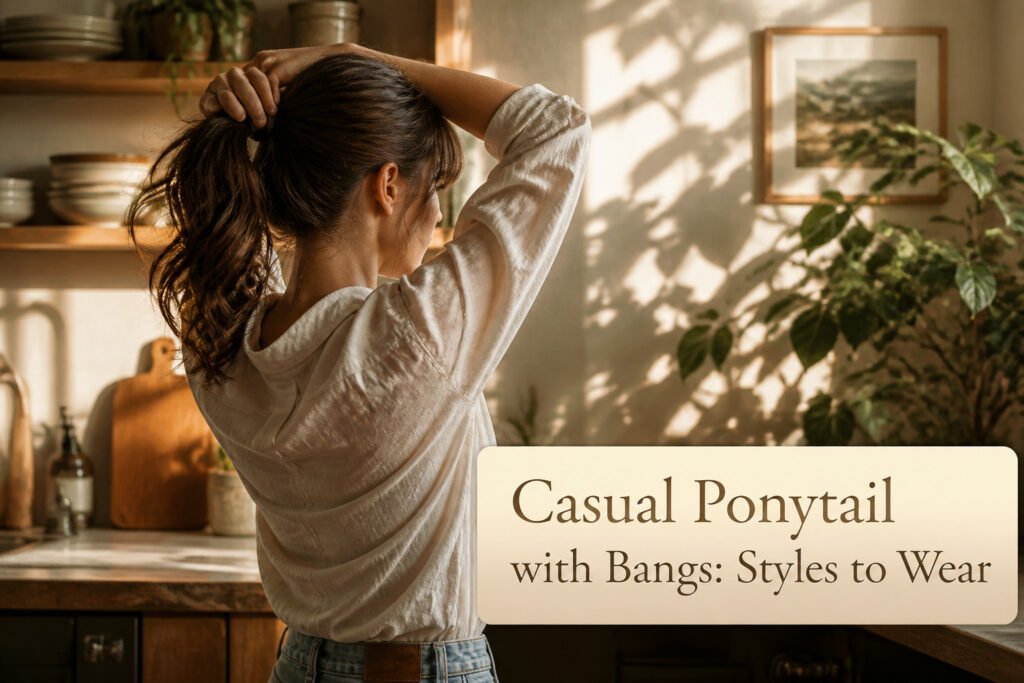
A casual ponytail with bangs is only as easy as the finish you choose. The same morning style collapses into a heavy shelf if the ponytail sits too low, or reads as polished if you lift it to the crown and lock the surface with strong-hold gel. The 16 versions below range from a three-minute teased crown with untouched fringe to stitch braids that feed into a flat high base, with one constant: the bangs do the structural work, and the ponytail height decides whether the look stays casual or shifts formal.
1. Sleek High Ponytail with Bangs

A sleek high ponytail with bangs pulls the eye upward and sharpens the whole silhouette, which is why it reads as polished rather than thrown-together. The blunt bangs sit at a strong horizontal line across the forehead while the ponytail lifts from the crown, creating a kind of frame-and-column effect that elongates what needs elongating and anchors what needs anchoring.
On oval and heart-shaped faces, this balance tends to land almost automatically. The height adds length to rounder shapes, and the bangs width keeps long faces from looking stretched. Square jaws get softened by the curve of the ponytail’s fall and the bangs’ blunt edge breaking up the angular plane. I have seen this go wrong when the ponytail sits too low, which drags the whole look downward and turns the bangs into a heavy shelf rather than a frame.
The finish matters more than the cut itself. A strong hold gel, worked through from roots to mid-length, keeps flyaways from fuzzing the line. The source look that keeps circulating uses long, straight hair for maximum sleekness, though medium to thick hair types hold the structure better than fine hair, which can look stringy if the ponytail isn’t full enough. For casual wear, the same style loosens slightly at the nape; for anything more formal, every strand stays pulled tight.
2. Stylish Ponytail with Soft Bangs

Soft bangs change the whole equation of a ponytail. Where blunt bangs sit heavy and graphic, a feathered or wispy fringe lets the face keep its natural geometry while the ponytail pulls the eye upward. The contrast matters: a blunt cut can flatten oval or heart-shaped faces by boxing in the cheekbones, but softer pieces falling past the brow bone actually follow the same angles those face shapes already have.
I learned this the hard way after a salon visit where I asked for "bangs like the picture" and walked out with a straight-across fringe that fought with my jawline for three months of growing out. The fix was simpler than I expected. Gathering hair into a loose, medium-height ponytail and letting the bangs fall with their own texture rather than forcing them flat against the forehead creates the dimension the style is after. A texturizing spray helps if the hair is fine to medium density, since too much weight at the crown collapses the softness the bangs are supposed to provide.
The style works across wavy or straight textures, and the low maintenance is genuine rather than marketing. No precise blow-dry required; the bangs keep their shape through the day because the ponytail itself does the structural work.
3. High Ponytail

A high ponytail with bangs sits at the crown or slightly above, and that placement is what shifts the whole mood from office-appropriate to something closer to off-duty model energy. The height pulls the eye upward, which reads as alert and playful rather than pulled-together in the formal sense.
For texture, you have two workable directions. One route is to keep the bangs natural and relaxed, letting them fall soft against the forehead while the pony stays polished and high. The other is to tease the hair roughly before tying it up, then hit it with a light mist of hairspray so the volume stays slightly undone. Both versions need the same anchor point: the ponytail base has to sit high enough that it is visible from the front, or the effect collapses into a standard mid-height look.
Braids can also feed into this style. Four sections worked into stitch braids toward the top of the head, then gathered into the ponytail, add structure without reading as event hair. The bangs stay easy in either case; they are the element that keeps the whole thing from trying too hard.
4. Side Ponytail

A sleek side ponytail with swoop bangs pulls the eye diagonally across the face, which softens length and brings balance to oval or longer shapes. The ponytail base sits off-center, usually at the temple or just behind the ear, while the bang sweeps in from the opposite side to meet it. That crossing line creates symmetry where there isn’t any: the bang covers one side of the forehead, the exposed cheek on the other side opens up, and the ponytail weight anchors the whole thing low and to one side.
Straight, medium-density hair carries this best because the clean lines do the work. Flyaways break the illusion, so a small amount of smoothing product through the crown and sides keeps the surface intact through the day. The swoop itself needs to be long enough to tuck, not so heavy that it fights the part. I have seen this read as polished rather than casual when the diagonal is too severe; keeping the ponytail at or below the ear line keeps it wearable for everyday.
5. Quick Weave Ponytail

A high ponytail with a neat wrap at the base gives thick, straight hair a refined silhouette that elongates the face, which makes it a strong match for rounder face shapes. The weave method matters here because denser hair textures have the natural volume to support the added weight without looking bulky or collapsing by midday. The construction works by securing the extension weft into the ponytail base, then wrapping a section of your own hair around it to hide the seam. Strong hold gel or pomade keeps the surface sleek and flyaways flat for an appearance that holds through formal events. The skill is in the wrap itself: too loose and the base looks sloppy, too tight and the tension becomes uncomfortable against a scalp already carrying thick, heavy hair. Practice the wrap on dry hair before committing to an evening out; the muscle memory pays off when you are working against the clock.
6. Ponytail with Blunt Bangs

Blunt bangs sit straight across the forehead with no feathering or tapering, which visually chops off the top inch or two of face real estate. The eye reads that solid horizontal line as the true start of the face, so everything above it, the actual skin of the forehead, drops out of the calculation. This makes the forehead read smaller and the overall proportions read more balanced.
The effect works best when there is actually forehead to spare. Someone with a high forehead, roughly four fingers or more from brow to hairline, gets the most dramatic payoff because the bangs bring that measurement down into average range without looking crowded. Someone with an already short forehead risks the opposite problem; the bangs can make the face feel compressed, with the brows sitting too close to the hairline and the chin seeming to jut.
For the ponytail part, height matters more than you might expect. A mid-height or slightly lifted ponytail keeps the eye moving upward from the bangs, so the face does not feel bottom-heavy. Too low, and the weight of the hair drags the visual center down against what the bangs just did. I have seen this combination fall flat when the ponytail sits at the nape and the bangs sit heavy and thick; the face ends up looking boxed in rather than refined.
The blunt edge itself needs to be crisp. A soft or grown-out blunt bang blurs that horizontal line and loses the shortening effect, so plan on a trim every three to four weeks if you are wearing this as a signature look.
7. Messy Ponytail

A low, rumpled ponytail with fringe looks best when the hair has some memory in it. Second or third-day strands carry just enough natural oil and bend to keep the style from falling flat, and the slight grit helps the elastic grip without sliding. Texture is what separates this from looking slept-on instead of intentional, so I work in a bit of dry shampoo at the roots for lift and a quick pass of texturizing spray through the mid-lengths before I tie it off. Unwashed hair actually holds the shape longer here, since fresh-washed silk slips out of place and fights the piece-y separation that makes the beachy effect read as styled rather than sloppy. Pull a few shorter pieces around the face free after you secure the tail, and let them do whatever they naturally want. That randomness is the whole point.
8. Braided Ponytail

A crown braid that trails into a loose ponytail gives the casual ponytail with bangs a structure that still reads relaxed. The braid sits at the top of the head, usually running from one temple back toward the crown or starting at the hairline and weaving toward the gathering point. This placement lifts the face and keeps the style from looking like an afterthought, which is the risk with any ponytail that tries too hard to be effortless.
The transition matters more than the braid itself. Where the secured section ends, the ponytail should fall into waves that are not curled or set, just air-dried or loosely tonged with the ends left out of the clamp. The contrast between the neat crown and the unsecured texture below is what keeps the look current rather than costume. I have seen this go wrong when the braid is too tight or too long; it becomes a rope that fights the softness underneath. Three to four inches of braided length at the crown, ending right where the elastic sits, is usually enough to register the detail without dominating. Bangs frame the whole thing and keep the style from feeling too pulled-back, especially if they are left to do their own thing with minimal product.
9. Curly Natural Hair Ponytail

Curls in a ponytail live or die by whether the style follows the coil instead of fighting it. Gather natural hair high and let the ringlets spring from the crown rather than pulling them taut against the scalp, which flattens the shape and stretches the curl into a wave that isn’t yours. Strategically placed highlights add the real payoff here: ribbons of lighter color woven through the mid-lengths catch light on each curl’s outer curve, giving the ponytail depth without breaking up the silhouette the way an all-over bleach would. The bangs stay loose and curly too, not blown straight, so the front matches the back in texture. Finger-combing the ponytail body, rather than brushing, keeps the curl clumps intact and prevents the frizz that a tool would introduce. For dimension, ask the colorist to paint the highlights where the curls naturally lift away from the head, usually the crown and the outer layer, leaving the underside deeper so the ponytail still reads as one solid shape from a distance. The result reads intentional, not like a default style you fell back on because the wash-and-go failed.
10. Half Pony with Side-Swept Bangs

A half pony with side-swept bangs carries the kind of quiet polish that makes long hair look intentional rather than just long. The partial gather is what saves it from feeling too done: you pull only the top section back, leaving the rest to fall naturally, which keeps the silhouette soft and the weight distributed so the style holds without tension.
The side-swept bangs are the part that integrates the look. Rather than pinning them back or splitting them into the gather, you leave them sweeping across the forehead, framing the face while the half-up structure lifts the crown. I have found that curling the hair first, then gathering high on top, gives the partial ponytail enough body to sit proud without looking like a leftover from a full updo. The bangs stay loose in front, and the contrast between the gathered top and the flowing lengths underneath is what reads as sophisticated rather than simply practical.
What makes this worth trying over a standard ponytail is that the partial structure works with the bangs instead of against them. A full high pony can fight with long fringe; the half-up version lets both elements coexist. The result reads as timeless rather than trend-driven, and on extra long hair, the proportions feel balanced rather than overwhelming.
11. Long High Pony with Braids

Stitch braids running into a high ponytail base that stays flat against the scalp take more planning than the finished look suggests. The technique works in sections: each braid is built by adding small, evenly spaced horizontal partings as you feed hair into the cornrow, creating that visible "stitched" ladder effect. Four sections across the top of the head is the workable number, braided back toward the crown where they all meet.
The bulk problem shows up at the gathering point. Four braids with their own elastic ends create a lump before you even tie the ponytail. The fix is to unbraid the last two inches of each stitch braid, or stop the stitch pattern short and switch to a plain cornrow for the final run. That loose tail lies flat and lets the ponytail elastic sit right against the head. Bangs stay relaxed and natural here, not styled into submission, which keeps the whole thing from looking overworked.
12. Tousled Low Pony with Bangs

Slightly wavy hair gives this style its structure without looking like you tried too hard. The nape placement sits right at the hairline, low enough that the ponytail drapes rather than juts out, and that weight at the back is what lets the bangs fall forward naturally instead of fighting each other for direction.
Controlled disorder works because the wave gives you built-in separation. Straight hair goes limp or puffs into a round helmet; too much curl and the ponytail turns into a shapeless cloud. A soft wave holds the tousled pieces in place so they read as texture, not accident. Gather it loose with your fingers, let a few strands slip out at the temples, and the result looks like you pulled it back five minutes ago and it settled exactly where it wanted. Golden jewelry catches the same warm tones if your hair runs blonde, though the pairing is optional rather than required.
13. Glam Wavy Locks

Glam waves sit at a very specific point on the curl scale, tighter than a beach wave but stopping short of full ringlets. That midpoint reads as intentional and formal, the kind of texture that catches light across a room rather than looking like you air-dried after a swim. For a ponytail with bangs, the challenge is carrying that polish through the whole style without the ponytail pulling the fringe flat against your forehead.
The fix starts with direction. Curl sections away from your face, then let them cool fully before you gather anything back. A curling iron around 1 inch works here, held vertically so the wave forms vertically too, not barrel-shaped. Once cooled, brush the waves out with a boar bristle brush before you ponytail, not after. That distributes the curl into a smooth ripple rather than a crimped line, and it gives the bangs body to stand slightly forward even once the rest is pulled back.
Secure the ponytail at the crown or just above, never low. A low placement with glam waves and bangs creates two competing focal points that flatten each other. The height lets the waves cascade from one continuous point, so the bangs read as the front edge of the same movement rather than a separate, squashed panel. A small section wrapped around the elastic keeps the occasion feeling intact.
14. High Messy Pony with Long Bangs

Teasing the crown is what gives this style its height without making it look like you tried too hard. Backcomb a two-inch section at the top of your head with a fine-tooth comb, working from ends toward roots in quick, short strokes. A light mist of hairspray locks in the lift before you gather everything into a high ponytail. Keep the bangs completely untouched by teasing or product so they fall forward in a soft, natural line. The contrast matters: the higher the ponytail sits, the longer your bangs should be, or the proportions start to compete. Let the bangs skim your eyebrows or brush the tops of your cheekbones, and the volume behind them reads as intentional rather than accidental. The whole thing takes under three minutes and holds through a full day.
15. Weaved Polished Pony with Blunt Bangs

A weave base is what separates this look from a ponytail you simply slick down. The extension weft, sewn or bonded into a cornrowed track, gives the ponytail its weight and that glass-smooth surface without asking your own hair to take the tension. Your natural hair stays protected underneath, which matters if you are trying to grow out length or recover from heat damage.
The edges are where the style lives or dies. A strong-hold gel, worked in with a fine-tooth comb or a soft brush, presses the baby hairs flat along the hairline and temples. The blunt bangs sit as a separate piece, usually cut from the same weave or a matching bundle, and they need to be dense enough to read as a solid line across the forehead. Too wispy and the contrast with the severe ponytail looks accidental rather than intentional.
This is medium-to-thick hair territory. Fine hair can struggle to hide the track and the weft seam, and the blunt bangs need real density to hang straight without separating. The payoff is a style that reads formal from a distance but still feels like a ponytail, not an updo; wear it to work, then keep it for dinner without touching up.
16. Minaj Pony with Arched Bangs

The Minaj pony lives or dies on the arc of those bangs. A rounded, arched point cut sits higher at the center and tapers down toward the temples, which keeps the forehead from looking heavy even when the rest of the hair is pulled tight. That arch needs long, sleek black hair to balance it. The length gives the ponytail enough weight to hang straight without flipping, and the smooth texture keeps the silhouette clean from the crown to the ends. On shorter or textured hair, the same bang shape can look disconnected from the ponytail rather than framing it. Even short bangs can work here, but only if they actually flatter your face shape; the arch is doing the structural work, so blunt or straight-across fringe fights the line rather than finishing it. A strong hold gel keeps the ponytail surface smooth and the bangs sitting where the point cut was placed.
Versatility Across Occasions

A casual ponytail with bangs becomes something else entirely with two small changes. The same loose morning ponytail, soft bangs falling forward, works for coffee or errands because it reads as intentional rather than leftover. For evening, the sources point to a sleek high ponytail with blunt bangs: strong hold gel, hair pulled clean, the bangs framing rather than hiding the face. The shift is product and tension, not a new style.
Long, wispy bangs soften the look for dates or after-work drinks; they draw attention to features instead of reading as office-safe coverage. The ponytail itself stays put. What moves is the finish: natural texture for day, polished straightness for night. Medium to thick hair handles the sleek version best; fine hair stays softer and more forgiving in the looser shape.
The real versatility is in deciding once. Pick the version in the morning, wear it through. No reworking between events, no bag of tools. That is what makes this practical rather than aspirational.
Face Shape Matching

The bangs on a casual ponytail do the heavy lifting for face shape balance, so getting the match right matters more than the height of the tail itself. A deep side part with flipped-out ends softens a square jaw or a pointed chin, since the diagonal line breaks up the symmetry that makes those shapes look severe. Oval faces have more room to move, but soft, wavy bangs still add structure that keeps the look from sliding into plain.
| Face shape | Best bang style | Ponytail finish |
|---|---|---|
| Oval | Soft, textured bangs | Wavy or straight, mid-height |
| Heart | Deep side part, flipped ends | Sleek with ends flipped out |
| Square | Side-swept or layered bangs | Sleek, low to mid height |
For square faces, avoid blunt, heavy bangs that end at the jawline; they draw a horizontal line right across the widest point. Heart shapes gain from volume at the ends of the ponytail, which balances a narrower chin. If you’re between shapes, the side part is the safer call: it shifts the visual weight without committing to a full fringe change.
Styling Products That Hold

Strong hold gel and texturizing spray serve two different jobs on a casual ponytail with bangs, and using the wrong one is usually why the style falls apart by noon.
- Strong hold gel is the right call for any sleek finish, whether the pony sits high or low. It keeps the hair lying flat and prevents flyaways around the base or across the bangs. The sources consistently pair this with polished looks, and in my experience reading through these styles, gel works best on medium to thick hair that has enough weight to stay put once the product sets. Apply it to damp or dry hair, comb through for even distribution, then build the ponytail before the gel fully dries.
- Texturizing spray belongs on tousled or messy ponytails, the ones where you want separation and a little grit rather than glassy smoothness. It adds grip so the elastic doesn’t slide, and it keeps the bangs from looking too freshly washed. This is the product for second-day hair or finer textures that need bulk at the crown.
- Gel on a messy ponytail or spray on a sleek one tends to backfire. Gel stiffens the movement you’re trying to create; spray breaks up the clean line you worked for. Match the product to the finish the style demands, not the finish you wish it had.
Frequently Asked Questions
What are some cute ponytail styles with bangs?
You can try a sleek high ponytail with blunt bangs for a polished look, a messy low ponytail with piece-y fringe for something relaxed, or a braided crown that trails into a loose ponytail for texture. A half pony with side-swept bangs also works for longer hair, and a tousled pony at the nape with soft waves reads as intentionally casual rather than thrown-together.
How can I style a ponytail with bangs?
For a sleek finish, work strong hold gel from roots to mid-length before pulling hair tight at the crown. For softer styles, use texturizing spray to give fine or medium hair body without collapse, or dry shampoo on second-day hair for a messy, piece-y look. Let bangs fall naturally rather than forcing them flat; the ponytail itself does the structural work.
What face shapes suit ponytails with bangs?
Oval and heart shapes carry most styles easily. A high sleek pony with blunt bangs adds length to rounder faces, while side-swept or layered bangs with a low-to-mid ponytail softens square jaws. Long faces need width from bangs to avoid looking stretched, so avoid styles that pull everything back too severely.