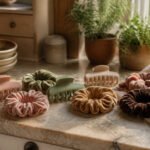
Trendy hair accessories are the finishing layer that turns a hairstyle into a look, but only if the finish and material match the hair they are meant to hold. Matte acrylic Korean clips in dusty rose or sage sit flat against fine hair where glossy Western barrettes slide out by noon, while velvet scrunchies need a tighter elastic to keep from walking down clean strands until they pool at the ends. The 25 styles here separate the pieces that function from the ones that only photograph well, with details on which textures grip, which surfaces slip, and where each accessory actually belongs in a grown-up rotation.
1. Korean Hair Clips

Korean hair clips stand apart for their geometry. Where Western barrettes often favor one large statement piece, these come in sets of slim rectangles, soft ovals, and abstract waves meant to cluster along the temple or sweep back a single side part. The shapes sit flat against the head, overlapping like tiles, which changes how you build a look: three small clips read as intentional where one bulky clip might look like an afterthought.
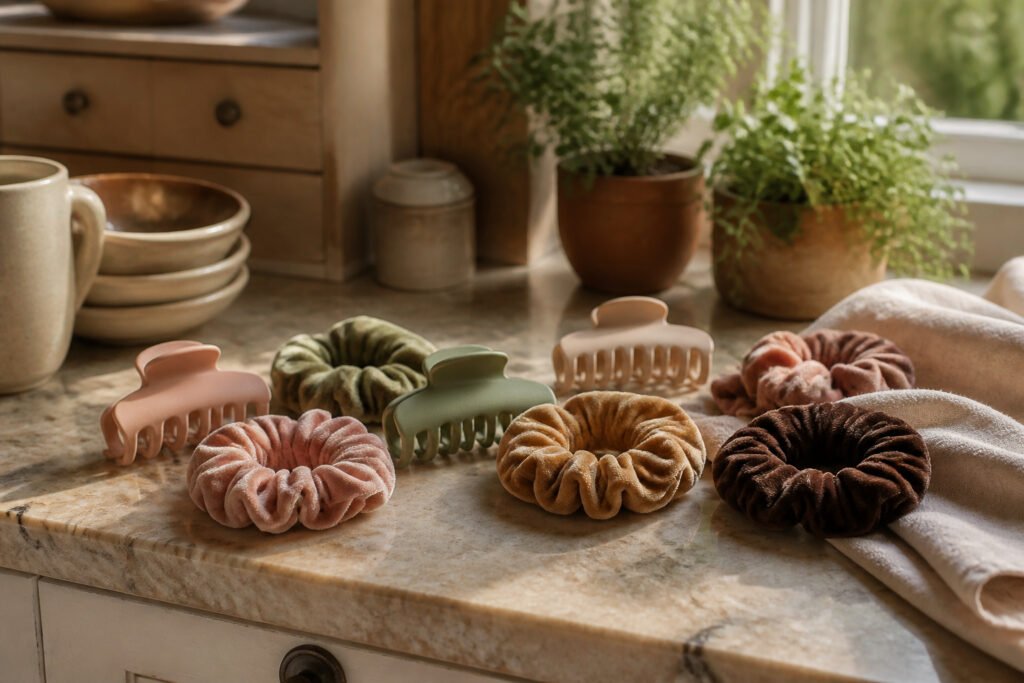
Acrylic resin dominates the material, usually in matte finishes that absorb light rather than reflect it. That matte surface is what keeps the colors, even the bright ones, from reading as childish. Dusty rose, sage, and warm caramel show up more often than primary shades, and the lack of gloss means they fade into hair rather than fight it.
For texture, the slim profile works in favor of finer hair that slides out of heavier clips. The tension is light, so they grip best when the hair has a little product or dry-shampoo texture to grab. On thick or curly hair, they function better as accents at the hairline or crown than as hold-everything-back tools. Cluster two at the temple and let the rest of the volume do what it wants; the clips become punctuation rather than structure.
2. Claw Clips

The claw clip that lived in every bathroom drawer in 1994 is back, only this time the finishes matter more than the logo. Matte and tortoiseshell have overtaken the shiny plastics that used to dominate, and the difference is practical: matte surfaces grip fine or freshly washed hair without the slip that sends a half-up twist sliding loose by noon. Tortoiseshell reads as neutral in a way leopard print never managed, so it disappears against most hair colors rather than fighting them.
Sizing has sorted itself out more sensibly than the one-size-fits-all approach of the original era. Thick or curly hair needs the large clips, the ones with enough width to hold a full twist without straining the hinge. Thin hair does better with mini clips that actually close flat instead of gapping. The real improvement, though, is what you cannot see: manufacturers have largely dropped metal springs in favor of all-plastic or coated mechanisms. The old metal ones rusted out in humid bathrooms, weakened over time, and eventually snapped hair along with themselves. The newer builds last longer and fail safer, which is the kind of 90s revival nobody complains about.
3. Pearl Hair Clips

Pearl hair clips in 2026 look nothing like the matched sets that covered every bridesmaid updo in 2019. The uniform rows of identical pins have given way to two distinct shapes that refuse to coordinate too neatly: oversized barrettes with a single fat pearl or an asymmetric cluster, and scattered single-pearl pins that look found rather than bought as a set.
Positioning is what keeps them from reading like leftover wedding hardware. One oversized barrette works best when it sits slightly off-center, gripping hair that has already been loosely twisted rather than pulled taut. The tension matters: too tight and the pearl looks like a functional clasp trying to be decorative, too loose and the whole twist slides out by noon. I have found that anchoring the barrette where the twist meets the scalp, not at the free end, changes the silhouette from "pinned up" to "held together."
The single-pearl pins need even more deliberate placement to avoid the scattered-afterthought look. Three is usually the workable maximum, and they should sit at visibly different heights, never in a line that the eye reads as a row. One at the temple, one tucked behind the ear where it catches light only when you turn, and one low at the nape where it stabilizes a half-up shape: the asymmetry signals intention. Two pins at matching heights still looks like you lost the rest of the set.
4. Scrunchies

Polyester scrunchies left the market for a reason. Cotton and silk versions now dominate because they grip without the micro-tearing that made the 90s originals a hair-health risk. The breakage argument was never about the elastic; it was the synthetic surface grabbing individual strands and snapping them on removal.
Diameter matters more than fabric choice for how you actually use one. A 3-inch diameter sits at the crown for a high ponytail that stays put through a workday, while anything under 2 inches works better as a wrist piece or for a low, loose hold at the nape. The 4-inch oversized versions that read as fashion statements tend to slide on fine hair and only really function on thick or textured types where the extra bulk has something to compress against.
Silk costs roughly triple what cotton does and loses its hand-feel faster with washing, though it causes less friction on already-damaged ends. Cotton holds its structure through dozens of washes but can feel stiff against the temple. I keep both in rotation: silk for days after heat styling when the cuticle is already stressed, cotton for everything else.
5. Velvet Scrunchies

Velvet scrunchies read as luxe in a way standard cotton or satin ones rarely manage, but the fabric’s nap direction matters more than most people notice. Run the velvet against the light one way and it looks nearly black; brush it the other direction and the same scrunchie glows jewel-tone, which is why product shots almost always show the pile catching side-light. For that reason, deep emerald, burgundy, and navy photograph better than pale colors that flatten under the same contrast.
The texture catches on itself, which keeps a velvet scrunchie from sliding out of thick or textured hair. On fine hair, though, that same friction works against you. Unless the internal elastic is tight enough to grip at the scalp, the weight of the velvet slowly walks down a slippery strand until it pools at the ends. I have watched this happen on freshly washed hair in particular, where the fabric nap and the clean strand compete to see which is slicker. A tighter elastic solves it, but test the tension before you commit to wearing one out; a loose velvet scrunchie looks intentional for about ten minutes, then just looks forgotten.
6. Floral Hair Clips

Pressed-flower resin and embroidered silk petals have largely replaced the plastic daisies that dominated floral clips for years. The resin pieces feel weightier and catch light differently, while silk embroidery gives movement that stiff plastic never managed. Both materials read as intentional rather than costume, though the line sits thinner than most shoppers expect.
Seasonal wearability is where these earn their keep. A single muted resin clip in dried lavender or sage works from March through October because the colors already exist in late-summer gardens and faded winter light. Brighter embroidered pieces, the ones with visible stitching in coral or butter yellow, narrow to May through August without looking wrong outside that window. The mistake is treating floral as universally spring. A dark plum or rust-toned petal clip reads autumnal and solves the November problem that pastel resin creates.
Placement keeps them from tipping into costume territory. One clip, off-center above the ear, functions as jewelry. Two matching clips, symmetrically placed, immediately suggest a theme party. The resin versions hold best in hair with some texture; silk embroidery grips smoother strands but can shift on windy days. I have moved a favorite embroidered piece to the inside of a coat lapel when the weather turned, which is not something the plastic daisies ever invited.
7. Butterfly Hair Clips

The Y2K revival hit hair accessories hard around 2022, and butterfly clips clawed their way back faster than most of us expected. Two hardware styles dominate now: the claw clip with its hinged grip, which holds more hair and stays put through a commute, and the alligator clip with its spring-loaded teeth, better for fine hair or for pinning back just a section rather than securing a full twist.
Metallic finishes read as jewelry rather than craft supply, especially the brushed gold and gunmetal tones. Iridescent acrylics catch light in a way that reads playful without tipping into costume territory, though in daylight they can skew younger than most of us want. Cluster them at the temple, two or three overlapping, rather than scattering one per side like you might have done at fourteen. The asymmetry draws the eye up and out, and the grouping looks intentional where single clips can look like you forgot to remove them. I tried the scattered approach last spring after digging out my old box; the temple cluster took three minutes longer to arrange but looked finished instead of accidental.
8. Hair Bows

The proportion has shifted hard toward oversized ribbons in grosgrain and velvet, tied at the nape or high on the crown rather than the side ponytail where they read as costume. A bow at the side, especially with a ponytail, still carries a strong grade-school association that most women past thirty want to avoid.
Placement is what separates the current look from its earlier versions. A velvet bow tied at the nape of a low bun or a grosgrain ribbon fastened at the crown above a half-up style reads as deliberate and adult. The fabric matters too: stiff grosgrain holds its shape and catches light differently than soft satin, which can look like leftover gift wrap.
The hair-length threshold sits around collarbone. On shorter cuts, the bow competes with the hairline and the proportion collapses toward childlike. At collarbone or below, the ribbon has enough hair mass to balance against, and the eye reads it as an accessory rather than a hair elastic with ambition. I have seen this fail on a sharp bob that hit the jaw; the same bow, moved to a low chignon on the same person, looked completely different.
9. Metal Hair Barrettes

Brushed gold and silver snap clips in that slim French rectangle shape have become the quiet workhorse of trendy hair accessories. The matte metal finish catches light without shouting, and the narrow profile sits flat against the head in a way rounder clips never managed.
Fine or straight hair holds these best. The snap mechanism needs enough tension to grip, and on loose curls or coarse textures the metal can slide right out or leave a crease that no amount of fluffing fixes. I have watched the same barrette work perfectly on a colleague’s sleek bob and then fail entirely on my own wavier texture after twenty minutes.
The rectangle shape does one thing exceptionally well: it pulls back a side section while looking intentional rather than like a rushed fix. Placement matters more than with plastic. Too high and the weight tips forward; too low and the line cuts the face at an unflattering angle. The sweet spot sits just above the temple, parallel to the eyebrow.
French-made hardware tends to keep its spring longer than the drugstore equivalents, though the price gap has narrowed in the last two seasons. For daily wear, two matching clips worn symmetrically still reads polished where one alone can look like you lost the other.
10. Crystal Hair Pins

Crystal hair pins live or die by what the crystal actually is. Swarovski glass refracts light in a tighter spectrum than ordinary molded glass, so the flash reads as color rather than glare, and that difference holds up under office fluorescents or candlelight. I learned to check the back of the pin: a clean rivet setting usually means precision-cut crystal, while glue-backed stones tend to be cheaper glass that dulls after a few wears.
The old approach of scattering five or six small rhinestones across a part line looks dated now. One substantial pin placed where it catches light during movement, usually just above the temple or at the crown twist, does more work with less fuss. For daytime, a single smoky crystal in a matte metal base stays quiet enough for a video call. The same pin at an evening event, turned so the light hits the facet at an angle, picks up enough flash to read as intentional rather than apologetic. The trick is buying one pin good enough to work both ways rather than two sets that each fall short.
11. Banana Clips

The vertical grip on a banana clip lifts hair straight up the back of the head without cinching it into a band, which is why you can pull it out at five o’clock and still have a smooth fall instead of that bent ponytail crease. Size tracks length more than you might expect: the standard six-inch clip works for shoulder hair and a little past, but once hair hits mid-back the shorter ones slide or pop. I have not found a hard rule on the jump, though most lines that carry both mark the larger one at eight inches for long hair.
Teeth spacing is where thick or curly hair wins or loses the clip entirely. Tight, close teeth grab fine hair but jam on density; wider spacing lets the clip slide through bulk and actually close. The retro shape has held up because the hinge runs the long way, so the teeth spread to take the volume rather than fighting it. Modern versions keep that mechanics but trade the neon plastic for tortoiseshell or matte resin. If the clip is labeled for thick hair, check that the teeth gap matches the width, not just the overall length.
12. Decorative Hair Combs

Celluloid vintage reproductions are driving the side-comb revival, and the difference between a comb that stays put and one that slides out comes down to insertion angle. Slide it in flat against the scalp, then tilt the spine downward so the teeth grip from underneath; that underhand catch is what takes the weight off the decorative top. Fine to medium hair holds this way without help, but denser textures need anchor pins at the spine or the comb will walk itself out within the hour. I have watched this fail on thick hair too many times to call it optional. The reproduction celluloid has the right flex and the right vintage color depth, though the originals from the 1950s had slightly longer teeth that gripped better. If your hair is thick, buy the comb for the look and plan on two crisscrossed pins you do not mind showing.
13. Rhinestone Hair Clips

Rhinestone hair clips sit at the sweet spot between dressy and wearable, and the difference from crystal comes down to construction. Rhinestones get their backing from glue-setting rather than prong or bezel mounts, which lets manufacturers press them into chunkier, more playful shapes: oversized stars, scalloped edges, abstract blobs that read casual rather than bridal. That same glue is the failure point. A clip that sheds stones on the first wearing usually has them simply pressed into shallow cavities with too little adhesive; you can spot the risk by looking at the back. If the metal shows clean cutouts with no visible glue pooling around the stone edges, the setting is shallow and the stones will pop out under normal tension from sliding into hair. A solid rhinestone clip has glue that rises slightly around each stone’s base, creating a tiny collar you can feel with a fingernail. Those hold through repeated use. For everyday wear, the chunkier shapes work better anyway; they do not read as trying to save a formal piece for Tuesday.
14. Knot Headbands

A knot headband starts with a padded tube of fabric, usually foam or batting wrapped in silk or velvet, that sits on the head like a soft crown. The knot itself is either sewn dead center for a symmetrical top-knot look or shifted toward one temple for a side-knot that reads more casual and less headmistress. I learned the hard way that placement matters for pressure: a top-knot distributes weight more evenly across the crown, while a side-knot can concentrate it at one edge of the hairline. The cheap ones leave that foam tube bare against your scalp, and after about two hours the friction against bare skin builds into a genuine headache. Versions with an interior lining, even a thin layer of satin, slide instead of grip, and that small difference lets you wear them through a full workday. The lining also protects the fabric from hair oil, which means the velvet or silk face stays presentable longer.
15. Padded Headbands

The Duchess effect made velvet and satin padded headbands unavoidable for about three seasons, and the reason they stuck around is simpler than the royal association. Width is what separates the flattering ones from the costume pieces. A band between one and a half and two and a half inches frames the face without swallowing it; anything wider starts to look like a fascinator missing its feathers.
Satin reads more office-appropriate, velvet more dinner-out, though both materials share the same practical problem. They slide. The fix is pushing the band back past the hairline, maybe half an inch, so the padding grips against the direction the hair grows rather than skating along the top. You will need a few bobby pins at the temples if your hair is freshly washed, which it usually is when someone is trying out a new accessory. I have seen the pushed-back placement work on every length from a chin bob to waist-length, though the shorter the hair, the more deliberate that placement has to look or it seems accidental.
16. Fabric Hair Bands

Elastic-back fabric bands sit like a headband but grip with a hidden strip, while full-circumference styles wrap the entire ponytail or bun in printed cotton or silk. The difference matters more than it looks: elastic-backs slip less on fine hair but can concentrate tension right where the strand bends, and a tight one worn daily will snap the same hairs until you notice a ridge of breakage at the crown. Full-circumference bands distribute pressure, though they take longer to position and can look bulky if the fabric is too stiff.
Prints that pick up a color from your outfit, rather than matching your hair, read as intentional rather than afterthought. A navy band with tiny ivory dots against dark hair, or a rust floral picking up the tone of a jacket, does more work than black or brown ever will. Silk prints cost more but glide against the strand; cotton holds its pattern through washing and costs less to replace when the elastic finally gives. Replace the elastic-back style as soon as the band starts to grip by force rather than fit; stretched elastic pulls harder, and that is where the breakage starts.
17. Minimal Hair Pins

U-shaped French pins and the 2-inch invisible bobby are the two minimal pieces that earned their spot in my kit after years of watching flashier clips slide right out. The French pin works best on hair with some natural grip: second-day texture, a light wave, or any density past fine and slippery. On stick-straight hair just washed, it needs a backcombed anchor or it rotates loose within an hour. The invisible bobby, matte and flat, disappears into a twist but only if the finish holds. Black-coated ones flaked on me after a few months of rotation, leaving dark dust on blonde sections that read as dandruff in daylight. Unfinished metal or a true enamel hold up without shedding, and the 2-inch length is the cutoff for a bun that stays put through a commute. Shorter pins look tidy but surrender by lunch.
18. Gold Hair Accessories

Gold tone in hair accessories sits differently against warm hair colors than cool ones, and the metal’s actual composition determines whether you’ll still be wearing it next year or fishing greenish flakes out of your brush. 14k gold contains enough actual alloy to resist the tarnish that turns cheaper metals dull or black, while gold-plated pieces carry only a microscopic layer over brass or nickel. That layer wears through at the clasp, the hinge, anywhere friction happens, and once it breaches, the base metal underneath reacts with sweat and hair products. Nickel in particular will raise a welt behind your ear or along your part line within hours if you’re reactive.
The surface finish matters as much as the metal. Polished gold catches light and throws it back at the room, which reads festive but can look hard against skin with yellow undertones. Brushed gold diffuses that same light, sits quieter against strawberry blonde or deep auburn, and forgives the fine scratches that accumulate in daily wear. A polished barrette looks deliberate, almost jewelry-box; brushed reads like hardware you reached for without thinking and got right.
19. Pearl Headbands

Imitation pearls sit on a metal or plastic band with glue and a setting, which is how you get a $12 piece that looks fine from three feet away. Freshwater pearls are strung or wired directly, heavier and cooler against the temple, and the band itself is usually narrower to carry the weight without sliding. Band width matters more than pearl size: anything under half an inch looks like a child’s dress-up set, while a full inch or more starts to resemble a dental mold unless the pearls graduate smaller toward the ears. The sweet spot sits around three-quarters of an inch, with the largest pearl centered and a gentle taper to each side.
For office wear, a single row of smaller freshwater pearls on a slim satin band reads as pulled-together without competing with a blazer collar. Evening allows the wider, more ornate pieces, the ones with clustered pearls and a little height at the crown, because the lighting is dimmer and the neckline usually lower. The mistake is wearing the evening version to a 9 a.m. meeting and watching it catch fluorescent light like a chandelier in a parking garage. I keep one of each, labeled, after showing up to a client presentation in what I now call my "birthday dinner" band and seeing the reaction in the conference room mirror.
20. Wedding Hair Accessories

Full tiaras have given way to single statement pieces, and the difference on the day is quieter than you might expect. A comb placed just above a low chignon, a vine trailing from temple to nape, or two matched pins flanking a center part each read as intentional rather than costumed. What convinced me, looking through dozens of recent wedding portfolios, is how these smaller pieces let the hair itself stay visible. The architecture matters more when there is less of it.
Order your piece before the hair trial, not after. Stylists need to build the style around the attachment point, whether the comb has teeth that slide flat against the head or a pin that needs buried anchorage. Veil placement compounds this: a comb that sits at the crown for the ceremony may need to come out entirely for the reception, or the veil may clip to the same hardware and stay. Testing both together prevents the last-minute discovery that your dream piece and your veil share one hook and fight for it.
Weight is the limit nobody talks about. A vine that looks delicate in photos can pull fine hair loose within an hour if it is metal rather than wire-wrapped beads. Ask the maker or the stylist to hold it in place for a full ten-minute walk-around before you commit.
21. Everyday Hair Rubber Bands

The elastic bands that leave no ridge and pull no strands loose when you slide them off are the only ones worth keeping in a drawer. I learned this after switching from the drugstore variety to the snag-free styles, and the difference in how much hair stayed on my brush was immediate. A band too thin for your ponytail’s weight stretches past recovery in a few wears; thicker diameters hold their grip through dozens of uses without that telltale gap that lets hair slip through. For a low, slim ponytail, a finer band does the job without bulk at the crown. A dense, heavy ponytail needs the wider circumference to distribute pressure so you are not pulling from one spot. The material matters too: the coated or fused styles lose their spring gradually, not all at once, which is how you end up with a band that snaps mid-removal and takes hair with it. Replace them before they go slack. Once a band needs a third loop to stay put, it is already past saving.
22. Cute Cartoon Hair Clips

Resin and enamel novelty clips shaped like strawberries, frogs, or tiny milk cartons hit differently at 28 than they do at 14. The material reads as deliberate kitsch rather than leftover childhood gear, especially when the finish has some weight to it. Cheap plastic versions tip straight into costume territory; a solid enamel piece with clean edges and a real metal clasp signals irony someone chose.
One clip, placed asymmetrically, does the work. A single banana or smiling cloud above the temple turns a plain ponytail into a reference without asking for attention. Two matching clips, evenly spaced, look like you’re trying to make them serious, and three or more anywhere on the head becomes a theme party.
The sweet spot for this look runs roughly mid-twenties to late thirties, where enough distance from actual cartoon-watching years exists for the reference to feel self-aware. Past forty, the same clip can read as trying too hard to signal youth unless the rest of the look is extremely restrained. Under twenty, it mostly just looks like you never stopped wearing them.
23. Minimal French Barrettes

The slim rectangle barrette in tortoiseshell, horn, or matte metal sits almost flush against the head, which is exactly what makes it read as intentional rather than leftover. A quality spring mechanism closes with a soft click, not a snap, and the gap between the clasp and the body should stay even when empty. Cheaper ones warp after a few months, and you feel it first when the tension goes uneven on one side.
Hair amount matters more than length with these. Too little and the barrette slides; too much and the spring strains open in an hour. The sweet spot is a gathered section about the width of two fingers, which for most textures means the barrette holds without that telltale gap at the hinge.
Some brands label their pieces "French made" or "Italian made" as if the distinction changes function. What actually differs is the hardware sourcing and the hand-finishing on the acetate. French manufacturers tend to keep the spring assembly in-house, while Italian workshops sometimes outsource that part and focus on polishing the shell. Both can last years; neither guarantees it. Check the hinge pin: if it is visible and slightly domed, it was set by hand and can be tightened later. A flat, flush pin usually means pressed assembly, and once it loosens, the barrette is done.
24. Matte Finish Claw Clips

Matte finish claw clips carry a different weight than their glossy cousins, and the difference starts at the fingers. The slightly textured surface grips fine or freshly washed hair without the slip that sends a glossy clip sliding toward the nape by noon. Colors shift too: matte navy, stone, or tortoiseshell hide the micro-scratches that turn a shiny black clip scuffed and thrifted in a matter of weeks.
Several labels have moved the material itself toward recycled cellulose acetate, which takes matte dye more evenly and carries less of the petroleum sheen of virgin plastic. The result reads as more expensive in an office or on a video call because it does not catch light and demand attention; it sits, holds, and lets the hair or the outfit do the talking. A matte clip in a neutral tone will outlast three glossy impulse buys on both wear and visual patience.
25. Oversized Statement Hair Clips

Oversized statement clips start at four inches, and anything smaller reads as a standard barrette that got lost on a bigger shelf. The ones that stay put distribute weight across a flat or gently curved back plate rather than pinching at a single hinge, which matters because a 4-inch clasp concentrating all its grip on one inch of scalp will slide backward within an hour. I have watched this happen on fine hair and thick; the difference is the engineering, not the texture.
For styling, a half-up gather lets the clip sit at crown level where the weight of the hanging hair actually helps anchor it. Pulling everything into a full twist changes the physics: the clip then holds the entire mass, and without substantial hair density the proportion starts to look like a serving utensil parked on a dinner roll. Hair needs to be at least medium-thick for a full gather to look intentional rather than apologetic. On finer hair, the half-up placement keeps the visual balance without requiring volume the hair does not have.
Why Hair Accessories Are Trending Now

The shift toward comfort-first fashion that started after 2020 never really reversed. Sweatpants gave way to softer tailoring, and hair became the natural place to add polish without sacrificing ease. A velvet band or a clean claw clip takes thirty seconds and reads as intentional on a video call where only your shoulders up are visible.
TikTok compressed the trend cycle into micro-moments that turn over weekly, but accessories fit that rhythm better than clothing. You buy a $12 clip instead of a $120 top, and when the moment passes, your wardrobe investment is minimal. The real value is updating what you already own: the same black turtleneck reads Tuesday with a slim barrette, Saturday with a padded satin headband.
Functionality drives the habit more than aesthetics. Growing-out bangs stay off your face. A strategically placed comb masks day-three roots. The accessories that rank are the ones that do both jobs, comfortable enough to wear through a full workday while holding shape for an evening event.
Hair Accessories for Different Hair Types

A claw clip that swallows thick hair will slide right out of fine strands, and the combs that grip straight hair can tear through tight curls. Matching the accessory to density and texture matters more than matching it to the outfit.
| Hair type | Best hold | What to avoid | 30-minute test |
|---|---|---|---|
| Thick | Large claw clips, banana clips, strong rubber bands | Mini clips, weak tension | Jump in place; if the clip shifts, size up |
| Thin | Mini claw clips, pearl pins, lightweight barrettes | Heavy or oversized pieces | Tilt head forward; slipping means wrong pin type |
| Curly | Soft scrunchies, wide headbands, large claw clips | Fine-tooth combs, tight elastics | Shake head; snagging or pulling means swap the comb |
| Long | Decorative clips, hair combs, oversized claw clips | Standard-size claws | Walk briskly; weight drag means redistribute or upsize |
Pearl pins with a wavy or ridged post grip slippery strands better than smooth metal, and wide-tooth combs slide through curls without catching. The 30-minute test is simple: if the accessory needs adjusting before half an hour of normal movement, it is the wrong tool for that hair type, not a failure of technique.
Hair Accessory Care and Storage

Metal hair accessories need dry storage to keep their finish intact. A bathroom drawer that traps humidity will leave barrettes spotted within a season, so a bedroom dresser or closet shelf wins every time. Resin pieces, the chunky tortoiseshell clips and geometric barrettes that have come back strong, scratch against each other in a jumble. A compartmentalized organizer with fixed dividers keeps them separated without adding bulk.
Pearl and crystal pins go into velvet pouches, soft-sided ones that cushion against impact and wick away the faint moisture left from handling. The pile of the fabric matters more than the closure type. For combs that actually touch the scalp, a quick cleaning protocol saves both the teeth and the next hairstyle: warm water with a drop of mild soap, a soft toothbrush working from the spine toward the tips, then air-dried completely before storage.
Perfume and hairspray both carry solvents that cloud finishes and weaken adhesives. Six inches of distance, applied before the accessory goes in, is the workable minimum. Spritz, wait for the mist to settle and dry, then style.
Frequently Asked Questions
What are the top trending hair accessories?
The top trending hair accessories for 2026 include Korean hair clips, claw clips, pearl hair clips, scrunchies, velvet scrunchies, floral hair clips, butterfly hair clips, hair bows, metal hair barrettes, crystal hair pins, banana clips, decorative hair combs, rhinestone hair clips, knot headbands, padded headbands, fabric hair bands, minimal hair pins, and gold hair accessories. Each style has evolved from earlier versions with better materials and more intentional placement.
How do I choose the right hair accessory?
Choose based on your hair type and the setting. Fine or straight hair holds slim metal barrettes and Korean clips best, while thick or curly hair needs large claw clips, banana clips with wide teeth spacing, and strong-hold pieces. For work, lean toward minimal barrettes, small claw clips, and neutral headbands. For casual wear, butterfly clips, scrunchies, and fabric bands work well. Dressier occasions call for pearl accessories, crystal pins, or decorative clips.
How do I care for my hair accessories?
Store accessories in a dry place and keep metal pieces away from water and perfume, which can accelerate tarnish. Replace elastic-back fabric bands as soon as the elastic starts gripping by force rather than fit, since stretched elastic pulls harder and causes breakage. For silk scrunchies or headbands, hand washing preserves the hand-feel longer than machine washing. Check rhinestone settings periodically; glue-backed stones loosen faster than prong or bezel mounts.