
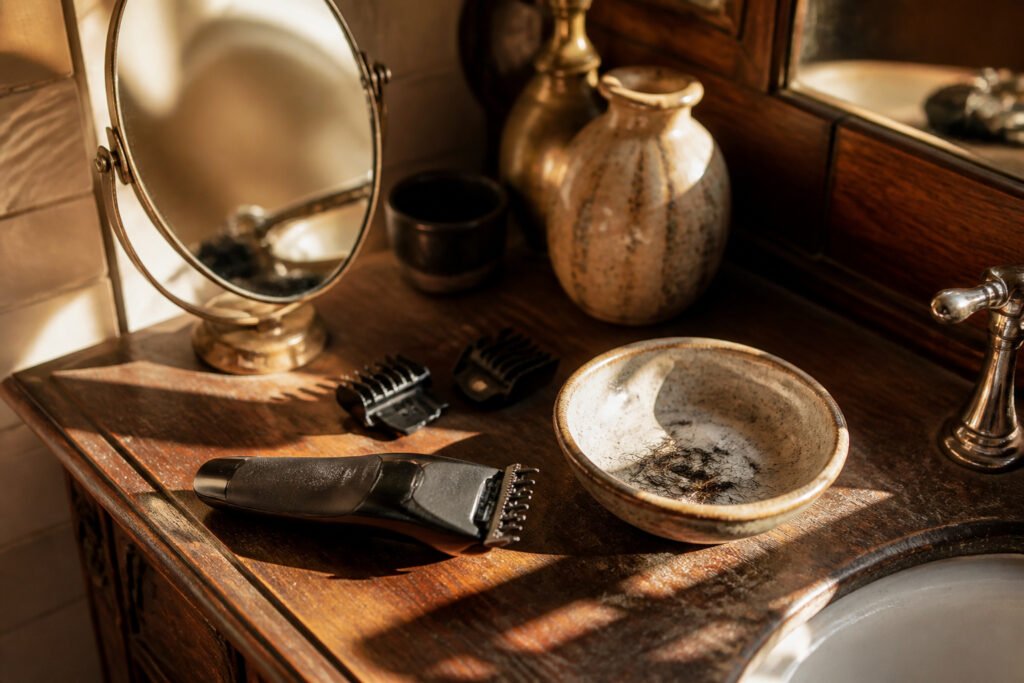
A clean, intentional pair of sideburns takes about ten minutes, a beard trimmer with multiple guards, and the discipline to start dry. Most people get the first part right and still end up lopsided because they skip the dry run: holding the guard against the sideburn before the blades touch hair shows exactly what will come off, and thirty seconds of that saves a month of growing back a quarter inch misjudged in the mirror. The real cost is not the trim itself but the unevenness that reads from ten feet away when you favor your dominant hand.
1. Wash and Dry Your Facial Hair

Clean, dry hair is the only reliable starting point for a sideburn trim. Wet hair lies longer than it grows, so a cut made fresh from the shower ends up shorter than intended once it dries. Wash your facial hair as part of your grooming routine, then towel or blow it completely dry before the blades come out.
A quick brush or comb through the sideburns keeps the strands running in their natural direction and pulls out any knots that would snag the trimmer. Tangled hair trims unevenly; the clippers catch on snarls and leave divots you did not plan. Brushing also reveals the true length and density you are working with, which makes the first pass with the trimmer predictable rather than a guess.
2. Trim the Longer Hairs to Shape

An electric beard trimmer on its longest guard setting tames the bulk and builds the basic silhouette you will refine later. Most guard systems run from 0 through 8, with zero being the shortest; starting high gives you room to step down if the line looks too heavy against your jaw. Aim for a width roughly matching your ear, then let the shape taper gradually toward the bottom so the sideburn does not read as a block pasted onto your face.
Before the blades touch hair, do a dry run. Hold the chosen guard against your sideburn without attaching it to the clippers and slide it upward. The hairs that peek above the guard’s edge are exactly what the clipper would cut, so you see the result before committing. It takes thirty seconds and has saved me from taking a month to grow back a quarter inch I misjudged in the mirror.
3. Clip With Shorter Settings to Refine

The second pass is where the shape actually shows up. Drop the guard to the second shortest setting and run it along the sideburn to clean the edge and even out any stragglers. This is refinement, not removal: you’re tightening the line, not cutting it back.
For the fade itself, switch to the shortest guard and hold the trimmer at an angle. Start at the bottom of the ear, about level with the mouth, and work up to the top of the sideburn. The Braun Precision Trimmer handles this well because its narrow head lets you angle into that transition without biting into hair you meant to keep. A fade lives or dies by whether the steps between lengths are visible; the smaller the blade footprint, the less likely you are to leave a sudden step. Move in thin passes. The skin shows through more at the bottom and the sideburn darkens as you climb; that gradient is the whole point.
4. Repeat and Adjust Until Satisfied

The finger test catches what the mirror alone misses. Stand facing the glass and hold one index finger beneath each sideburn, resting the pads lightly against your cheeks. The horizontal line your fingers create makes any height difference obvious, even the quarter-inch drift that happens when you favor your dominant hand.
Uneven sideburns are the most common mistake in home trimming, and they read as lopsided from ten feet away. If one finger sits lower, that sideburn needs to come up; trim the longer one in small increments, checking after each pass. The finger position also helps you judge whether the shape suits your face. Longer sideburns that reach near the earlobe can narrow a square jawline, while stopping at mid-point works better for oval or oblong shapes. Adjust until both sides match and the length flatters your structure, then step back for a final look before putting the clippers down.
5. Maintain Every 3 to 5 Days

Sideburns lose their edge fast. Three to five days is the window where they still look intentional rather than neglected, though coarser facial hair might push toward the shorter end of that range and slower growth can stretch a day or two without looking ragged. The maintenance itself is quick: a pass with short clippers, checking symmetry in the mirror, and you’re done. What comes after matters more than most people bother with. A few drops of beard oil or a small amount of balm, worked through the hair and onto the skin beneath, keeps the area from drying out and flaking. The conditioning also softens the texture so the sideburns don’t read as bristly against the rest of the haircut. For daily upkeep between trims, a beard comb run through in the morning keeps everything lying flat and catches any hairs that have started wandering out of line. It’s a ten-second habit that prevents the weekly correction from turning into a full reshaping job.
6. Classic, Short and Long Sideburns

The three basic lengths each carry their own logic for framing the face. Here is how they break down:
- Classic sideburns end at the mid-point of the ear. This length works as the default for oval, oblong, or diamond-shaped faces. It divides the face evenly without drawing attention to any one feature, which is why it reads as balanced rather than bold.
- Short sideburns stop higher, above the ear’s midpoint. They open up the cheek and jaw area, which can make a round face look longer or keep a busy hairstyle from feeling cluttered at the sides.
- Long sideburns extend below the ear’s midpoint. On a square face, they narrow the jawline toward a more chiseled look. On a round face, they add angles that the face otherwise lacks.
The finger test helps check symmetry: hold one index finger beneath each sideburn in the mirror to see whether they line up or need leveling.
7. Tapered and Connected Styles

Tapered sideburns fade from full volume at the top to low volume at the bottom, sometimes tapering all the way to a skin fade. Connected sideburns extend down the jawline to meet a beard or mustache, which changes how you approach the trim.
- Tapered sideburns work best when you start with a longer guard at the top and step down by one setting every half inch. The fade should look gradual, not stepped; if you can see a line between lengths, blend with a guard between the two sizes.
- Connected sideburns require you to treat the sideburn and beard as one continuous shape. The sideburn should not stop abruptly at the ear; instead, it narrows as it travels toward the jaw, where the beard takes over.
- Beard fade technique keeps the cheek area tight while letting the bottom grow fuller. Start short around the sideburns and let length increase as you move down the face. This works for short, medium, or long beards; the point is controlling where the volume sits rather than matching the sideburn length to the beard length.
- A common mistake is fading the sideburn too high, which leaves an awkward gap before the beard starts. Keep the transition zone within an inch of the jawline so the connection reads as intentional.
8. Choose by Face Shape

Sideburns do more than fill the gap between hairline and ear; they frame the jaw and shift how wide or narrow a face reads in the mirror. A natural design approach matches their length to what the rest of the face already does. Square jawlines soften when sideburns run longer, drawing the eye vertically and away from the widest point. Rounder faces gain the opposite benefit: length at the side adds angles that are not otherwise there. For oval, oblong, or diamond shapes, the midpoint tends to sit right without fighting the existing proportions. The finger test, holding one index finger beneath each sideburn to check evenness, keeps the balance from drifting off after a few careless trims. Getting this right is not a minor detail in personal grooming; it is the detail that makes the rest of the haircut look intentional.
What You Need Before Starting

A decent electric beard trimmer with multiple guard sizes is the one tool you genuinely cannot fake your way around. The guards are what set the actual length, and every brand labels them differently. Some use numbers running 0 through 8, where zero cuts the shortest. Others use colors, which still makes no practical sense to me after reading through a dozen of these guides. What matters is having a wide range so you can step down gradually rather than guessing at one length and hoping it frames your face right.
The beard comb matters more than people treat it. Combing the hair straight before you cut keeps the trimmer from catching uneven patches and leaving divots you only notice in daylight. After the trim, the same comb works the beard oil or balm through to condition both the hair and the skin underneath. Skip that conditioning step and the new edge you just shaped will itch or flake inside two days, which defeats the point of looking intentional about this.
Why Sideburns Matter

Sideburns do more work than most people credit them for. A well-shaped pair can square off a jawline, pull attention to the hairline, or soften the width of the cheeks, depending on what the face needs. The name itself comes from Ambrose Burnside, the 19th-century Union general whose flamboyant facial hair stretched from mustache to ear in a continuous strip. Over the decades, sideburns have stood in for rebellion, polish, or subculture affiliation, from the greasers of the 1950s to the rock musicians who kept them going through the 1970s and after. The point is not to chase any of those looks, but to recognize that sideburns frame the face the way a neckline frames a haircut: ignore them and the whole style sits slightly wrong.
Styles That Include Sideburns

Sideburns rarely sit in isolation. The same face reads differently depending on what joins them, and the combinations are worth mapping before you pick up a trimmer.
- Worn alone, sideburns frame the jaw without competition. Clean-shaven skin above and below keeps the eye on the cheekbone line; this is the default that works when you want structure without commitment.
- Paired with a moustache, they create a visual bracket around the mouth. The gap of clean-shaven chin between them becomes part of the style, not an absence. The historical "friendly mutton chops" follow exactly this logic: sideburns connected to a moustache with the chin kept bare.
- With a beard or goatee, sideburns act as the transition zone. They soften the hard edge where hair meets skin, and trimming them shorter than the beard itself prevents a helmet effect. Once sideburns extend from ear to ear via the chin, they cease to be sideburns and become a beard, chinstrap, or chin curtain.
- A full facial hair style uses sideburns as the anchor point. Everything else radiates from there, so their length and taper set the proportion for the whole face.
Frequently Asked Questions
How can you tell if sideburns are even?
Hold one index finger beneath each sideburn while facing a mirror. The horizontal line your fingers create makes any height difference obvious, even a quarter-inch drift. Trim the longer side in small increments, checking after each pass, until both sides match.
How should men wear sideburns?
Choose a length that complements your face shape. Classic sideburns ending at the mid-point of the ear suit oval, oblong, or diamond faces. Short sideburns above the ear midpoint work for round faces or busy hairstyles. Long sideburns extending below the midpoint can narrow a square jawline or add angles to a round face.
What is the purpose of sideburns?
Sideburns frame the face and shift how wide or narrow it reads. A well-shaped pair can square off a jawline, pull attention to the hairline, or soften cheek width. They function much like a neckline does for a haircut: ignore them and the whole style sits slightly wrong.