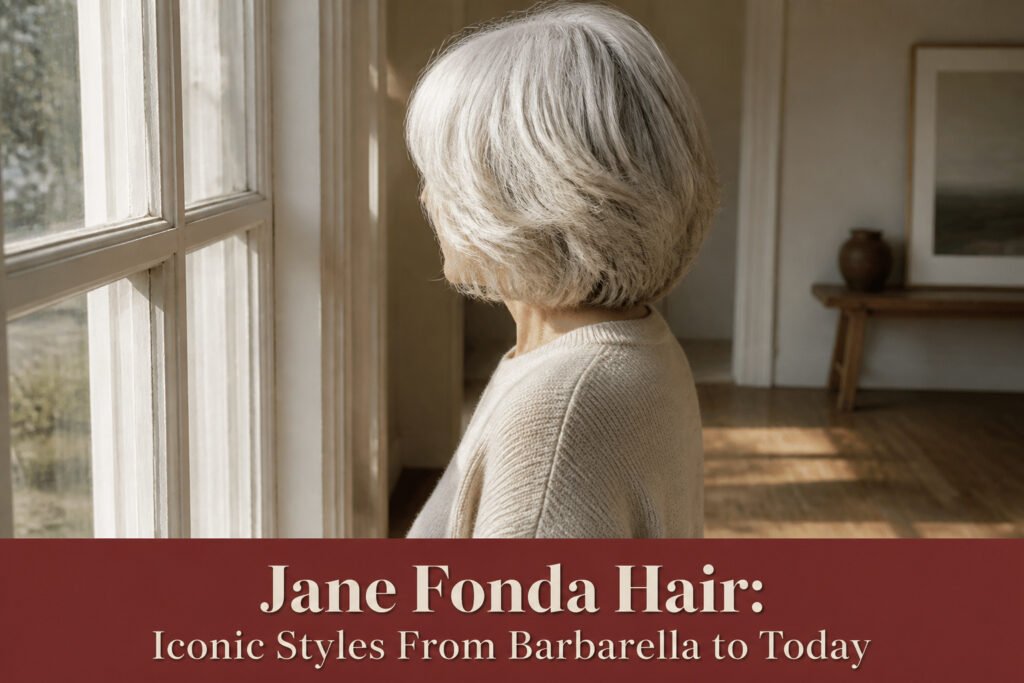
Jane Fonda hair is a six-decade archive of reference cuts that still land in salon chairs, from the gravity-defying Barbarella volume to the silver bob she wears at 87. The catch is that most of these styles depend on hidden structure, not surface shape: interior layering builds the crown volume that keeps her current cut from falling helmet-flat, and the 1968 look only worked because the hair still moved like hair under all that product. Colorist Jack Martin spent seven hours taking her to icy silver at the 2020 Oscars, a dye job that proved going gray well is active, not passive.
1. The Sophisticated Silver Bob

The silver bob Jane Fonda wears now sits somewhere between chin and shoulder, and the length matters less than what happens inside it. Soft interior layering builds the volume through the crown that keeps the cut from falling flat against her face at 87. That interior structure is what lets the style read as expensive rather than merely short.
Gray hair changes texture, often drying and coarsening with age, which makes that hidden layering even more necessary. Without it, the same length would sit heavy and helmet-like. The cut also keeps subtle face-framing pieces that break up the line and draw the eye up.
For styling, lift at the root with a volumizing mousse first, then smooth the lengths with a lightweight blowout cream. A texture spray at the end gives the movement that reads as polished rather than finished. Fonda has worn this blowout shape for years, though she has occasionally swapped it for a softer curl with a middle part, the layers near her face waved rather than rolled under. Either way works because the cut underneath is doing the actual work.
2. The Barbarella Bombshell

The 1968 Barbarella look is what most people picture first: long, softly layered hair with dramatic volume and face-framing movement that moved like it had its own gravity. Stylists still get requests for this cut because it frames the face without falling flat, and the volume sits through the crown rather than spraying out at the sides like so much 1960s helmet hair.
To build that movement, a large round brush and a blow-dryer do most of the work. Velcro or heated rollers add the lift at the root, and a flexible-hold hairspray keeps the shape touchable rather than shellacked. I have seen modern versions go wrong when someone reaches for too much product; the original worked because the hair still looked like hair.
What separated this style from the decade’s other big looks was that it defined the era instead of copying it. The teased beehive and the sharp Vidal Sassoon geometric cuts were already everywhere. Fonda’s Barbarella hair floated somewhere between those poles: structured enough for science-fiction glamour, soft enough to look like she had just landed rather than been assembled. That balance is why the reference still lands in salons almost sixty years later.
3. The Chic Silver Crop

The softly layered crop Jane Fonda has worn in recent years sits somewhere between a pixie and a true short cut, and that in-between quality is what makes it work for so many women watching their hair change with age. The crown is left longer than a standard pixie would allow, which builds subtle volume right where the face needs lift rather than hugging the skull. That extra length through the top also lets the fringe sweep across the forehead instead of cutting blunt. A blunt fringe on silver hair can read heavy or helmet-like; the sweep keeps the line soft and draws the eye diagonally, which flatters a wider range of face shapes than a straight-across cut.
The movement matters as much as the length. Lightweight layers, not closely cropped sides, give the silhouette its modern feel. To style it, a lightweight volumizing mousse goes on damp hair before a blow-dry with a small round brush. A dry texture spray at the end defines the layers without weighing them down. The whole routine stays quick, which matters when the goal is polished rather than overstyled.
4. The Fitness Perm

The layered curly cut from Jane Fonda’s 1980s workout era works because the perm rod size creates rounded volume rather than a long, stretched curl. Gray or white perm rods, roughly the diameter of a drinking straw, build that compact, bouncy silhouette that sat high on her head instead of pulling the shape downward.
Layering prevents the triangle effect that ruins so many perms. Hair that is all one length with curl piled on top of curl flares at the bottom and narrows at the scalp; interior layers remove weight from the lower perimeter so the volume stays distributed. The shortest layers crown the head, then graduate longer through the sides and back, which keeps the rounded profile intact even as the curls relax.
Maintenance during daily filming meant managing moisture without letting the curl go limp. A curl cream applied to damp hair, then diffused until almost dry, sets the shape without the crunch of older mousse formulas. Gently separating the curls with fingers rather than a comb breaks up any helmet-like uniformity and gives the softer, more wearable finish that translates off-screen. Heated or velcro rollers between shoots could revive flattened sections, with a thermo-activated product like Flex Pli helping the shape hold through multiple tapings.
5. The Klute Shag

The shoulder-grazing shag with textured layers and face-framing pieces that Fonda wore in Klute still shows up in salon reference books for a reason. The cut sat right at the collarbone, broken up with enough texture to catch the light differently across every angle, which kept her face dimensional on film in a way that flatter styles often flatten. Stylists I have watched work will rough-cut the shape, then go back in to chip out weight around the crown so the top moves independently from the bottom. That separation is what keeps a shag from reading as just grown-out layers. For the face-framing, ask for pieces that start at the cheekbone and taper to nothing at the jaw; anything heavier and the balance tips toward curtain-bang territory, which is a different look entirely. The finish should feel like you raked your fingers through it, not like you ironed it into submission.
6. The Grace & Frankie Layers

The collarbone-length cut with long, invisible layers that Fonda wore through seven seasons of Grace & Frankie sits at a length that reads as intentional, not accidental, on a streaming camera. Invisible layering means the layers are cut so far apart, usually starting well below the chin, that you see movement and separation rather than steps or shelf-like lines. The ends stay full, which matters more than it used to: streaming compression can flatten a wispy bottom into a solid block, but weight through the perimeter keeps the silhouette alive even at lower bitrates.
For the character, the length works because it is long enough to pull back during a crisis, short enough to look styled without effort, and neutral enough to wear with caftans or business casual. The movement reads differently than it did on film. Digital sensors pick up contrast more aggressively than celluloid did, so the separation between layers shows up as distinct bright and dark ribbons under set lighting rather than the softer blur of 35mm grain. A small amount of styling cream through the ends before a dry texture spray gives the separation the camera catches without turning frizzy under those lights.
7. The Hollywood Blowout

Long, softly blended layers with fullness through the ends and face-framing movement defined Jane Fonda’s Hollywood blowout. The distinction matters: soft blending keeps the weight line gradual and invisible, while feathering thins the perimeter into wispy ends that read dated on this shape. Fullness at the ends rather than the roots gives the silhouette its polished swing; root lift alone would puff the outline and lose the elongated, expensive line that made this one of her most elegant looks.
The brush technique builds that structure deliberately. A large round brush lifts at the roots while the ends stay smooth and softly curved, not flicked or flipped. Prep with a lightweight blowout cream so the set holds without stiffness. The result is movement that stays polished, the kind of body that looks intentional rather than teased.
8. Tousled Feathered Hairstyle

The tousled feathered hairstyle sits in that useful middle ground where a woman can walk into a morning meeting or a late dinner without looking like she tried too hard for either. Jane Fonda has worn this short-to-medium cut with layers fine enough to move but heavy enough to hold shape, and the real work happens at the roots. Teasing just the crown and top layers, two or three quick backcombing strokes with a fine-tooth comb, builds the lift without the breakage that comes from overworking the same section. The ends need a different tool entirely: a round brush with natural bristles, rolled outward on each layer, creates the feathered flick that separates this from a standard blowout. A lightweight mousse at the roots before drying, followed by a thermo-activated product like L’Oreal Professional Flex Pli, sets the shape without the shellacked finish of older styling routines. The result reads as polished from the front and slightly undone at the back, which is exactly where most women want to live on a Tuesday.
9. Mid-Length Textured Crop

A softened shag keeps the movement of the 1970s cut that defined Fonda’s Klute era but pulls back the aggression. Where a standard shag runs heavy, choppy layers all over, the softened version keeps texture through the crown and sides while the perimeter stays light and feathered rather than blunt. Feminine lines mean the face-framing pieces curve inward toward the cheekbone; androgynous cuts leave them straight or flick outward. The difference is maybe half an inch of angle at the ends, but it reads as warmth rather than edge.
Mid-length lands in that useful spot: short enough that the layers spring up with a round brush and a little mousse, long enough to tuck behind an ear or pin back if the day calls for it. There is no grow-out cliff to dread. Ask for length through the crown that sweeps into a soft fringe, and tell your stylist you want the silhouette to feel modern rather than closely cropped. Blow-dry with a small round brush, then hit the layers with dry texture spray so they separate without falling flat.
10. Shag with Face-Framing Layers

The shag lives or dies by what happens at the crown and around the face. Crown volume comes from shorter interior layers stacked beneath longer ones, not from teasing or product alone. On fine hair those layers need to sit closer together to avoid collapse; on thicker hair the same stacking reads as bulk unless the stylist removes weight with point-cutting or texturizing shears.
Wispy flicks around the face happen when the ends are cut to a fine taper, almost point-cut, so each piece bends away from the cheekbone on its own. Blunt pieces, by contrast, are cut straight across and fall heavier, which can drag the eye downward. The difference is tool choice and tension, not magic.
What makes this cut read younger is movement without disguise. The face-framing pieces break up horizontal lines at the jaw and forehead, so the eye travels instead of settling. It does not hide anything; it redirects attention to motion. That distinction matters after forty, when "youthful" styling often tries too hard and lands in costume territory instead.
11. Short Curly Shag

The short curly shag Jane Fonda wore in the late 1970s and early 1980s kept the movement of the classic shag but swapped the straight feathered ends for curls with real bounce. "Perky" in curl terms means the spring sits up near the root rather than pulling the length down; the curl forms at the crown and holds its own weight, so the face keeps its open shape instead of closing in. Side bangs on curly hair work differently than a full fringe because they blend into the layers along the cheekbone rather than forming a solid horizontal line that fights the natural coil pattern. A full fringe on curls needs constant moisture to avoid shrinking into a poodle puff, but side bangs can air-dry into place with far less intervention. To keep the curl defined without that stiff shellacked crunch, a lightweight curl cream applied to soaking wet hair does the job; scrunch it in, then let the hair dry untouched. Touching while wet breaks the forming cast and invites frizz.
12. Layered Bob with Curled-In Locks

A medium layered bob with curls turned inward toward the face sits in that useful middle ground between a sharp crop and length you are not ready to commit to. The curl direction matters more than most people notice at first. Curled-in ends roll under, softening the jawline and drawing the eye inward; flipped-out ends do the opposite, pushing volume away from the face and reading as more assertive, sometimes dated depending on the rest of the cut.
The layers are what make the inward curl behave. Shorter pieces around the crown and through the mid-lengths remove bulk so the ends can curve under without fighting the hair’s own weight. Without those layers, a growing-out bob collapses at the neck and flips where it wants to, usually outward in the back where the length is longest. A stylist who understands the grow-out process will place the shortest layers no higher than the cheekbone, keeping enough density to avoid a wispy, accidental mullet at month four.
This shape also forgives the awkward stage between a pixie and a true bob. The curls give the ends a deliberate look even when the length is still catching up at the sides. A round brush and a dryer with a concentrator nozzle finish it, rolling each section under and setting the bend while the hair is warm. The result looks styled, not like you are waiting for something better to happen.
13. Feathered Pixie Cut

Feathering on a pixie is what keeps the cut from looking like a helmet. Clipping lays the hair flat against the head, which can expose every bump in the skull and add years to the face. Feathering, done with a razor or very pointed shears, breaks the ends so they taper outward with air between them. The silhouette stays soft even when the hair is two inches long, and the movement catches light the way a blunt edge never will.
The brown Fonda wore here sits in that narrow space between caramel and chestnut. Ashy browns pull green or gray under fluorescent light; this one carries enough red and gold to read warm even on overcast days. The glow comes from the color lifting slightly at the ends, not from all-over highlights. A single process on the roots with a balayage-style freehand lighten through the crown mimics what sun and time do naturally, and the feathered cut makes those lighter pieces flicker when she turns her head.
14. Razored Bixie Hairstyle

A bixie sits right in the middle ground, longer than a pixie but cropped enough that it reads short. The razored layering keeps the silhouette from going helmet-shaped, which matters more as hair loses density. The blade removes bulk without the stair-step look scissors can leave behind, though that precision means touch-ups every five to six weeks or the shape collapses into something undefined.
Two-tone highlights on hair this short work best when the lighter pieces sit where the light actually hits: the crown and around the face. The contrast reads as dimension rather than stripes because there is not enough length for a heavy foil pattern to blend. On Fonda, the darker base stayed close to her natural tone while the brighter pieces caught the flashbulbs without looking deliberately edgy.
The maintenance cost is real. Razor work demands a stylist who uses the tool regularly; a dull blade or hesitant hand shreds the cuticle. Between appointments, a texturizing paste keeps the separation visible rather than letting the layers mat together into a single mass.
15. Short Textured and Layered Hairstyle

The 2013 Academy Awards marked a shift in how stylists talk about height placement for round faces. Fonda wore her hair with layers stacked through the crown and teased at the roots, which pulled the eye upward rather than letting it settle on the widest part of the face. That vertical lift changes the proportions in a way simple volume never does; volume puffs outward, while texture breaks the silhouette into pieces that catch light at different angles. I notice this distinction most when clients over 50 ask for the cut by name. The shape has become shorthand in salons for a specific request: keep the length short enough to avoid drag, build the top for structure, and razor the sides so they move rather than sit heavy against the jaw. Regular trims every 4–6 weeks keep the layers from growing out into a shapeless bowl, which is the usual failure point. Stylists who specialize in this demographic keep the appointment book open because the cut works with gray texture rather than fighting it; the wiry quality of silver hair actually holds the teased crown longer than finer strands would.
16. Spiked-Up Short Shag

Thicker dispersing flicks, concentrated around the crown, give this short shag its lift without tipping into full punk territory. The flicks are short sections cut to stand away from the head rather than lie flat, and grouping them at the crown builds height where the face needs it most. The silhouette reads as textured and awake from the front, but the sides stay controlled enough for a premiere or a dinner out. What keeps it wearable is the attention to the ends: they sweep backward instead of jutting straight up, so the shape moves with you rather than fighting gravity all evening. The chin-length base stays jagged and razored, which lets the crown do the dramatic work while the perimeter stays easy to maintain with regular trims. For someone who wants edge but still needs to look like herself in daylight, this sits right in the middle.
Styling Tips for Volume and Movement

Volumizing mousse at the roots is the starting point for that lifted crown Fonda’s bob relies on, but the real work happens once heat hits the hair. L’Oreal Professionnel Tecni.ART Flex Pli Thermo Modelling Volumising Hair Styling Spray activates from the blow-dryer’s warmth to set the shape and hold it without stiffness; I would not skip this step if I wanted the style to last past lunch. For the ends, the direction matters more than the product: roll the brush under for that curled-in finish she wore for years, or switch to a round brush pulled straight through with tension for the softer movement of her more recent looks.
The newer option worth testing is K18 AstroLift Reparative Volume Spray, a volumising mist that builds natural-looking body rather than stacking product on product until the hair goes flat from the weight. Heated or velcro rollers through the crown after the mousse and before the Flex Pli give the set lift that a brush alone rarely achieves, especially on finer hair that collapses by noon. Skip the rollers and you are left with teasing, which reads as dated and damages what aging hair already struggles to keep dense.
Hair Color and Going Gray

The shift to gray that Fonda revealed at the 2020 Oscars was not a casual decision. Colorist Jack Martin spent seven hours on the dye job, taking her from three inches of salt-and-pepper roots and faded warm golden blonde to a silver, icy blonde that read as a deliberate statement rather than surrender. At 82, the timing aligned with everything else she was doing: Fire Drill Fridays, the red coat she called her last new clothing purchase, a lifetime of choosing her own terms.
"Jane had about three inches of her salt-and-pepper natural roots and the rest was a [faded] warm golden blonde. Her goal color was a silver, icy blonde to surprise everyone."
— Vogue
What that seven-hour process tells anyone watching their own color change is that going gray well is active, not passive. The texture shift matters as much as the tone. Gray hair tends to wiry dryness and can turn brassy or dull without the right maintenance. Fonda’s current routine reportedly includes Redken ACG gloss treatments, which deposit tone without lifting and add the shine that gray can lack on its own. The ACG line is built for exactly this: managing the coarser cuticle of unpigmented hair while keeping the color cool rather than yellow. A gloss every few weeks beats a full color overhaul, both for the hair’s condition and for the time spent in the chair.
What Age Changes and What It Does Not

Jane Fonda turned 87 this past December, and the silver crop she wears now carries the same deliberate energy as the shag she cut for Klute at thirty-four. The difference is what the cut is working with. Hair density thins with age, and the styles that read as intentional rather than defensive are the ones that lean into that change instead of camouflaging it. Her current bob is kept sharp with regular trims every 4-6 weeks, a schedule that prevents the ends from going wispy and drawing attention to exactly the texture shift most women over sixty worry about.
The Academy Awards style from a few years back, all teased height and layered movement, worked because the layers were uniform and the shape was maintained on that same 4-6 week cycle. Without the trim, those cuts collapse into something that looks accidental rather than editorial. What Fonda’s hair has never done is chase a trend that belonged to a younger demographic. The fitness-era blowouts matched her actual life; the silver bob matches this one. The confidence comes from that alignment, not from the particular cut. A woman over sixty borrowing the shape should know the maintenance is non-negotiable, but the payoff is a style that announces intention rather than apology.
Frequently Asked Questions
What are Jane Fonda’s most iconic hairstyles?
Her most recognizable looks span six decades: the 1968 Barbarella bombshell with long, softly layered volume; the 1971 Klute shag with textured, shoulder-grazing layers; the 1980s fitness perm with rounded, bouncy curls; the Hollywood blowout with long, blended layers; and her current sophisticated silver bob with interior layering for crown volume. She has also worn variations including a chic silver crop, a feathered pixie, a razored bixie, and the collarbone-length layers from seven seasons of Grace & Frankie.
How can I achieve volume like Jane Fonda?
Start with volumizing mousse at the roots, then blow-dry with a large round brush while directing heat at the crown. Heated or velcro rollers add lift that brushes alone rarely achieve, especially on finer hair. For hold without stiffness, use a thermo-activated spray like L’Oreal Professionnel Tecni.ART Flex Pli, which sets from the dryer’s warmth. The newer K18 AstroLift Reparative Volume Spray builds natural-looking body without stacking heavy product that can flatten hair by midday.
What products does Jane Fonda use for her hair?
For her silver hair, Fonda reportedly uses Redken ACG gloss treatments, which deposit tone without lifting and add shine that gray hair often lacks. Her stylists have also used L’Oreal Professionnel Flex Pli, a thermo-activated volumizing spray that holds shape through heat styling. For volume, experts recommend Living Proof’s shampoo, conditioner, and mousse range, plus K18’s AstroLift volumizing mist for natural-looking body without weight.