A bridal hairstyle quiz matches your face shape, venue, and dress neckline against specific styles rather than showing generic inspiration boards. The catch is that the same quiz result can fail if your hair texture fights the cut or if humidity swells the finish by the first dance. Sarah Crews, a Kérastase artist, notes that handmade combs from local artisans are trending now, which matters because the accessory often carries the whole look.
1. Sleek Bridal Bob

A chin-length bob cut clean and worn without fuss reads modern in a way that updos often do not. Strong jawlines carry it well; the line of the cut echoes the bone rather than softening it, which is the point. Minimal dress details matter too, since the shape sits close to the face and competes with nothing. City venues, loft spaces with concrete floors and steel windows, suit this better than garden settings where wind and texture feel expected.
Hair weight decides whether the bob looks deliberate or grows out by noon. Dense, heavy hair holds the line; fine hair may need the interior thinned so the ends do not flip, though too much texturing ruins the polished surface. Under a veil, the bob sits at a tricky length. A comb anchored at the crown and a short blusher forward works; a long cathedral veil dragging past the shoulders fights the geometry and tends to tangle where the cut ends. Ask your stylist to test the placement before the day, not after the appointment slot is gone.
2. Handmade Accessories

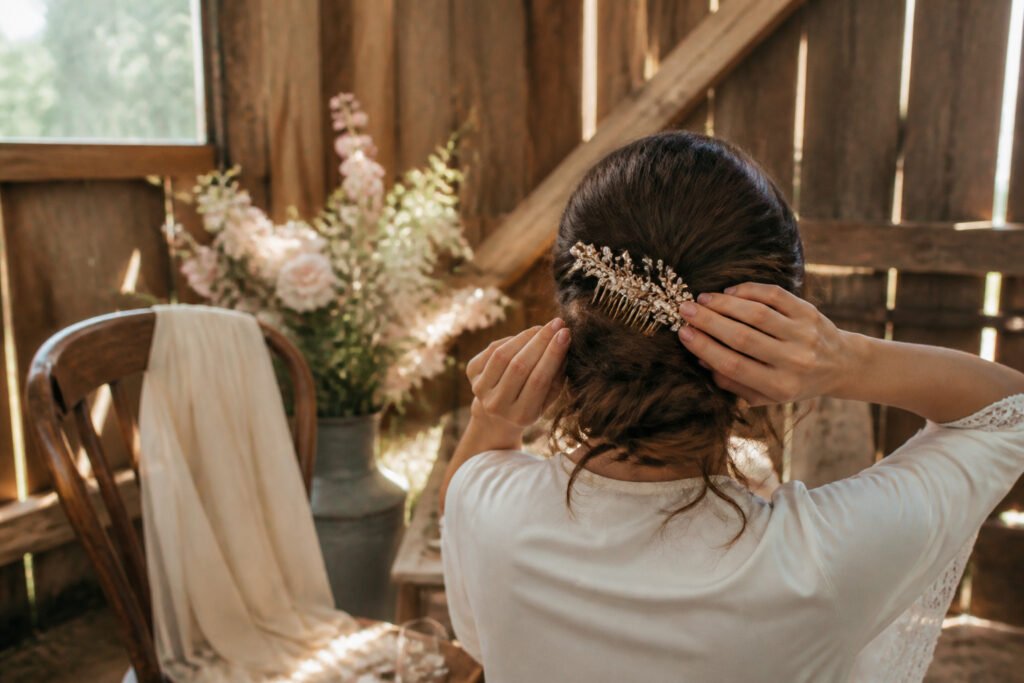
A simple low bun with a handmade comb pinned at the base reads bridal in a way the same bun with a drugstore clip never quite manages. The comb does the ceremony; your hands do the work, not a stylist’s four-hour appointment. Sarah Crews, a Kérastase artist, notes that beautiful handmade combs or crowns from a local artisan or designer are trending now alongside florals and barrettes, and that shift toward small makers matters for how you build the look.
The real decision is whether the accessory replaces an elaborate style or finishes one. A pinned-back base with one statement comb needs nothing else: the piece carries the visual weight. But a floral crown over already-intricate braids fights itself, two focal points competing for attention. The barrettes and crowns work best when they are the single non-traditional element, not piled onto every technique in the book. Pick the simpler hair, let the maker’s piece do the transformation.
3. Old Hollywood Glam

Deep, sculpted waves set close to the head carry the 1930s and 1940s fingerprints of studio-system dressing rooms, where stylists spent upward of two hours building each Marcel wave with heated irons and setting lotion. That time investment hasn’t changed much; a finger-waved bridal version still demands roughly ninety minutes of chair time plus a trial run, and the humidity control has to be exact or the ridges soften into loose curls by the first dance.
The drama works best when the face can absorb it. Oval and longer face shapes carry the sculptural quality without looking costumed, since the vertical line of the wave pattern echoes what is already there. Rounder faces tend to read more theatrical than glamorous with this much engineered structure sitting so flat against the skull; the eye keeps catching the styling rather than the bride. Heart shapes split the difference. The waves need to start lower, below the temple, so the width at the cheekbone doesn’t compete with the wave crest itself.
4. Rustic Romantic Updos

Soft, deliberately imperfect buns and twists carry the tendrils you release around the face and nape as a deliberate design choice, not an afterthought. For a barn or outdoor venue, this looseness reads romantic precisely because it looks like it might not hold, which creates the tension that makes the style work.
The real engineering lives in the pin placement. I spent time studying how stylists balance this: the base structure gets the heavy-duty grips and small elastics hidden underneath, while the surface pieces stay light and movable. Wind becomes part of the effect when the secure foundation keeps the shape from collapsing, letting only the intentional wisps respond to air movement. Too tight and you lose the romance; too loose and fifteen minutes of breeze turns intention into actual mess.
Bobby pins placed in crossed pairs, not singles, anchor the weight without visible hardware. A light mist of workable spray sets the tendrils so they hold curve but still move. The finished look should suggest you pinned it up yourself in soft morning light, even when the construction took forty minutes and three hands.
5. Bohemian Waves

Loose, textured waves that look unstyled rather than set carry a specific risk at a wedding: they can read as effortless, or they can read as you forgot to finish your hair. The difference sits almost entirely in the texture work underneath. A stylist builds this look on damp hair with a salt spray worked through mid-lengths, then lets it air-dry while scrunching intermittently so the wave sets irregular rather than uniform. The irregularity is the point; a curling iron gives you pattern, air-drying gives you movement that still looks like your hair.
This style earns its place at beach and desert weddings where the wind will do half the work anyway, but the same looseness that reads romantic against sand or red rock turns underdressed in a ballroom or cathedral with heavy drapery and formal seating. The line into too casual usually shows up in the root area. If the top two inches sit flat and undefined against a polished dress, the whole look collapses into "beach day." A light backcomb at the crown or a few small braids pulled back from the face adds enough structure to signal intention without killing the undone quality that drew you to it.
6. Vintage Glamour

Hollywood waves and finger waves both borrow from the past, but the decades they reference and how they’re built are not the same thing. Finger waves, the 1920s and 1930s technique, are set flat against the scalp in an S-pattern using comb and gel, giving that close-to-the-head shape you see in black-and-white portraits. Hollywood waves, the 1940s and 1950s version, are deeper, looser, and fall past the jawline with a continuous rolling motion that moves as the head turns.
The headband or clip placement is what dates the look more than the wave itself. A thin band sitting across the forehead, low and straight, reads 1920s; a side comb tucked behind one ear with waves swept to the opposite shoulder reads 1940s. Modern bridal interpretations often mix these signals, using the deeper wave pattern with a lower placement, or keeping the finger-wave flatness but letting it break at the shoulder. Ask your stylist which era they are actually referencing, because "vintage" in a salon can mean either the sculpted Marcel-wave finish or the soft Veronica Lake drape, and the two require different prep, different products, and different timing on the morning of.
The distinction matters for your trial run. Authentic finger waving is done on wet-set hair and takes patience; a modern interpretation may use a curling iron and brush-out to suggest the shape without the rigid structure. One holds through humidity, the other may need touch-ups.
7. Sleek and Modern

A low bun or straightened hair with a center part reads as intentional, not lazy, when the finish carries weight. Product is what separates architectural from merely flat. I learned this watching a bride in a converted warehouse last spring: her stylist worked a heavy-hold gel through dry sections, pressing each panel with a flat iron set low, so the surface looked almost laminated under the Edison bulbs. The center part was drawn with a tail comb, not a finger, and that severity is what made it confident rather than cold.
The venue match matters here. A gallery or industrial space with concrete floors and exposed ductwork gives this style its context. The same look in a garden tent can feel unfinished, like you forgot the flowers. Clean lines need clean backgrounds.
Product-weighted finishes also mean honesty about hair texture. If your natural wave fights back, the prep takes longer than the styling itself. A smoothing serum on damp hair, blown straight with tension, then the flat iron in thin sections. The bun sits at the nape, no tendrils, secured with pins that match your color so they disappear. The result is contemporary, minimalist, and entirely self-possessed.
Wedding Vibe Match

A hairstyle that fights the wedding instead of flowing with it will photograph like a costume change gone wrong. I learned this watching a cousin’s beach ceremony where her structured victory rolls looked magnificent in the salon mirror and completely out of place against driftwood and bare feet. The wind did not cooperate, but more than that, the eye kept catching the hair as a separate object rather than part of a whole.
The seven styles in this quiz map cleanly to three atmospheres. Sleek buns and straight center-parted hair carry a modern, effortless wedding: clean lines, minimal décor, city loft or glass-walled venue. Soft curls, braids, and half-up arrangements belong to romantic and over-the-top celebrations: garden roses, candlelight, movement in the fabric and the hair moving with it. Vintage waves and polished updos suit traditional and chic settings where the architecture itself is formal and the hair answers that formality.
Mismatching costs more than playing it safe. A bohemian wave style at a black-tie hotel reads as underdressed; a severe low bun at a barefoot vineyard reads as cold. The camera notices the dissonance before the conscious mind does.
For a hair trial, bring fabric swatches from the dress, bouquet photos, and a sense of what the bridal party will wear beside you. Scheduling the trial before these decisions firm up usually means paying for a second one.
Dress Neckline Pairing

An off-the-shoulder neckline leaves the collarbone bare, which draws the eye straight up to the jaw and then the hairline. An updo here keeps that whole channel open, almost like a frame within a frame. Strapless works the same way, though the visual line starts even lower, so a half-up style or soft wave can fill the space without competing. The plunging neckline is trickier: the eye travels down, not up, so hair pulled back actually restores balance by keeping attention near the face. Backless dresses reverse the problem entirely. The drama is behind you, which an updo reveals cleanly while loose hair would hide. Sweetheart and scoop necklines both soften the collarbone with a curve, and that curve is what you echo or contrast. Waves repeat the softness; a structured bun above a sweetheart line creates tension that can feel modern or just busy, depending on the dress. The test is the three-second glance: where does the eye land first, and does the hair help it get there? At my own trial, I pinned a wave loosely to one side above a scoop neck and the whole look collapsed into one soft blur. The stylist tightened it to a low chignon, and the neckline finally had its own shape. Fabric swatches help here more than photos of finished brides, because the texture of the dress, not just its cut, decides whether the hair should read as crisp or relaxed beside it.
Weather and Wear Time

A style that looks flawless at 10 a.m. can surrender completely by the first dance if you ignored the forecast. Humidity swells the cuticle on every hair type, so loose waves and half-up styles need a backup plan for muggy afternoons; they soften into something unrecognizable within four hours without intervention. Updos pinned off the face hold their architecture longer because the structure relies on tension and placement rather than surface smoothness.
Wind demands the same containment. An out-style like Hollywood waves reads romantic indoors but tangles and separates the moment a breeze picks up, which is why that look needs a heavier lacquer layer than most stylists default to. Rain is simpler to anticipate: any style with height at the crown risks collapse if droplets saturate the base, so a low chignon or braided bun survives a sprinkle where a teased updo would flatten.
Sweat from hours of dancing acts like humidity concentrated at the hairline. Styles with pieces intentionally left out around the face, the ones that frame so beautifully in photos, are the first to show it. The realistic window for an untouched look runs about six hours for a secured updo, three to four for anything left down, and half that if the air is thick. A heavy-duty hairspray is not optional for any of the seven styles if your reception runs past sunset.
Hair Length Reality

Short hair limits the bridal styles that hold their own without help. A chin-length blunt bob or polished pixie can carry a sleek, modern look or a vintage finger-wave set, but anything piled high needs either a three-month grow-out minimum or a well-matched extension piece clipped at the crown. Medium hair sits in the easiest spot: most updos, half-up styles, and textured waves work with the length you probably already have, though a bohemian braided crown might need a few extra inches that clip-ins supply in minutes. Long hair opens every option on the board, yet it also tempts brides to keep more than the style needs; a heavy rustic romantic updo can swallow a small frame, and cutting six to eight weeks before the wedding lets the ends soften into the shape rather than looking freshly shorn. If you are growing out from a pixie to reach a low chignon, count backward from the date: hair grows roughly half an inch per month, so three months buys you only an inch and a half, enough to secure a small twist but not a voluminous bun. Book the trial with your actual length, not the length you hope for, so the stylist can map where real pins will grip versus where extensions must step in.
Frequently Asked Questions
What best describes your wedding vibe?
Modern and effortless weddings pair with sleek buns and straight center-parted hair in city lofts or glass-walled venues. Romantic, over-the-top celebrations suit soft curls, braids, and half-up arrangements with garden roses and candlelight. Traditional and chic settings call for vintage waves and polished updos where the architecture itself is formal.
What neckline does your dress have?
Off-the-shoulder and strapless necklines favor updos that keep the collarbone channel open. Plunging necklines need hair pulled back to restore balance and keep attention near the face. Backless dresses demand updos to reveal the drama behind you. Sweetheart and scoop necklines work with waves that echo their softness or structured buns that create deliberate tension.
What is your biggest wedding hair priority?
Styles that must stay put all night need secured updos with tension and placement rather than surface smoothness. Humidity and wind resistance calls for low chignons or braided buns instead of teased updos that flatten, with heavy-duty hairspray as non-optional for any style past sunset. Veil and accessory compatibility means testing placement before the appointment slot is gone, especially for chin-length bobs where a short blusher forward works but a cathedral veil fights the geometry.